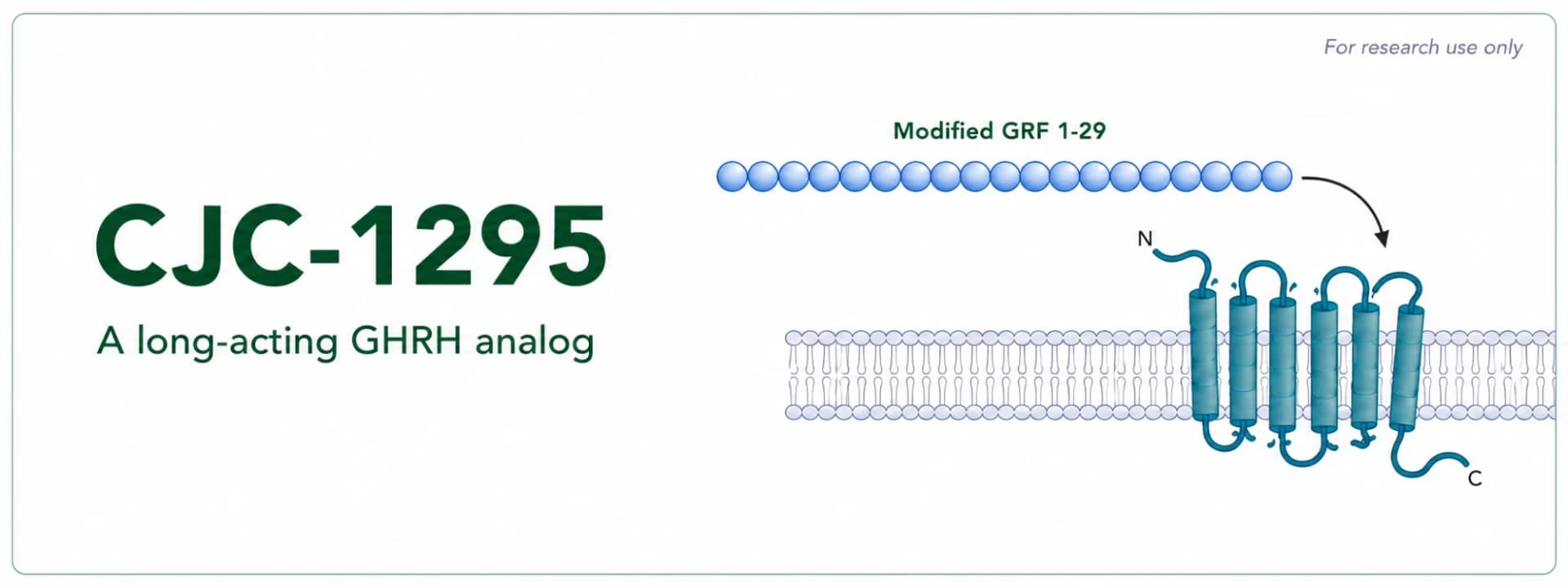
El CJC-1295 es un análogo sintético de la hormona liberadora de la hormona del crecimiento (GHRH), diseñado para prolongar su vida media plasmática mediante la unión covalente a la albúmina a través del mecanismo del complejo de afinidad farmacológica (DAC). En estudios preclínicos y de fase inicial se han investigado los cambios sostenidos en la señalización de la hormona del crecimiento y del IGF-1 en comparación con la GHRH nativa. La investigación sigue en curso y todos los resultados requieren una validación clínica adicional.
Ha existido un interés constante por la investigación sobre el CJC-1295 entre los investigadores que participan en estudios sobre el eje somatotrópico, estudios de farmacocinética de péptidos y la regulación de la secreción de la hormona del crecimiento (GH). Pero, ¿qué es el CJC-1295? El CJC-1295 es una variante sintética de la hormona liberadora de la hormona del crecimiento (GHRH), diseñada para tener una duración de acción mucho más prolongada que la hormona original. En este artículo se analizará la estructura peptídica del CJC-1295, el modelo de complejo de afinidad farmacológica del que forma parte y los efectos fisiológicos que ejerce al unirse a los receptores de la GHRH en el eje somatotrópico. La información aquí presentada se basa en la literatura preclínica y no representa los resultados esperados en sujetos humanos.
El CJC-1295 es un análogo modificado de la GHRH
La GHRH natural es una hormona hipotalámica compuesta por 44 aminoácidos; de ellos, los primeros 29 residuos amino, GRF(1-29), conservan sus efectos fisiológicos sobre el receptor de la GHRH. El CJC-1295 se ha diseñado a partir de esta cadena principal 1-29. Según Jette et al.[1], el péptido sintético presenta cuatro sustituciones de aminoácidos [D-Ala2, Gln8, Ala15, Leu27]. La modificación en la posición 2 confiere resistencia a la dipeptidil peptidasa-4, la enzima que inactiva el GRF(1-29) natural en el plasma sanguíneo mediante la escisión entre los residuos 2 y 3. Las otras tres sustituciones abordan diferentes problemas distintos de la proteólisis: Gln8 sustituye a una asparagina propensa a la desamidación en solución acuosa; Leu27 sustituye a la única metionina del péptido, que es propensa a la oxidación; y Ala15 sustituye a la glicina para aumentar la afinidad de unión al receptor de GHRH, más que para mejorar la estabilidad. Esta estructura central también se conoce como GRF(1-29) modificado. Por sí sola, es un análogo más estable de la GHRH, aunque sigue siendo de acción corta en comparación con la forma que lleva el complejo de afinidad farmacológica (DAC).
Cómo el DAC prolonga la actividad del CJC-1295
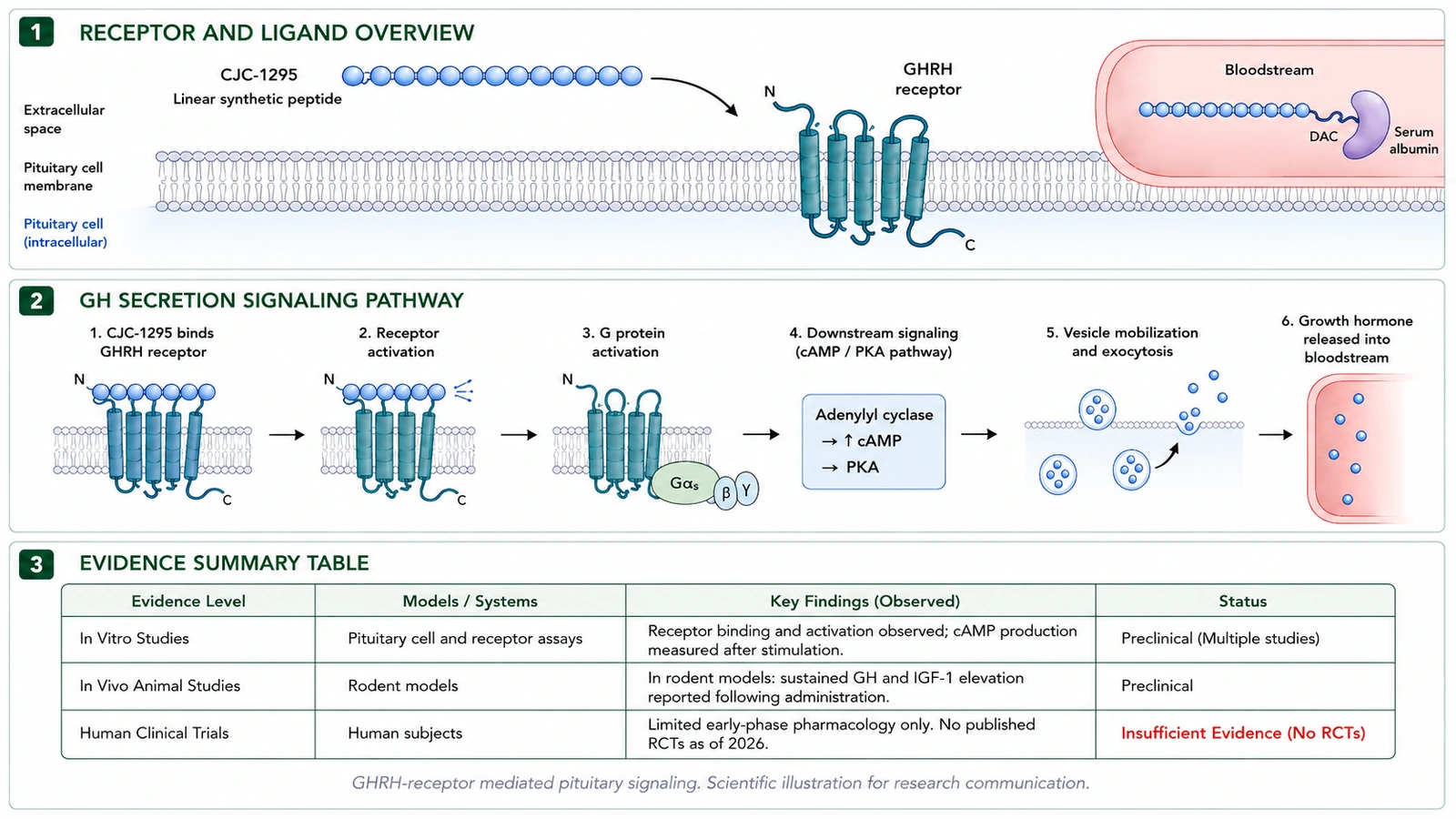
Lo que distingue al CJC-1295 es su capacidad para formar un DAC. Concretamente, en la forma de DAC, el análogo modificado de GRF(1-29) contiene un grupo químico reactivo, un enlazador basado en maleimida que se une covalentemente a la albúmina sérica circulante al entrar en el torrente sanguíneo, reaccionando con un residuo de cisteína presente en la albúmina. Dado que la albúmina es muy abundante y relativamente estable, la unión del péptido a la albúmina cumple el doble objetivo de proteger al análogo de una eliminación rápida y de prolongar la duración de la acción de este fragmento de GHRH —que, de otro modo, tendría una vida media corta— hasta varios días. Jette et al.[1] identificaron este bioconjugado de albúmina como CJC-1295 y demostraron en ratas que sigue activando el receptor de la GHRH (GRF) en la hipófisis anterior, lo que confirma que la unión a la albúmina no impide que actúe sobre el receptor. Por lo tanto, ambas formas no son intercambiables. Solo el conjugado que contiene DAC —el compuesto que Jetté et al. identificaron como CJC-1295— se une a la albúmina y actúa durante varios días; el núcleo modificado de GRF(1-29) comercializado como «CJC-1295 (sin DAC)» carece del enlazador maleimido, sigue siendo de acción corta y no adquiere la duración de acción prolongada descrita anteriormente. Todos los resultados farmacocinéticos y relativos a la duración de la acción que se analizan a continuación se obtuvieron con la forma con DAC.
El CJC-1295 y la señalización del receptor de la GHRH en el eje somatotrópico
El mecanismo de acción del CJC-1295 es similar al de la propia GHRH. El receptor del GHRH es un receptor acoplado a proteínas G de clase B que se encuentra en las células somatotróficas de la glándula pituitaria anterior. Tal y como describe Mayo,[2], la unión del agonista se acopla a la proteína G estimuladora (Gs), activa la adenilato ciclasa, eleva los niveles intracelulares de AMP cíclico e impulsa tanto la síntesis como la liberación pulsátil de la hormona del crecimiento. A continuación, la GH estimula la producción hepática del factor de crecimiento similar a la insulina tipo 1 (IGF-1), el principal mediador circulante de los efectos de la GH, lo que ejerce una retroalimentación negativa para regular el eje. Al unirse a este receptor de larga vida media, el CJC-1295 actúa como un secretagogo de la hormona del crecimiento de la clase GHRH, a diferencia de los secretagogos miméticos de la grelina, que actúan a través de un receptor distinto.
Lo que revelan los estudios preclínicos
Los estudios preclínicos sobre el CJC-1295 han demostrado tanto la acción sobre el receptor como la persistencia de la molécula. El estudio fundamental de Jette et al.[1] en ratas demostró que el análogo conjugado con albúmina activaba el receptor de GRF en la hipófisis anterior y producía un aumento de aproximadamente cuatro veces en el área bajo la curva de la hormona del crecimiento durante un intervalo de dos horas, en comparación con el hGRF(1-29), mientras que el conjugado en sí mismo seguía siendo detectable en plasma más allá de las 72 horas. En dicho estudio se midieron la secreción de GH y la farmacocinética; no se midió el IGF-1. Alba y sus colegas[3] evaluaron posteriormente el análogo en un ratón con deleción del gen GHRH, un animal que no puede producir su propia GHRH y que, por lo tanto, presenta un retraso en el crecimiento. A lo largo de cinco semanas, la administración una vez al día normalizó el peso corporal y la estatura de estos animales y aumentó el ARNm de la GH hipofisaria, lo que indica que el análogo puede sustituir funcionalmente a la hormona nativa ausente. La misma dosis administrada cada 48 o 72 horas mejoró el crecimiento en comparación con el placebo, pero no lo normalizó por completo; los autores concluyeron que el compuesto es menos eficaz en esos intervalos más prolongados. Se trata de resultados obtenidos en animales en modelos controlados, no de un resultado que deba esperarse en personas.
Investigación en humanos sobre el CJC-1295
La investigación en humanos sobre el CJC-1295 es mínima y debe considerarse totalmente independiente de los estudios en animales. La farmacología en humanos se ha caracterizado en un pequeño número de estudios de fase inicial realizados en voluntarios sanos[4][5], diseñados para evaluar el comportamiento del análogo en el organismo, más que para analizar un criterio de valoración clínico. Además de estos, ConjuChem llevó a cabo un ensayo de fase II multicéntrico, aleatorizado, controlado con placebo y doble ciego con el CJC-1295 (DAC) durante 12 semanas en pacientes infectados por el VIH con obesidad visceral asociada al VIH (ClinicalTrials.gov NCT00267527). Dicho ensayo figura como finalizado: se interrumpió en julio de 2006 tras el fallecimiento de un participante. No se estableció la relación entre la muerte y el fármaco del estudio, pero el desarrollo clínico del CJC-1295 no se reanudó y, desde entonces, ningún promotor lo ha incluido en un ensayo registrado. No existen ensayos controlados a gran escala ni a largo plazo, la replicación independiente es limitada y no hay ninguna indicación aprobada. A fecha de 2026, el CJC-1295 no es un fármaco aprobado. Los lectores deben considerar que cualquier extrapolación de estos primeros datos farmacológicos a resultados en seres humanos en el mundo real carece de fundamento.
En qué se diferencia el CJC-1295 de la sermorelina
La comparación entre el CJC-1295 y la sermorelina es, en gran medida, de carácter estructural. La sermorelina es el GRF(1-29), el fragmento no modificado de 29 aminoácidos; actúa sobre el mismo receptor de GHRH, pero se elimina rápidamente porque carece de los cambios estabilizadores. El CJC-1295 es el mismo fragmento, pero reforzado: las sustituciones del GRF(1-29) modificado prolongan ligeramente su vida media, y la versión DAC la prolonga de forma notable gracias a la unión a la albúmina. Ambos son secretagogos de la hormona del crecimiento de la clase del GHRH y comparten un mismo mecanismo; lo que difiere es la durabilidad, que es precisamente la propiedad que la investigación sobre el CJC-1295 se ha propuesto caracterizar.
Limitaciones actuales y cuestiones pendientes
Existen varias consideraciones que condicionan cualquier interpretación de la investigación sobre el CJC-1295. No existe ninguna indicación terapéutica aprobada, y el compuesto no está caracterizado para su uso en humanos. Las consecuencias a largo plazo de la estimulación sostenida del receptor de GHRH, incluidos los efectos sobre la arquitectura de retroalimentación del eje y sobre el IGF-1 a lo largo del tiempo, no están bien caracterizadas ni siquiera en modelos preclínicos. Gran parte del trabajo realizado hasta la fecha es preclínico, la replicación independiente es limitada y la pureza e identidad del material varían según las fuentes, lo cual es relevante para cualquier estudio de laboratorio que utilice CJC-1295 de grado de investigación. En general, su mecanismo está bien fundamentado y su perfil farmacocinético es distintivo, pero la base empírica sigue siendo limitada.
Conclusión
El CJC-1295 es un análogo modificado de la GHRH cuya característica definitoria es su longevidad diseñada: un núcleo estabilizado de GRF(1-29), unido opcionalmente a la albúmina a través del DAC, que actúa sobre el receptor de la GHRH, con un tiempo de permanencia en plasma que, en modelos preclínicos, se mide en días en lugar de en minutos. El trabajo preclínico es coherente y la justificación farmacocinética es clara, pero la base de evidencia general sigue siendo limitada, sin ninguna indicación aprobada. El material al que se hace referencia aquí está destinado exclusivamente al uso en investigación de laboratorio, y los resultados describen lo que se ha estudiado en sistemas preclínicos, no lo que cualquier persona debería esperar.