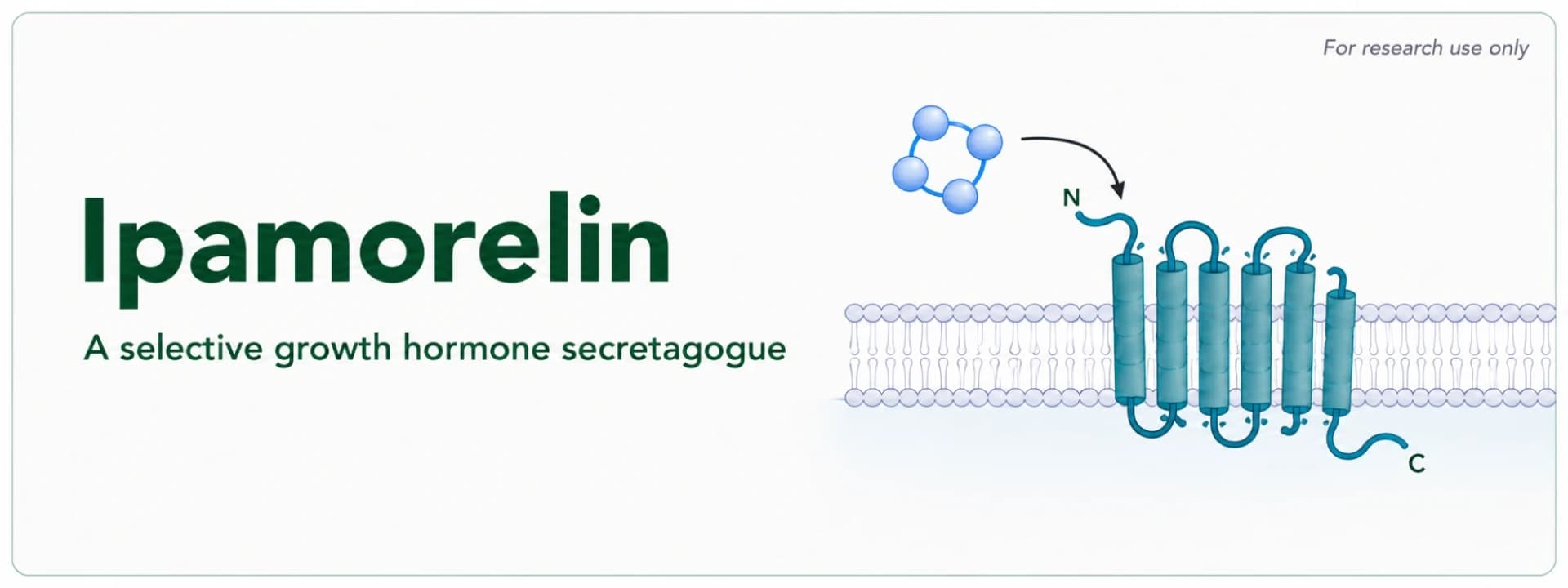
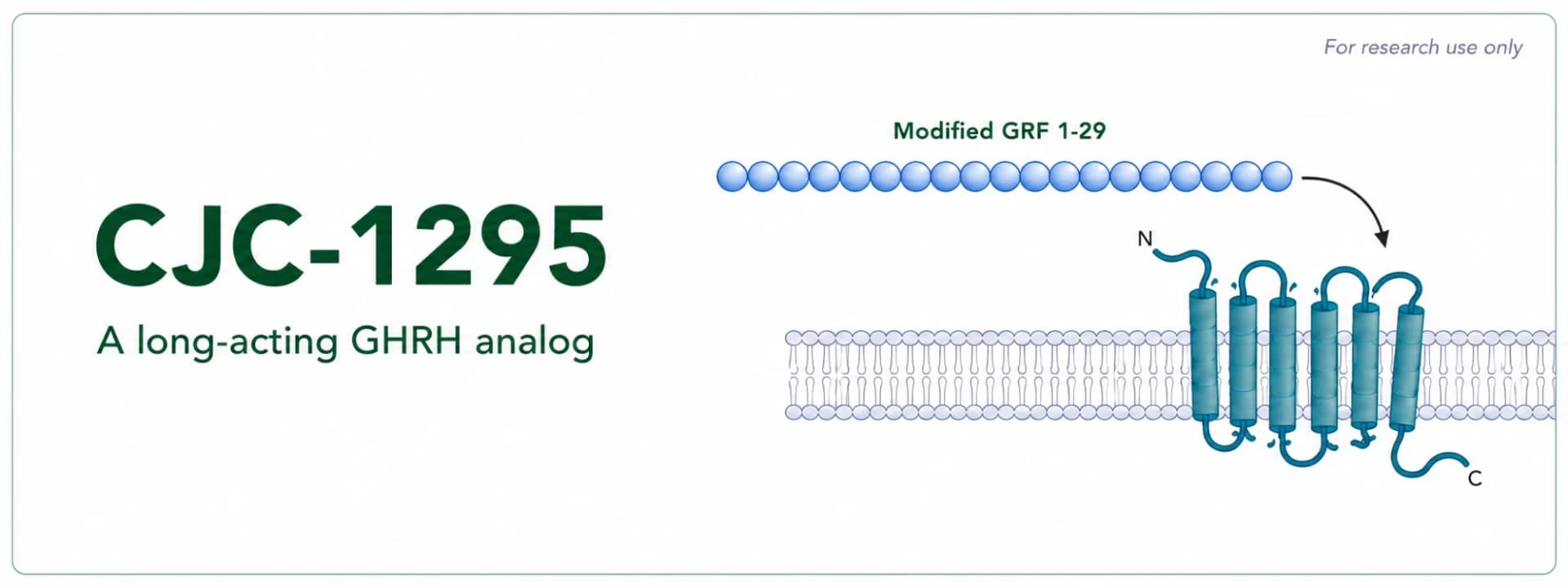
La ipamorelina es un pentapéptido sintético secretagogo de la hormona del crecimiento que ha sido objeto de estudios publicados por su interacción selectiva con el receptor GHS-R1a en el contexto de la señalización de la hormona del crecimiento. Fue desarrollado por Novo Nordisk como candidato a fármaco —Raun et al. concluyeron que su especificidad lo convertía en un candidato muy interesante para un futuro desarrollo clínico— y los estudios señalaron un perfil de señalización endocrina más selectivo que el de los GHRP anteriores, como el GHRP-6. Los estudios preclínicos han examinado los patrones de secreción de la hormona del crecimiento en función de la dosis en modelos animales.
La investigación sobre la ipamorelina ha resultado importante para estudiar la regulación de la hormona del crecimiento (GH), dado su diseño específico. Entonces, ¿qué es la ipamorelina? La ipamorelina es un péptido liberador de la hormona del crecimiento (GHRP) sintético de cinco aminoácidos que actúa como agonista específico del receptor GHS-R1a, de forma similar a la grelina. El aspecto más interesante de la historia de la ipamorelina es que puede liberar GH, mientras que los GHRP anteriores no podían hacerlo sin provocar efectos hormonales secundarios. Este artículo explica la estructura del péptido ipamorelina, su mecanismo de acción, qué lo convierte en un secretagogo selectivo en comparación con los GHRP más antiguos, como el GHRP-6, y qué muestra realmente la literatura preclínica. La ipamorelina es un compuesto de investigación y no está caracterizada para su uso en humanos en este contexto.
La ipamorelina es un secretagogo selectivo
La ipamorelina es un pequeño péptido sintético, y su posición en este campo se comprende mejor si se compara con los compuestos anteriores. Los péptidos liberadores de la hormona del crecimiento fueron descritos por primera vez por Bowers et al. en 1980 (Endocrinology 106(3):663-7; PubMed PMID: 7353536). En su publicación de 1984[1] informaron de que un nuevo hexapéptido sintético, denominado GHRP-6, podía liberar GH de la glándula pituitaria a través de un mecanismo no identificado independiente de la GHRH. El GHRP-6 era potente, pero no constituía un indicador puro del eje de la GH: Bowers et al. describieron la liberación de GH sin ningún aumento concomitante de LH, FSH, TSH o PRL, y no informaron sobre la ACTH ni el cortisol; trabajos posteriores en cerdos conscientes demostraron que el GHRP-6 también elevaba los niveles plasmáticos de ACTH y cortisol (Raun et al.[2]). La ipamorelina se identificó en un programa químico de cribado de compuestos que carecían del dipéptido central Ala-Trp del GHRP-1, y el hecho de que no aumentara la ACTH ni el cortisol fue un hallazgo inesperado, más que un resultado previsto; según el trabajo de Raun et al.[2] de 1998, fue, no obstante, el primer ejemplo de un secretagogo selectivo de la hormona del crecimiento de este tipo.
Estructura del péptido ipamorelina
La estructura del péptido ipamorelina es la de un pentapéptido, cuya fórmula es Aib-His-D-2-Nal-D-Phe-Lys-NH₂, donde Aib es el residuo no natural ácido alfa-aminoisobutírico, y D-2-Nal es una naftilalanina en configuración D. El uso de aminoácidos no naturales y en configuración D, junto con la amida C-terminal, es lo que confiere a la molécula su estabilidad metabólica. Su selectividad endocrina no se explica por la unión a un receptor diferente: el perfil de antagonismo descrito por Raun et al.[2] demostró que la ipamorelina, al igual que el GHRP-6, libera GH a través del mismo receptor similar al GHRP, y dichos autores describieron la ausencia de una respuesta de ACTH y cortisol como algo muy sorprendente, más que como algo intencionado. Se trata de una construcción totalmente sintética que no se corresponde con ninguna secuencia peptídica natural.
Mecanismo de acción de la ipamorelina
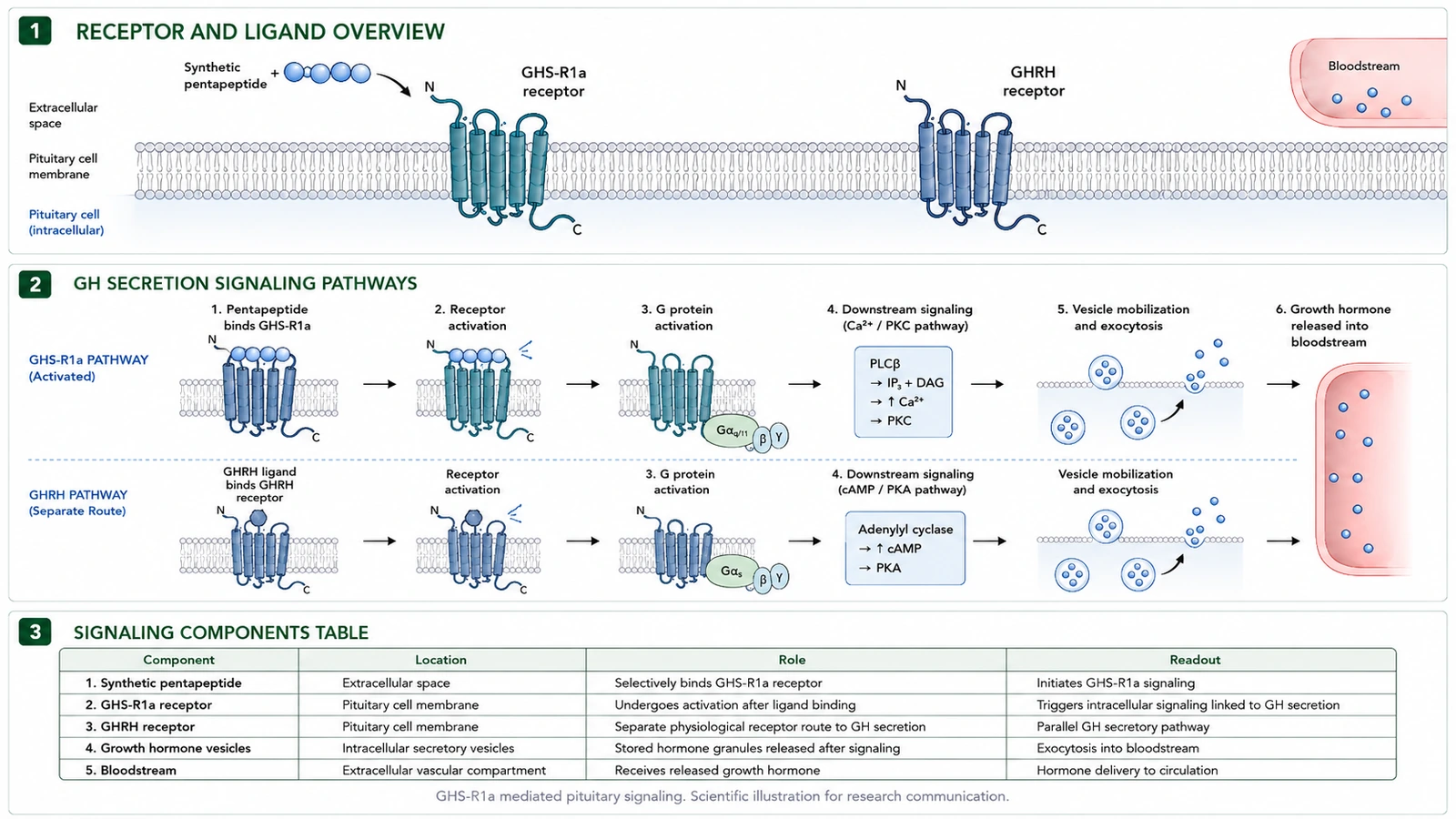
El modo de acción de la ipamorelina implica una vía y un receptor distintos en comparación con el receptor de la GHRH. Este receptor, el GHS-R1a, fue descubierto por primera vez por Howard et al.[3] en 1996, y se comprobó que actuaba como receptor hipotalámico y hipofisario en la regulación de la liberación de la hormona del crecimiento; sin embargo, aún no se había identificado su ligando endógeno. No fue hasta 1999 cuando Kojima et al.[4] descubrieron la grelina, el péptido acilado, lo que condujo a la identificación del GHS-R1a como receptor de la grelina, clasificando así a los GHRP como agonistas o análogos de la grelina. Al unirse a los receptores GHS-R1a en los somatotrofos de la glándula pituitaria, la ipamorelina actúa induciendo la secreción de GH mediante la activación de las vías de transducción de señales, sin recurrir al mecanismo dependiente del AMPc empleado por los secretagogos de la clase GHRH. Dado que ambas vías son distintas, aunque están interconectadas, los dos tipos de secretagogos suelen estudiarse conjuntamente.
¿Qué hace que la ipamorelina sea más selectiva que el GHRP-6?
Este es el núcleo de la comparación entre la ipamorelina y el GHRP-6. En los mismos estudios que establecieron su potencia de liberación de GH, Raun et al.[2] demostraron que la ipamorelina liberaba GH con una potencia y eficacia comparables a las del GHRP-6, pero que en cerdos conscientes —en los que tanto el GHRP-6 como el GHRP-2 elevaban los niveles plasmáticos de ACTH y cortisol—, la ipamorelina producía niveles de ACTH y cortisol que no diferían significativamente de los observados tras la estimulación con GHRH, incluso a dosis más de 200 veces superiores a su ED50 para la liberación de GH. Esto es precisamente lo que ha hecho que este compuesto sea selectivo: actúa sobre el eje de la GH a través del receptor GHS-R1a sin el aumento de ACTH y cortisol que el GHRP-6 y el GHRP-2 produjeron en el mismo estudio; en dicho estudio, ninguno de los secretagogos analizados, incluida la ipamorelina, alteró los niveles de FSH, LH, PRL o TSH. Para cualquier persona que estudie la biología de la GH, un agente que estimule la GH sin alterar simultáneamente el cortisol constituye una herramienta más precisa, y esa selectividad es la característica más citada de la molécula.
Lo que muestran los estudios preclínicos
Los estudios preclínicos con ipamorelina constituyen la base de la evidencia. El estudio farmacológico fundamental en animales realizado por Raun et al.[2] caracterizó la liberación de GH en células hipofisarias de rata in vitro, en ratas anestesiadas y en cerdos conscientes; el trabajo sobre la especificidad hormonal que define el compuesto, incluidas las mediciones de ACTH y cortisol, se llevó a cabo únicamente en los cerdos. Además de haber sido estudiado por sus características fundamentales, el péptido ha servido como herramienta de investigación en modelos fisiológicos específicos. Andersen et al.[5] informaron en 2001 de que, en ratas adultas, la ipamorelina contrarrestaba una disminución de la formación ósea inducida por glucocorticoides, en un estudio que examinaba el eje de la GH en el contexto de los efectos de los corticosteroides sobre el hueso. Por otra parte, Venkova et al.[6] utilizaron la ipamorelina como mimético de la grelina en un modelo de íleo postoperatorio en ratas en 2009, y señalaron que una dosis única acortaba el tiempo hasta la primera evacuación intestinal sin alterar la producción fecal acumulada, la ingesta de alimentos ni el aumento de peso, mientras que la administración repetida aumentaba estos tres parámetros. En conjunto, estos datos ilustran cómo se ha empleado la molécula en distintas líneas de investigación preclínica, todas ellas en sistemas animales o celulares, y ninguna de las cuales permite predecir un resultado en personas.
Investigación en humanos sobre la ipamorelina
La investigación en humanos sobre la ipamorelina es mínima y debe considerarse independientemente de los estudios en animales. Se han publicado dos estudios en humanos. Un estudio farmacocinético-farmacodinámico en fase inicial, realizado en voluntarios varones sanos, caracterizó el comportamiento del péptido en el organismo y su respuesta en cuanto a la GH con cinco velocidades de infusión diferentes (Gobburu et al., Pharm Res 1999; PubMed PMID: 10496658). Posteriormente, la ipamorelina pasó a la fase de desarrollo clínico para el tratamiento del íleo postoperatorio: un ensayo de fase II, multicéntrico, aleatorizado, doble ciego y controlado con placebo (NCT00672074), realizado en 114 pacientes sometidos a resección intestinal, reveló que se toleraba bien, pero que no ofrecía mejores resultados que el placebo en el criterio de valoración clave de la eficacia, el tiempo mediano hasta la tolerancia de una comida sólida estandarizada (25,3 h frente a 32,6 h, p = 0,15), ni en los análisis secundarios de eficacia (Beck et al., Int J Colorectal Dis 2014;29(12):1527-34; PubMed PMID: 25331030). No existe ninguna indicación aprobada, y prácticamente todo lo que se sabe sobre el compuesto procede de la farmacología preclínica. Cualquier extrapolación de estos datos limitados en humanos a resultados en el mundo real carece de fundamento.
Limitaciones actuales y cuestiones pendientes
Los estudios sobre la ipamorelina presentan varias limitaciones que deben tenerse en cuenta a la hora de interpretar los resultados. No existe ningún uso autorizado y el compuesto no está caracterizado para su uso en humanos. Gran parte del trabajo preclínico determinante procede del desarrollador original, lo que plantea la habitual cuestión de la replicación independiente, y los efectos a largo plazo de la estimulación del receptor GHS-R1a no están bien caracterizados. Al igual que con cualquier péptido de investigación, la identidad y la pureza del material varían según la fuente, lo cual es relevante para cualquier estudio de laboratorio que utilice ipamorelina de grado de investigación. Teniendo todo esto en cuenta, el mecanismo está bien definido y la selectividad constituye su verdadera característica distintiva, aunque se basa en ese único estudio del desarrollador que no ha sido replicado; sin embargo, la base empírica más amplia sigue siendo limitada y las cuestiones pendientes son, en su mayoría, aquellas que los estudios debidamente controlados aún no han respondido.
Conclusión
La ipamorelina es un agonista sintético y selectivo del receptor de la grelina: un pentapéptido estable que actúa sobre el GHS-R1a para liberar la hormona del crecimiento, al tiempo que evita las respuestas de ACTH y cortisol que complicaban los GHRP anteriores, como el GHRP-6. La farmacología preclínica que lo define es coherente, pero su selectividad se basa en una única serie de experimentos con cerdos realizados por el desarrollador original y no se ha replicado de forma independiente; además, la base de evidencia más amplia es limitada y no existe ninguna indicación aprobada. El material al que se hace referencia aquí está destinado exclusivamente al uso en investigación de laboratorio, y los resultados describen lo que se ha estudiado en sistemas preclínicos, no lo que cualquier persona debería esperar.