CJC-1295 Research
An evidence-based overview of CJC-1295 research: its modified GHRH analog structure, the Drug Affinity Complex mechanism, and what preclinical studies show about GH and IGF-1 signaling.
Shop by category
Growth Hormone Axis ResearchRegeneration ResearchPeptide BioregulatorsCognitive & Neuropeptide ResearchMetabolic & Cellular ResearchMelanocortin & Endocrine ResearchDermal Peptide ResearchImmune & Thymic ResearchIn-depth articles on peptide research, mechanisms of action, and laboratory best practices — written for researchers.
Per-compound evidence reviews: mechanism and published findings from the primary literature.
Peptides targeting the somatotropic axis: GHRHs, GHRPs, and IGF-1 analogs for growth hormone pathway research.
An evidence-based overview of CJC-1295 research: its modified GHRH analog structure, the Drug Affinity Complex mechanism, and what preclinical studies show about GH and IGF-1 signaling.
An evidence-led review of CJC-1295 with DAC research: how the DAC modification extends half-life to days, the single registered trial, and a reported death.
An evidence-led review of GHRP-2 research: what the human record covers, the cortisol and prolactin selectivity problem, and the reported Japanese approval.
An evidence-led review of GHRP-6 research: its receptor and pathway, what has been measured in humans, and the cortisol and prolactin question.
An evidence-led review of Hexarelin research: two receptors rather than one, desensitization on repeated dosing, and the human and rat cardiac findings.
An evidence-led review of HGH Fragment 176-191 research: which molecule the work was actually done on, the animal findings, and the human evidence.
An evidence-led review of IGF-1 DES research: the same receptor as IGF-1 but different binding-protein behaviour, what has been measured, and in what.
An evidence-led review of IGF-1 LR3 research: weaker binding at the same receptor, what has been measured, and why the half-life claim runs backwards.
An evidence-based overview of Ipamorelin research: its selective GHS-R1a mechanism, comparison with GHRP-6, and what preclinical studies show about growth hormone secretion.
An evidence-led review of MGF research: what the splice variant is, its contested receptor and laboratory record, and the state of the human evidence.
PEG-MGF research reviewed: one PubMed record, no peer-reviewed human studies, no CAS, and an FDA compounding nomination withdrawn by its nominator.
Sermorelin held two FDA approvals, both withdrawn in 2009. What the primary regulatory record and the small human trial base actually establish.
An evidence-led review of tesamorelin research: what its approval covers and what it does not, and what the human trials actually found.
Research peptides for tissue and cellular repair: BPC-157, TB-500, GHK-Cu, LL-37, and related compounds.
ARA-290 (cibinetide) reached phase 2 in humans. An evidence-led review of what its trials found, what they missed, and where development now stands.
B7-33 is a single-chain relaxin-2 analog with no published human study. Serelaxin's failed confirmatory trial tested a different molecule.
An evidence-led look at BPC-157 research into tissue repair, covering proposed angiogenic mechanisms, tendon and ligament studies in rodent models, and the current absence of human trial data.
An evidence-led review of GHK-Cu research: copper binding, collagen and matrix findings in cell and animal models, and the limits of human data.
KPV has never been administered to a human in a published study. A review of its preclinical evidence, its unsettled mechanism and FDA's position.
LL-37 is an endogenous human peptide, and only four human studies have administered it. Its largest placebo-controlled trial missed its primary endpoint.
An evidence-led look at TB-500 research into Thymosin Beta-4 biology, covering the actin-binding domain, proposed mechanisms in cell migration and angiogenesis, and preclinical dermal and cardiac repair studies.
Thymosin beta-4 (timbetasin) is the 43-residue parent of TB-500, not the same molecule. Review of its Phase 3 record, nulls and conflicts.
Short-chain regulatory peptides including the Khavinson bioregulator series of organ-specific oligopeptides, alongside related immunomodulatory peptides for research use.
An evidence-led look at Bronchogen research: an unsettled sequence, the cell and animal findings, and the single group behind nearly all of it.
An evidence-led look at Cardiogen research: an unresolved identity, how small the record is, and why no published study measured anything cardiac.
An evidence-led look at Cartalax research: identity and naming, the four records that make up its literature, and what has never been tested.
An evidence-led look at Cortagen research: identity and naming, a null result in its clearest animal study, and the rest of the cell and animal work.
An evidence-led look at Crystagen research: its identity, the entire published evidence base, who produced it, and what remains unanswered.
An evidence-led look at Epitalon research: why it is not Epithalamin, the human and animal lifespan reports, and the telomere claims.
An evidence-led look at Livagen research: its identity, what has actually been reported, and how it relates to its sibling bioregulators.
An evidence-led look at N-Acetyl-Epitalon: no peer-reviewed literature under this name, an unresolved structure, and why epitalon data does not carry over.
An evidence-led look at Ovagen research: what the molecule is, a name collision that misleads searches, and what has been published on EDL.
An evidence-led look at Pancragen research: identity and its C-terminal amide, the cell, animal and human reports, and what is not established.
An evidence-led look at Pinealon research: identity and naming, in vitro and animal findings, and its relationship to the sibling peptides.
An evidence-led look at Prostamax research: a safety signal in its clearest result, identity as a defined peptide not an extract, and what is untested.
An evidence-led look at Testagen research: what the compound is, the entire published literature, and the questions that remain unstudied.
An evidence-led look at Thymalin research: what the preparation actually is, the COVID-19 trial, the older human literature, and what is unproven.
Vesilute is a trade name for the dipeptide Glu-Asp. The one indexed animal study found no difference from its amino acids on the three endpoints it measured.
An evidence-led look at Vesugen research: identity and naming, its presence inside four other products, and two uncontrolled human reports.
An evidence-led look at Vilon research: how independent the literature is, animal findings including an adverse one, and a computational DNA mechanism.
Nootropic and neuropeptide compounds for cognitive and neurological pathway research, including Semax, Selank, and Dihexa.
An evidence-led review of ADAMAX: what the published literature contains, the nearest relevant chemistry, and where the seller rationale comes from.
Cerebrolysin is a porcine brain-derived peptide preparation, not a single molecule. Its largest randomized stroke trial missed its primary endpoint.
Colivelin is a synthetic hybrid peptide never given to a human being. No human study of colivelin has been published. A review of the record.
Dihexa, also known as PNB-0408: the animal evidence, the retracted mechanism papers, and the three human prodrug trials that missed their endpoints.
DNSP-11 is an 11-mer from the pro-GDNF proregion. No published human study of it exists. Every dopaminergic finding comes from one patent-holding lab.
DSIP research: what controlled human sleep trials found, why independent groups did not replicate the sleep effect, and FDA reviewers' 2026 call.
No study registered on ClinicalTrials.gov has ever given humanin to human participants. What the cell, animal and biomarker research actually reports.
Orexin-A is mostly measured, not given: four small human intranasal studies, wakefulness nulls, and approved insomnia drugs that block its receptors.
Orexin-B research is small: 81 title-level papers against 868 for orexin-A, no human dosing study, and a mouse blood-brain barrier null.
P021 research is sixteen years of animal and cell studies with no independent replication. No human trial has ever run. What the evidence shows and omits.
A spadin-derived peptide designed to block TREK-1, PE-22-28 has three preclinical papers, no independent replication and no trial on ClinicalTrials.gov.
Preclinical Selank research on GABAergic signaling, enkephalin mechanisms and anxiolytic peptide biology, with evidence clearly tiered. Research use only.
An evidence-led look at Semax research into BDNF and neurotrophic signaling, covering cerebral ischemia models, enkephalin-degrading enzyme inhibition, and the peptide's clinical registration context in Russia.
Peptides and small molecules targeting metabolic pathways, mitochondrial function, and cellular regulation.
ACE-031 is an ActRIIB-Fc fusion protein. Its Duchenne trial was stopped early for nosebleeds and telangiectasias, and it is approved nowhere.
An evidence-led review of Adipotide research: molecular identity, the animal evidence, renal findings in primates, and the absence of a human record.
An evidence-led review of AICAR research: how it becomes ZMP to act on AMPK, what preclinical work shows, and why its human trial program failed.
An evidence-led review of AOD-9604 research: the trial that decided it, the rest of the human program, and the peptides it is routinely confused with.
Follistatin 344 is a protein, not a peptide. The five ClinicalTrials.gov studies using it as the intervention delivered a gene, not an injected protein.
An evidence-led review of FOXO4-DRI research: the proposed mechanism, the preclinical findings, the negative and null results, and the human record.
GDF-8 is myostatin, a negative regulator of muscle mass. No published or registered human study has given it to a person. Inhibitor data are separate.
An evidence-led review of MOTS-c research: why human studies measure the body's own peptide, what the animal work shows, and a finding that cuts the other way.
An evidence-led review of NAD+ research: what counts as evidence for NAD+ itself, what has never been tested, and why the precursor trials do not transfer.
An evidence-led review of PNC-27 research: the human record, FDA findings on material sold to patients, the proposed mechanism, and the cell and animal work.
PYY 3-36 research: human appetite infusion findings, a contested rodent replication record, dose-limiting nausea, and a Phase 2 trial that missed.
An evidence-led review of SS-31 research: its regulatory status stated in full, how small the pivotal evidence is, and the trials that missed.
Melanocortin receptor agonists and endocrine signaling peptides for receptor binding and hormonal pathway research.
An evidence-led review of ACTH 1-39 research: what it is, the molecules it is not, how it acts, and its regulatory status in the United States.
An evidence-led review of kisspeptin-10 research: its mechanism, the human studies, why the evidence in women is inconsistent, and what it does not show.
A receptor-biology look at Melanotan 2 research: peptide structure, melanocortin receptor agonism, and preclinical findings on the MC1R, MC3R, MC4R, and MC5R subtypes.
An evidence-led review of oxytocin research: regulatory status, the delivery question, the autism trials, and the trust and social cognition literature.
FDA approved bremelanotide only for premenopausal women with acquired, generalized HSDD. Its label says it is not indicated to enhance sexual performance.
PTD-DBM is a CXXC5-blocking peptide studied in cells and mice for wound healing and hair regrowth. ClinicalTrials.gov lists no human trial of it.
An evidence-led review of VIP and aviptadil research: regulatory status stated precisely, the COVID-19 and ARDS trials, and the erectile dysfunction evidence.
Signal peptides for in-vitro dermal biology research, including Matrixyl, PAL-GHK, and SNAP-8.
Matrixyl is a Sederma trademark for palmitoyl pentapeptide-4. A review of the mostly manufacturer-funded topical research on Pal-KTTKS, and its gaps.
Pal-GHK is copper-free palmitoyl tripeptide-1, not GHK-Cu. ClinicalTrials.gov lists no trial of it, and every human result for it alone is from one maker.
A PubMed search for acetyl octapeptide-3 returns two papers, and neither tests it alone. ClinicalTrials.gov lists none. What the SNAP-8 record contains.
Thymic and immune signalling peptides for in-vitro immunology research, including Thymosin Alpha-1, Thymulin, Thymagen, and HEP-1.
HEP-1 is the peptide in the Russian medicine Gepon. Its published evidence base is small, largely uncontrolled and not independently replicated.
Thymagen, alpha-Glu-Trp, is in Russian-registered medicines. Its Kaposi's sarcoma Phase III found no benefit over placebo and shorter time to progression.
Thymalfasin is approved in Italy as a flu-vaccine immune enhancer and in China for hepatitis B, not in the US. A review of the phase 3 trial evidence.
Thymulin is a zinc-dependent thymic nonapeptide. Its human trials date from the 1980s, it is approved nowhere, and its newest evidence is preclinical.
Class-level overviews spanning the compounds within a research category.
GHK-Cu, Matrixyl, PAL-GHK and Snap-8 all appear in dermal research, but they do not all act through the same biological pathway. This article discusses GHK-Cu, Matrixyl and PAL-GHK in relation to collagen and extracellular matrix (ECM) biology. Snap-8 is studi
Growth hormone secretagogues (GHS) are molecules studied for their ability to make the pituitary gland release growth hormone (GH). Research so far has found that these molecules can reach the same end point by different routes or pathways. This article compar
The IGF-1 family includes several research compounds. Each one acts within the insulin-like growth factor 1 (IGF-1) signaling system, or is derived from it. Growth hormone secretagogues work upstream at the pituitary to raise growth hormone, but these compound
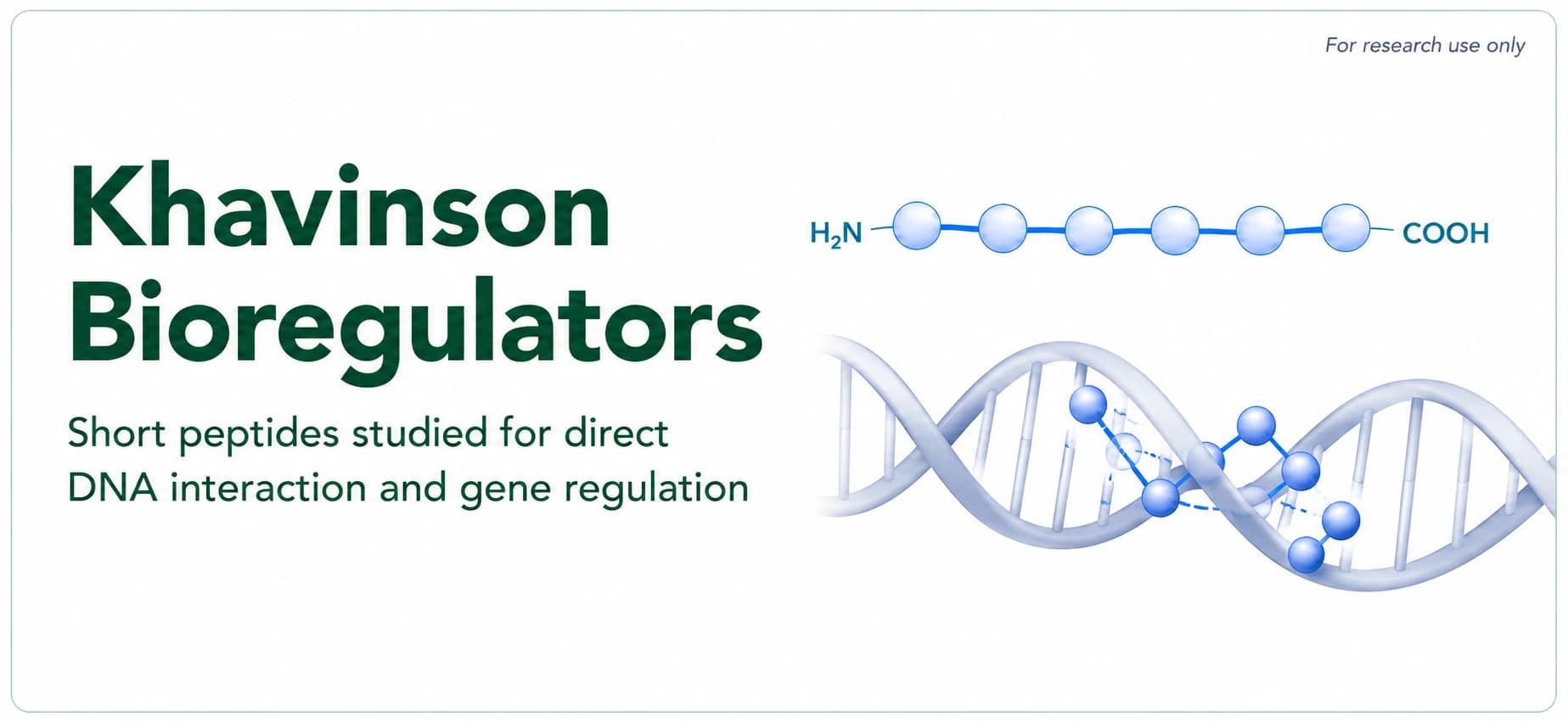
Khavinson bioregulators are ultra-short synthetic peptides studied for a proposed direct peptide-DNA interaction mechanism and geroprotector effects in preclinical models.
NAD+, SS-31 and AICAR are all studied in relation to cellular energy metabolism and mitochondrial function, but they work in different ways. NAD+ is an essential coenzyme that several classes of enzyme depend on. SS-31 is a mitochondria-targeted peptide that a
The myostatin pathway is one of the clearest biological systems involved in limiting skeletal muscle growth. GDF-8, Follistatin and ACE-031 each act at a different point in this pathway: GDF-8 provides the inhibitory signal, and Follistatin binds and neutraliz
Semax, Selank, and related neuromodulatory peptides in preclinical research — BDNF/NGF signaling, anxiolytic and GABAergic findings. For research use only.
BPC-157, TB-500 and GHK-Cu in preclinical tissue repair research — angiogenesis, migration and matrix findings, evidence tiered. For research use only.