
EducationThe document that reports it
How to Read a Peptide Certificate of Analysis (COA)

Written by Julia Piccoli, PhD
Associate R&D Director, Kemin Industries LATAM · Published · 5 min read
A certificate of analysis, or COA, reports analytical information for a specific material and batch. Start with the batch number, not the purity result. Then compare each specification with its result and review whether identity, purity, net content and the chromatogram tell a consistent story. A certificate is useful evidence, but only for the attributes it actually reports.

In this article+−
What is a certificate of analysis?
It's the testing lab's record of what it found in a sample from one batch. ICH Q7, the international good practice guideline for makers of drug ingredients, sets out the usual pattern: a certificate names the material and its batch, lists each test performed with its acceptance limits and numerical results, and is dated and signed. The World Health Organization's model certificate follows the same shape, ends by stating whether the sample complies with the specification, and notes that one is usually prepared for each batch.
The walk-through below uses a real certificate, the one published for a batch of BPC-157, and describes only what it prints.
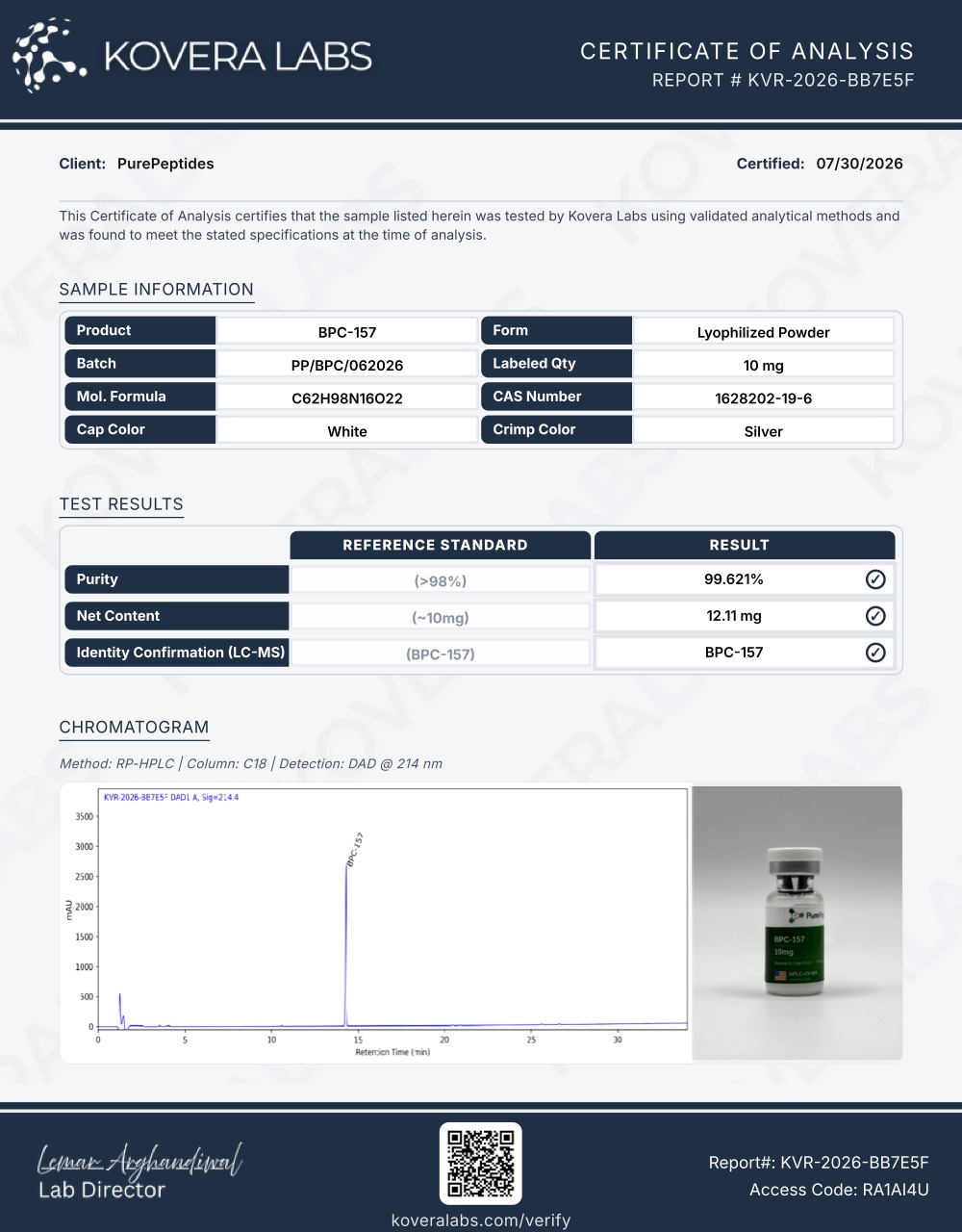
- Header. Who tested the sample, for whom and when, and the report number.
- Sample information. Product, form, batch, labeled quantity, and cap and crimp colors.
- Test results. Each test's specification, headed “Reference Standard”, beside its result.
- Chromatogram. The method line and the detector trace behind the purity figure.
- Verification. Report number, access code, QR code and the lab's verification address.
Pure Peptides describes its certificates as "issued by an independent third-party laboratory", and the full set sits in the certificate of analysis library.
The header answers who and when. On this certificate the testing lab is Kovera Labs. The client line, PurePeptides, names the company that sent the sample. The certified date is 07/30/2026, and the report number, KVR-2026-BB7E5F, appears at both the top and the foot of the page. The report number is the certificate's own ID, and it's what the lab will ask for if anyone queries a result.
BPC-157 on this siteBPC-157 ReferenceBPC-157 ResearchRegeneration Peptides
Why check the batch number before the purity?
Because the certificate describes a sample, and the sample came from one batch. The "Sample Information" box says which:
Sample information, as printed
- ProductBPC-157The compound named on the vial
- FormLyophilized powderA freeze-dried solid
- BatchPP/BPC/062026The production batch the sample came from
- Labeled Qty10 mgThe amount stated on the label
- Cap ColorWhiteThe color of the plastic cap on the vial
- Crimp ColorSilverThe color of the metal seal crimped around the stopper
The box also prints a molecular formula and a CAS registry number for the substance.
The batch number is the link between paper and vial. If a vial or its paperwork carries a batch number, it should match this one exactly. A different batch number means the certificate isn't about that vial, however good its numbers look. The cap and crimp colors add a physical check, and the certificate also prints a photograph of a vial.
This document-to-material check should happen before interpreting any numerical result. A technically strong analytical report cannot compensate for an uncertain link between the report and the sample.
What do "Reference Standard" and "Result" mean?
The results table has two columns. The left one is headed "Reference Standard" and holds, in brackets, the target each test had to meet. The certificate's opening line says the sample met the stated specifications, so these bracketed values are the specifications. The right column, "Result", is what the lab measured, with a tick where the result met its target.
Three tests, three different questions
Purity
Specification>98%
Result99.621%
Answers: The main peak's share of what the detector recorded at one wavelength. Not a weight.
Net Content
Specification~10 mg
Result12.11 mg
Answers: How much peptide the lab found, by weight.
Identity Confirmation (LC-MS)
SpecificationBPC-157
ResultBPC-157
Answers: Whether the main component is the expected peptide.
In analytical chemistry, a reference standard means a characterized substance used as the standard in an assay, identity or purity test. Guidelines call the targets themselves acceptance criteria.
Purity is an HPLC figure: the main peak's share of everything the detector recorded at one wavelength. It's not a weight, which is why what a purity figure does and doesn't count matters before you compare numbers.
Net content is a separate measurement: how much peptide the lab found, by weight. This batch measured 12.11 mg against a specification of about 10 mg.
Identity is a different question again. Purity says the sample is mostly one thing, while identity supports whether the main component is the expected peptide. The identity result is reported as "Identity Confirmation (LC-MS)", with BPC-157 shown as the target and result. This indicates the laboratory's reported conclusion. The certificate does not include the mass spectrum.
What does the chromatogram add?
The results table gives the purity figure; the chromatogram shows the detector trace behind it. The method line reads "Method: RP-HPLC | Column: C18 | Detection: DAD @ 214 nm", meaning reversed-phase HPLC on a C18 column, detected at 214 nanometers.
On this trace, one tall peak labeled BPC-157 appears just after 14 minutes, with small early disturbances. Because no peak table is printed, the shape can be reviewed but individual peak areas cannot.
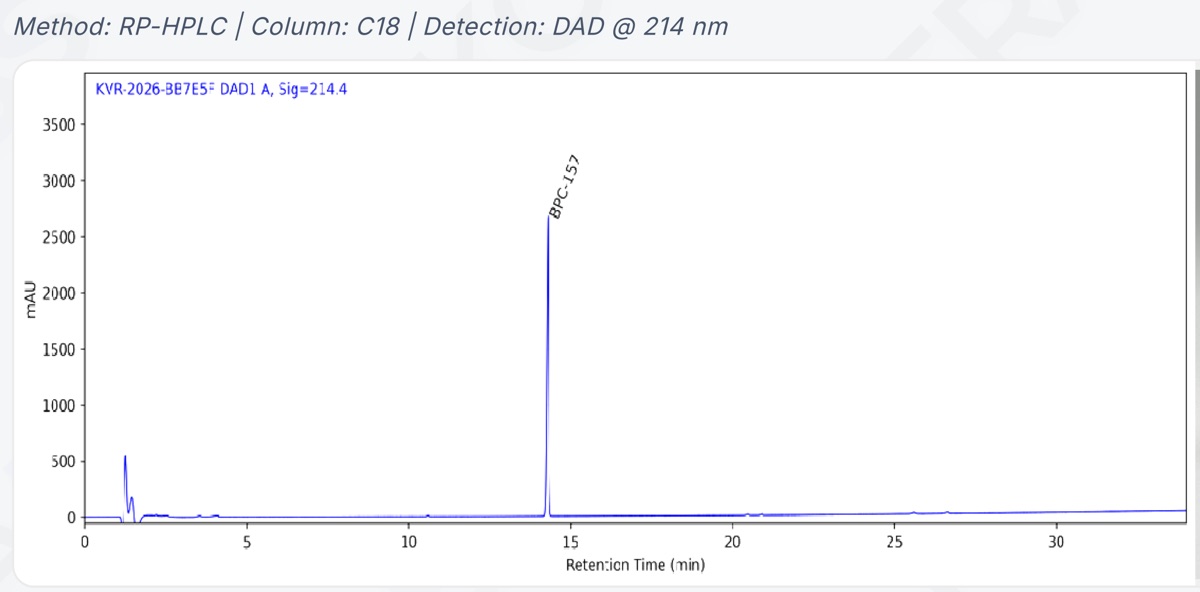
- The method line: reversed-phase HPLC on a C18 column, detected at 214 nm.
- One tall peak, labeled BPC-157, just after 14 minutes.
- Small early disturbances.
- The baseline.
Not printed: a peak table, so the shape can be reviewed but individual peak areas cannot.
Check whether the chromatogram supports the reported purity: look for a dominant target peak, minor peaks or shoulders, a stable baseline and enough method detail to support the conclusion.
How do you know a certificate is genuine?
Verify the certificate with the issuing laboratory. This one prints a report number, access code, QR code and koveralabs.com/verify, and the lab's verification page looks a certificate up by its report number. Compare the laboratory's record with the document: product, batch, date and results should match. For a stronger check, visit the laboratory's site directly rather than relying on the document's link or QR code. If the record is missing or differs, treat the certificate as unverified until the discrepancy is explained.
Verifying a certificate
- Note the report numberOn this certificate, KVR-2026-BB7E5F. The lab's verification page looks a certificate up by it.
- Go to the lab's site yourselfVisit it directly, rather than relying on the document's link or QR code.
- Compare the recordProduct, batch, date and results should match the document.
- Missing or different?Treat the certificate as unverified until the discrepancy is explained.
What can't a certificate tell you?
A COA has three important limits:
- Other batches. Results apply only to the batch identified.
- Changes after testing. The certificate reflects the sample "at the time of analysis", not later storage or handling.
- Unlisted attributes. It cannot support a test or attribute that was not reported.
Quick checklist
- The batch number matches the vial or its paperwork.
- The product, form and labeled quantity match.
- The cap and crimp colors match, where they're printed.
- Every result meets its specification.
- A method line and chromatogram support the purity figure.
- The report checks out on the issuing lab's own site.
Frequently Asked Questions
Does one COA cover every vial of a product?+−
No. A COA applies only to the batch identified, so the batch number on the vial or paperwork must match.
What's the difference between the specification and the result on a COA?+−
The specification is the acceptance criterion; the result is the laboratory's measurement. Here, purity must exceed 98%, and the reported result is 99.621%.
What is a common problem when interpreting a COA?+−
Treating the COA as a single pass/fail statement. Purity, identity and net content answer different questions, and a checkmark says nothing about attributes that were not reported.
What does the chromatogram show that the results table does not?+−
It shows peak shape, minor signals and baseline behavior. Without a peak table and integration details, however, the printed trace cannot independently reproduce the purity calculation.
Sources
- ICH Q7, Good Manufacturing Practice Guide for Active Pharmaceutical Ingredients (2000), section 11.4, Certificates of Analysis, and Glossary database.ich.org/sites/default/files/Q7%20Guideline.pdf
- ICH Q6A, Specifications: Test Procedures and Acceptance Criteria for New Drug Substances and New Drug Products: Chemical Substances (1999), section 2.11 and Glossary database.ich.org/sites/default/files/Q6A%20Guideline.pdf
- World Health Organization, Model certificate of analysis, WHO Technical Report Series No. 1010 (2018), Annex 4 cdn.who.int/media/docs/default-source/medicines/norms-and-standards/guidelines/quality-control/who-model-certificate-of-analysis.pdf
- Kovera Labs, Certificate of Analysis, report KVR-2026-BB7E5F (BPC-157, batch PP/BPC/062026, certified 07/30/2026) purepeptides.com/coa/bpc-157-pp-bpc-062026.pdf
Worked example
The article borrows BPC-157 from the catalogue to show the idea on a real molecule.
Shop lot-tested BPC-157
View Product · BPC-157The document in this article
BPC-157 certificate of analysisKovera Labs report KVR-2026-BB7E5F, batch PP/BPC/062026
Open the PDF
About the author
Julia Piccoli, PhD
Associate R&D Director, Kemin Industries LATAM · PhD in Biotechnology
Dr. Julia Piccoli is the Associate R&D Director for Latin America at Kemin Industries in Brazil, where she leads innovation and technical strategy initiatives across the animal nutrition market. She holds a bachelor's degree in chemistry and earned both her M.Sc. and Ph.D. in Biotechnology. With more than 14 years of experience in academia and industry, her work has focused on peptides, biotechnology, food preservation, enzymes, and applied innovation for both pharmaceutical and animal nutrition. Julia collaborates closely with commercial, regulatory, and technical teams to translate scientific research into practical solutions that create value for customers and the industry.
Disclosure: Employed by Kemin do Brasil. The opinions expressed are her own and do not necessarily reflect those of her employer. No conflicts of interest related to the information presented are declared.
The author checked the claims in this article against its sources and approved the text as published on .