
What Is Lyophilization, and Why Do Peptides Arrive as a Powder?

Written by Julia Piccoli, PhD
Associate R&D Director, Kemin Industries LATAM · Published · 6 min read
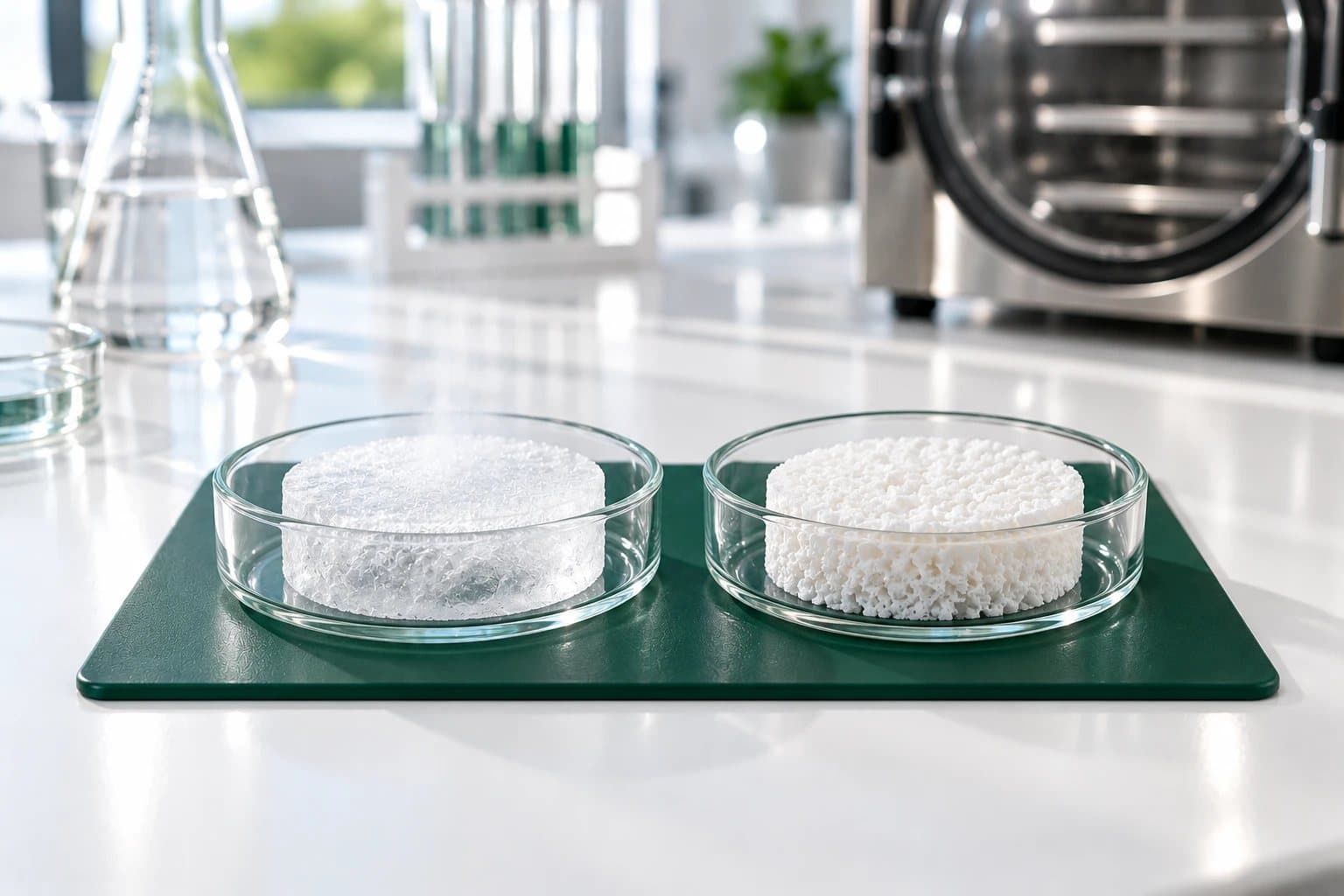
Lyophilization, also called freeze-drying, freezes a peptide solution, removes the ice by sublimation under vacuum, and then reduces the remaining moisture, leaving a porous dry solid, or "cake", in the vial. The process is designed to dry the peptide without damaging the molecule.
In this article+−
How can ice turn into vapor without melting?
By lowering the pressure. Water can only exist as a liquid above a certain pressure. There is a point, called the triple point, where ice, liquid and vapor can coexist. The International Association for the Properties of Water and Steam gives the triple point as 273.16 K (0.01 °C) and 611.657 pascals, about 0.6% of normal air pressure. Below that pressure, ice that gains energy goes straight to vapor: this is sublimation.
You may have seen it outdoors: frost that vanishes from a car roof on a cold, dry, sunny morning without ever turning to water. The comparison breaks down at control. Outdoors it takes hours and depends on the weather; a freeze-dryer sets the pressure and temperature deliberately.
In practice, the chamber is held far below the triple-point pressure. In one worked example from Cheng and colleagues, product at minus 20 °C, whose ice has a vapor pressure of about 770 millitorr, sits in a chamber held at 120 millitorr, roughly 1/6,000 of normal air pressure. Vapor leaves the ice because the chamber's pressure is lower than the ice's own.
Water's phase diagram, not to scale
How low the pressure goes (log scale)
What happens during the three stages of lyophilization?
FDA's guide to lyophilization describes the process as three separate but interdependent steps: freezing, primary drying by sublimation and secondary drying by desorption.
Freezing. The starting solution is cooled until most of its water forms ice. The freezing pattern affects the structure of the final cake. Larger ice crystals generally leave larger pores after sublimation. These larger channels can reduce resistance to water-vapor movement during primary drying. Smaller ice crystals leave a finer structure that may slow vapor removal. This is why freezing should not be treated as a simple preliminary step. It helps establish the physical structure through which water must later escape.
Primary drying. After freezing, the pressure is reduced and controlled, and heat is applied, allowing the ice to sublime and leaving a porous solid structure. The key is to provide enough energy for efficient drying without exceeding the formulation's collapse temperature (Tc). Above Tc, the cake can lose its structure and collapse, retain moisture, reconstitute more slowly, and increase the risk of peptide degradation. Careful control of shelf temperature and chamber pressure therefore keeps the process efficient while protecting product quality.
Secondary drying. At the end of primary drying, visible ice has been removed, but water is still associated with the solid matrix. Secondary drying reduces this remaining water by desorption. The temperature used during secondary drying is commonly higher than during primary drying because there is no longer a large ice phase in the product. The objective is to reach an appropriate residual-moisture level, not necessarily to remove every water molecule. Cheng and colleagues describe 20 °C to 40 °C as common for this step in protein products.
What can go wrong. If the temperature is too high, the peptide may degrade; if secondary drying is too short, residual moisture may remain above the target.
An illustrative cycle
Why are peptides lyophilized?
Because water drives many of the reactions that degrade a peptide. Hydrolysis, the reaction that breaks peptide bonds, uses water directly, and other degradation reactions also need it, or run far faster with it.
RelatedWhat breaks a peptide bond
Drying helps in two ways. It removes most of the water those reactions need, and it locks the molecules into a solid where they can barely move, so they rarely meet anything to react with. Jameel and colleagues, in best-practice recommendations for freeze-drying, credit the stability of freeze-dried products to exactly this combination: limited hydrolytic reactions and restricted molecular mobility. As the FDA guidance explains, products are freeze-dried because they tend to be less stable in solution. In their dry powder form, they can achieve greater stability.
What is the cake inside a lyophilized vial?
The cake is the porous solid left after freezing and drying, with pores formed where ice crystals were removed. Cracking, shrinkage, uneven surfaces, or partial collapse may occur, but appearance alone does not confirm peptide degradation. Visual inspection should be treated as an indicator for further investigation, supported by analytical data and process history. The key question is whether the unusual appearance is associated with changes in residual moisture, purity, peptide content, reconstitution, or stability.
RelatedPurity and peptide content
Visual observations, not pass or fail results
- IntactEven, fills the base
- CrackedSplits across the cake
- ShrunkenPulled away from the wall
- Partially collapsedSlumped, denser in places
Why do residual moisture and sealing matter?
Lyophilization does not remove every trace of water. The amount remaining after the drying cycle is called residual moisture. Karl Fischer titration is commonly used to measure this water. Jameel and colleagues give 1% or less as a typical specification, and Tchessalov and colleagues say values below 0.5% are commonly achieved, though they also note that some products are most stable at an intermediate water content rather than the lowest.
Once dry, a cake will happily absorb moisture from the air, so how the vial is closed matters. FDA's guide notes that for most cycles, stoppering happens inside the freeze-dryer, and the chamber is often refilled with an inert gas such as nitrogen first. Cheng and colleagues add that stoppers for freeze-dried products need low moisture transmission, because the products are often moisture-sensitive.
What does this mean for a vial on the shelf?
The BPC-157 certificate of analysis lists the sample's form as "Lyophilized Powder", the end product of the process described above. Those two words tell you the material was frozen, dried by sublimation and dried again to remove bound water before it was sealed.
RelatedHow to read a certificate of analysis
The storage recommendations for freeze-dried peptides usually come down to three simple rules: keep them dry, cold, and protected from light. Dryness matters because moisture can restart the degradation reactions that freeze-drying helped slow. Cold temperatures matter because chemical reactions become slower as temperature decreases. Protection from light is important because light can promote oxidation of sensitive amino acid residues such as tryptophan and tyrosine. While these principles apply broadly, the optimal storage conditions vary from one peptide to another, so it is always important to follow the guidance provided for the specific compound.
- DryMoisture can restart the degradation reactions that freeze-drying helped slow.
- ColdChemical reactions become slower as temperature decreases.
- DarkLight can promote oxidation of residues such as tryptophan and tyrosine.
BPC-157 on this siteBPC-157 ReferenceBPC-157 ResearchRegeneration Peptides
Frequently Asked Questions
Is lyophilized the same as freeze-dried?+−
Yes. Lyophilization is the technical name for freeze-drying: removing water from a frozen product by sublimation under vacuum, then removing the remaining bound water by desorption. "Lyophilized powder" on a certificate or label means the material was dried this way, which is why it arrives as a dry solid rather than a liquid.
Why can two vials of the same lyophilized peptide look different?+−
Variations in freezing, ice-crystal formation, heat transfer, vial position, and drying behavior can produce differences in cake appearance. Cracking, shrinkage, or partial collapse may be visible. These observations may justify further review, but they do not independently establish purity, identity, peptide content, or residual moisture.
Does freeze-drying remove all the water?+−
No. Some residual moisture always remains, and labs measure it, usually by Karl Fischer titration. Typical specifications are around 1% or less, depending on the product. That remaining water is one reason dried peptides are sealed in vials with tight stoppers, often under nitrogen, and kept away from humid air.
How should lyophilized research peptides be stored?+−
Lyophilized peptides are generally stored at −20 °C or below in sealed containers protected from moisture. Exposure to humidity, light, and temperature fluctuations should be minimized to preserve product quality. Moisture uptake can easily be overlooked, and the cake may still look acceptable even when its residual moisture has increased. That is why appearance alone is not enough. Storage history and analytical results, such as water content, purity, and peptide content, should also be considered.
Sources
- US Food and Drug Administration. Guide to Inspections of Lyophilization of Parenterals. fda.gov/inspections-compliance-enforcement-and-criminal-investigations/inspection-guides/lyophilization-parenteral-793
- International Association for the Properties of Water and Steam. Revised Release on the Pressure along the Melting and Sublimation Curves of Ordinary Water Substance. iapws.org/technical-guidance/release/MeltSub.download
- Jameel F, Alexeenko A, Bhambhani A, et al. Recommended Best Practices for Lyophilization Validation 2021, Part I: Process Design and Modeling. AAPS PharmSciTech. 2021;22:221. doi.org/10.1208/s12249-021-02086-8
- Jameel F, Alexeenko A, Bhambhani A, et al. Recommended Best Practices for Lyophilization Validation 2021, Part II: Process Qualification and Continued Process Verification. AAPS PharmSciTech. 2021;22:266. doi.org/10.1208/s12249-021-02107-6
- Cheng Y, Duong HTT, Hu Q, et al. Practical Advice in the Development of a Lyophilized Protein Drug Product. Antibody Therapeutics. 2025;8(1):13–25. doi.org/10.1093/abt/tbae030
- Tchessalov S, Maglio V, Kazarin P, et al. Practical Advice on Scientific Design of Freeze-Drying Process: 2023 Update. Pharmaceutical Research. 2023;40:2433–2455. doi.org/10.1007/s11095-023-03607-9
- Patel SM, Nail SL, Pikal MJ, et al. Lyophilized Drug Product Cake Appearance: What Is Acceptable? Journal of Pharmaceutical Sciences. 2017;106(7):1706–1721. doi.org/10.1016/j.xphs.2017.03.014
- Nugrahadi PP, Hinrichs WLJ, Frijlink HW, et al. Designing Formulation Strategies for Enhanced Stability of Therapeutic Peptides in Aqueous Solutions: A Review. Pharmaceutics. 2023;15(3):935. doi.org/10.3390/pharmaceutics15030935
- Kovera Labs. Certificate of Analysis, report KVR-2026-BB7E5F, BPC-157, batch PP/BPC/062026. purepeptides.com/coa/bpc-157-pp-bpc-062026.pdf
Worked example
The article borrows BPC-157 from the catalogue to show the idea on a real molecule.
Shop lot-tested BPC-157
View Product · BPC-157The document in this article
BPC-157 certificate of analysisKovera Labs report KVR-2026-BB7E5F, batch PP/BPC/062026
Open the PDF
About the author
Julia Piccoli, PhD
Associate R&D Director, Kemin Industries LATAM · PhD in Biotechnology
Dr. Julia Piccoli is the Associate R&D Director for Latin America at Kemin Industries in Brazil, where she leads innovation and technical strategy initiatives across the animal nutrition market. She holds a bachelor's degree in chemistry and earned both her M.Sc. and Ph.D. in Biotechnology. With more than 14 years of experience in academia and industry, her work has focused on peptides, biotechnology, food preservation, enzymes, and applied innovation for both pharmaceutical and animal nutrition. Julia collaborates closely with commercial, regulatory, and technical teams to translate scientific research into practical solutions that create value for customers and the industry.
Disclosure: Employed by Kemin do Brasil. The opinions expressed are her own and do not necessarily reflect those of her employer. No conflicts of interest related to the information presented are declared.
The author checked the claims in this article against its sources and approved the text as published on .