
EducationThe numbers on a label
What Is Molecular Weight? And Why the Salt Form Changes It

Written by Dr. Sufia Ul Haque
Chemist and scientific writer · Published · 5 min read
Molecular weight tells us how heavy a molecule is. In peptide specifications, the number is often reported as molar mass in grams per mole (g/mol). The same peptide may have two different values because one refers to the peptide alone and the other includes its salt-forming partner, called a counter-ion. Both can be correct.
In this article+−
What does molecular weight actually measure?
A mole is a fixed number of particles: exactly 6.02214076 × 10²³. Chemists use it to connect individual molecules with amounts they can weigh. Molar mass describes the mass of one mole of a substance. A peptide listed at approximately 1,419.5 g/mol therefore has that mass per mole of peptide molecules. Strictly speaking, relative molecular mass, often called molecular weight, has no units. In everyday laboratory documents, however, 'molecular weight' and 'molar mass' are commonly used for the same numerical value.
Mass spectrometry reports molecular masses in daltons (Da). One dalton is one-twelfth of the mass of a free carbon-12 atom. For ordinary laboratory reporting, a molecular mass in Da has virtually the same numerical value as the corresponding molar mass in g/mol. The SI Brochure explains the definitions; the equivalence is extremely close rather than mathematically exact after the 2019 SI revision.
In my work with organic synthesis and analytical characterization, I have found it useful to check which quantity a document actually reports before comparing numbers. A familiar unit does not always mean the underlying chemical form is identical.
How do you calculate molecular weight from a formula?
Start with the molecular formula. Multiply the number of atoms of each element by its standard atomic weight, then add the results. Consider BPC-157, with the formula C62H98N16O22. Using the abridged standard atomic weights published by IUPAC's Commission on Isotopic Abundances and Atomic Weights, the calculation is:
Each element's share of the molar mass
- Carbon (C) 62 × 12.011744.682
- Hydrogen (H) 98 × 1.008098.784
- Nitrogen (N) 16 × 14.007224.112
- Oxygen (O) 22 × 15.999351.978
Total1,419.556 g/mol
The result is about 1,419.56 g/mol. PubChem lists BPC-157 at approximately 1,419.5 g/mol. Small differences in the final decimal places can reflect rounding and the atomic-weight values used. A much larger difference deserves a closer look at the chemical formula and salt form.
RelatedBPC-157 product page
BPC-157 on this siteBPC-157 ReferenceBPC-157 ResearchRegeneration Peptides
Why do average and monoisotopic masses differ?
An element can occur as several isotopes, atoms with the same number of protons but different numbers of neutrons. Carbon, for example, occurs mainly as carbon-12, with a smaller natural proportion of carbon-13. The IUPAC atomic-weights commission reports a carbon-13 abundance interval of about 0.96% to 1.16%.
Average molecular mass uses the natural isotopic composition of the elements. Monoisotopic mass instead uses the most abundant isotope of each element. For BPC-157, PubChem reports a monoisotopic mass of approximately 1,418.704 Da, compared with an average molecular weight near 1,419.5. These are two ways of describing the same molecular formula, not evidence of two different peptides.
BPC-157, one formula, two ways of counting
Average molecular weight
1,419.5 g/mol
Uses the natural mix of each element's isotopes.
Suits a bulk material, which holds many isotopic combinations.
Monoisotopic mass
1,418.704 Da
Uses the most abundant isotope of each element.
Useful for assigning an ion's composition in mass spectrometry.
The distinction matters when reading mass spectrometry results. Instruments detect ions and can resolve isotope-related signals; the monoisotopic value is therefore useful for assigning an ion's composition. A bulk material contains many isotopic combinations, making the average value more appropriate for conventional mass calculations.
Why does the salt form change the molecular weight?
Many synthetic peptides contain groups that can carry a positive charge. Negatively charged counter-ions, such as acetate or trifluoroacetate (TFA), can accompany them to maintain electrical neutrality. Sikora and colleagues explain that TFA used during peptide cleavage and purification may remain associated with peptides and can sometimes be exchanged for acetate or chloride. These additional components contribute mass without changing the peptide's amino acid sequence.
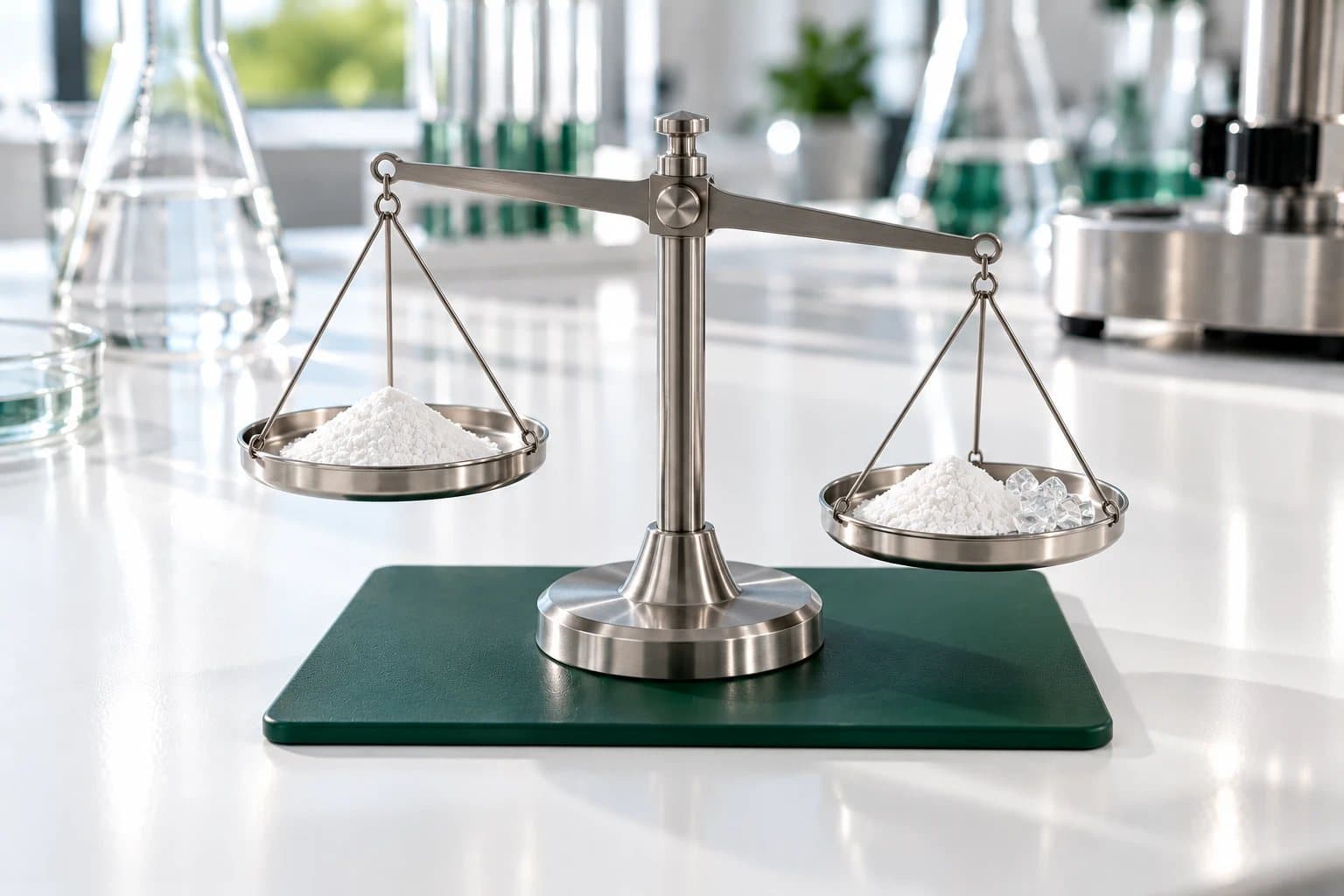
PubChem lists BPC-157 with formula C62H98N16O22 and molecular weight about 1,419.5 g/mol. Its separately recorded 1:1 acetate form has formula C64H102N16O24 and molecular weight about 1,479.6 g/mol. The difference corresponds to C2H4O2, the composition of one acetic acid molecule, approximately 60.05 g/mol. The peptide accounts for about 95.9% of that idealized salt's formula mass.
Peptide alone
BPC-157
C62H98N16O22
1,419.5 g/mol
- Peptide
1:1 acetate, as PubChem records it
BPC-157 acetate
C64H102N16O24
1,479.6 g/mol
- Peptide, about 95.9%
- Acetic acid, C2H4O2
Difference: C2H4O2, one acetic acid +60.05 g/mol
This 1:1 formula is a database representation, not a promise that every real batch has exactly one acetate per peptide. The counter-ion amount can depend on the peptide's charged groups and the material's composition. Trifluoroacetic acid has a molar mass of about 114.02 g/mol, so its contribution can be substantial when more than one counter-ion is present.
What does molecular weight mean on a certificate or vial label?
A powder's total mass may include peptide, counter-ions, water and residual solvents. That is why gross powder mass and net peptide content are not interchangeable. Net peptide content expresses how much of the material is peptide itself, rather than the accompanying components. McCarthy and colleagues describe mass-balance approaches used for peptide reference standards, including measurements of water, counter-ions and other non-peptide material.
The size of the difference varies. Erckes and colleagues reported about 0.333 mg of TFA per milligram of peptide salt for one studied peptide. That is a specific example, not a general ratio for all peptides. Net peptide content can also vary between preparations because the material may contain counter-ions, water, and residual solvents. Therefore, the actual peptide content should be determined from analytical data rather than assumed from the total powder weight.
When reviewing characterization data, I treat purity and material content as separate questions. A chromatographic purity percentage describes what a particular analytical method detects relative to other detected components; it does not, by itself, establish the peptide's fraction of the entire weighed powder. A certificate or specification should be read for the basis of its reported quantity.
Frequently Asked Questions
Is molecular weight the same as molar mass?+−
Not strictly. Relative molecular mass, often called molecular weight, is a dimensionless number. Molar mass is mass divided by amount of substance and is expressed in g/mol. In routine laboratory writing, people often use 'molecular weight' for the numerical molar-mass value, so the unit and context tell you what is intended.
What is the difference between daltons and g/mol?+−
Daltons describe the mass of an individual molecule, while g/mol describes the mass of one mole of molecules. Their numerical values are almost identical for the same substance. Mass spectrometry commonly uses Da, whereas chemical specifications often use g/mol. The distinction is about the quantity and unit, not a change in chemical identity.
Why do two sources give different weights for the same peptide?+−
Small differences usually reflect rounding, atomic-weight conventions or whether the source reports average or monoisotopic mass. A larger difference may mean one source includes acetate, TFA or another component while the other reports the peptide alone. Compare the molecular formulas and the type of mass before treating either number as an error.
Sources
- BIPM. The International System of Units (SI Brochure). 9th edition, 2019. Sections on the mole and Table 8 (dalton). bipm.org/documents/20126/41483022/SI-Brochure-9-EN.pdf
- IUPAC Commission on Isotopic Abundances and Atomic Weights (CIAAW). Abridged Standard Atomic Weights. ciaaw.org/abridged-atomic-weights.htm
- IUPAC Commission on Isotopic Abundances and Atomic Weights (CIAAW). Carbon isotopic abundances. ciaaw.org/carbon.htm
- PubChem. BPC-157 (CID 9941957). pubchem.ncbi.nlm.nih.gov/compound/9941957
- PubChem. BPC-157 Acetate (CID 155977614). pubchem.ncbi.nlm.nih.gov/compound/155977614
- Murray KK, Boyd RK, Eberlin MN, et al. Definitions of terms relating to mass spectrometry (IUPAC Recommendations 2013). Pure and Applied Chemistry. 2013;85(7):1515–1609. doi.org/10.1351/PAC-REC-06-04-06
- Sikora K, Jaśkiewicz M, Neubauer D, et al. The role of counter-ions in peptides: an overview. Pharmaceuticals. 2020;13(12):442. doi.org/10.3390/ph13120442
- Erckes V, Streuli A, Chamera Rendueles L, et al. Towards a consensus for the analysis and exchange of TFA as a counterion in synthetic peptides and its influence on membrane permeation. Pharmaceuticals. 2025;18(8):1163. doi.org/10.3390/ph18081163
- McCarthy D, Han Y, Carrick K, et al. Reference standards to support quality of synthetic peptide therapeutics. Pharmaceutical Research. 2023;40(6):1317–1328. doi.org/10.1007/s11095-023-03493-1
Worked example
The article borrows BPC-157 from the catalogue to show the idea on a real molecule.
Shop lot-tested BPC-157
View Product · BPC-157
About the author
Dr. Sufia Ul Haque
Chemist and scientific writer · PhD in chemistry, Aligarh Muslim University
Dr. Sufia Ul Haque is a chemist and scientific writer. She holds a PhD in chemistry from Aligarh Muslim University and carried out postdoctoral research in organic and natural-product synthesis in the United States, where her work included multistep synthesis, purification and chromatography. She has published in journals including Biosensors and Bioelectronics, the Journal of Power Sources and Scientific Reports, and reviews for several international journals. She writes about chemistry for readers without a scientific background.
Disclosure: No conflicts of interest declared.
The author checked the claims in this article against its sources and approved the text as published on .