
Cognitive & Neuropeptide ResearchRead Research →
PE-22-28 Research
A spadin-derived peptide designed to block TREK-1, PE-22-28 has three preclinical papers, no independent replication and no trial on ClinicalTrials.gov.
August 28, 2026
Shop by category
Growth Hormone Axis ResearchRegeneration ResearchPeptide BioregulatorsCognitive & Neuropeptide ResearchMetabolic & Cellular ResearchMelanocortin & Endocrine ResearchDermal Peptide ResearchImmune & Thymic ResearchResearch & info
Research HubReference LibraryEducationCompareBlogCOAsContactAboutFAQCalculatorGlossary
Reviewed by Dr. Martina Rossi, PhD
Scientific Contributor and Reviewer · Reviewed
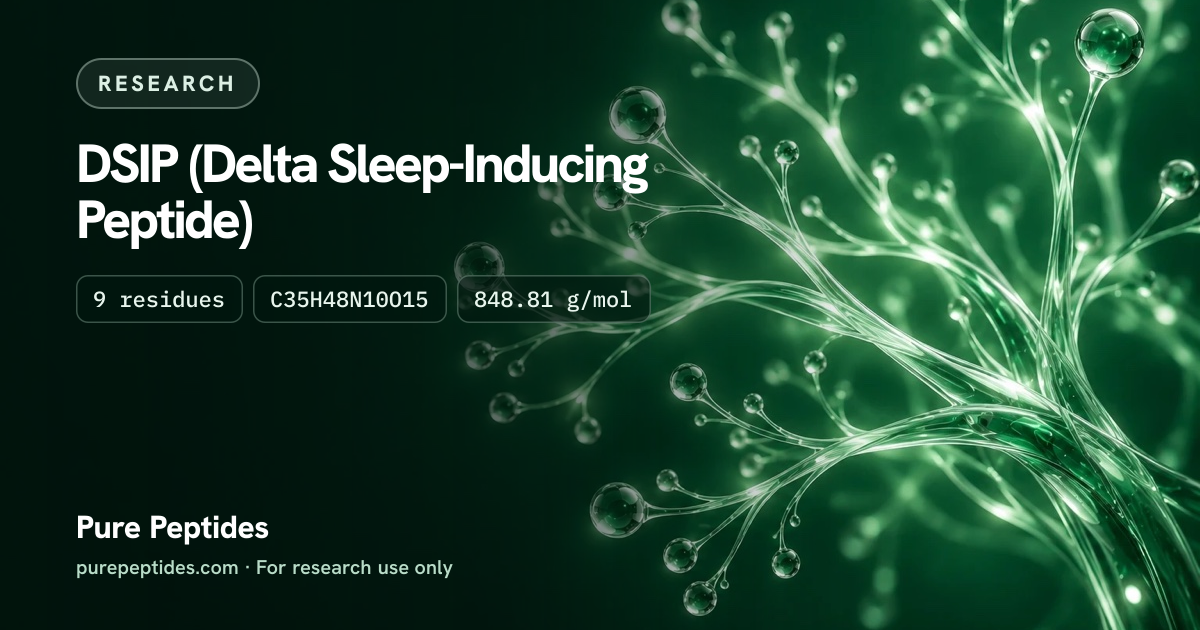
DSIP, or delta sleep-inducing peptide, is a synthetic nonapeptide described in the 1970s as a candidate sleep factor. DSIP research is unusual in that the compound was named for an effect that later work largely failed to confirm.
DSIP is a linear nonapeptide, sequence Trp-Ala-Gly-Gly-Asp-Ala-Ser-Gly-Glu or WAGGDASGE. PubChem records CID 68816, CAS 62568-57-4, formula C35H48N10O15 and molecular weight 848.8 for the free base. Research material is commonly supplied as an acetate salt, a chemically distinct substance of higher molecular weight. Its WHO International Nonproprietary Name, emideltide, is a naming assignment and confers no regulatory approval of its own.
The origin is widely misreported. In the founding animal study, the peptide was purified from the extracorporeal dialysate of cerebral venous blood in rabbits undergoing hypnogenic electrical stimulation of the thalamus [1]. It was not isolated from cerebrospinal fluid, nor from a naturally sleeping animal.
In an in silico sequence study, Mikhaleva and colleagues reported in 2011 that nothing is known of DSIP's protein precursors or their encoding genes [2]. They proposed a JMJD1B-type histone demethylase as a possible precursor. That remains a hypothesis, not a demonstration.
A review by Kovalzon and Strekalova states that the link between DSIP and sleep was never characterized, partly because no DSIP gene, protein or receptor was isolated [3]. That review calls the sleep-factor hypothesis poorly documented and weak, and suggests another unidentified peptide accounts for the tissue signal. Most human reports of DSIP in plasma, brain, gut or milk measure DSIP-like immunoreactivity, which is antibody binding rather than identification of the peptide.
NCBI Gene 1831 is aliased DSIPI, but its official symbol is TSC22D3, and a structural study shows its product does not contain the DSIP sequence [4]. Evidence about that protein is not evidence about DSIP. No DSIP receptor has been identified [3]. Writing in 1987, DSIP researchers stated that several mechanisms of action had been proposed but that no convincing evidence had been obtained for any of them [5].
In a controlled rat EEG study, Tobler and Borbély concluded that neither DSIP nor arginine vasotocin qualified as a specific sleep-promoting substance [6]. In a second controlled rat study, Obál and colleagues found DSIP did not increase sleep while two D-amino-acid analogues did [7]. A controlled rabbit study of fourteen compounds found DSIP and most analogues had no statistically significant effect on sleep against saline [8].
In animal sleep assays, protease-resistant analogues repeatedly promoted sleep where the parent nonapeptide did not. Those analogues were engineered because DSIP itself failed in such assays. Analogue results are not DSIP results. In the same animal work, one analogue suppressed sleep [8] and one fragment was frankly arousing [7].
One in vitro result bears on non-injected routes: in cultured human intestinal epithelial monolayers, roughly 8 percent of apically applied DSIP survived two hours, with free tryptophan as the major metabolite [9].
The controlled human record is small, old and unregistered. Total exposure across all published controlled human sleep studies is roughly sixty to seventy subjects. No trial with DSIP as an intervention is registered on ClinicalTrials.gov under any of its names, and PubMed holds no systematic review, meta-analysis or Cochrane review of it. FDA states that the American Academy of Sleep Medicine and American College of Physicians chronic-insomnia guidelines do not discuss emideltide, and that the same holds for narcolepsy and opioid withdrawal [10]. Fourteen drugs are FDA-approved for insomnia in adults [10].
The founding human trial reported that DSIP did not change sleep onset latency or final waking time against placebo [10][11]. Its authors described only tendencies toward fewer awakenings and higher sleep efficiency, plus a slight arousing effect in the first hour. FDA's review also identifies a carryover problem in that crossover design. The same authors reported elsewhere that DSIP has delayed effects 13 to 22 hours later, so the placebo nights may have been contaminated by the preceding DSIP night [10].
The most quoted positive human study reported sleep onset latency falling from 58.4 to 27.6 minutes in fourteen chronic insomniacs [12]. FDA's 2026 review found this human study had no placebo arm despite being described as placebo-controlled, and reclassified it as externally matched controlled [10]. Those figures therefore describe change from baseline and comparison with an external matched control group, not a placebo comparison.
Monti and colleagues, the first independent group to test the claim in humans, ran a randomized, double-blind, placebo-controlled crossover in six severe chronic insomniacs [13]. A shorter sleep latency and roughly twenty extra minutes of total sleep did not reach significance against baseline or placebo. Where DSIP and placebo did differ significantly, for NREM sleep time and stage 2 sleep, the same differences were already present in the baseline values. The authors called the improvement of little clinical significance.
Bes and colleagues, independently, ran the only chronic-insomnia trial with a parallel placebo group, in sixteen chronic insomniacs [14]. They judged the effects weak and possibly an artifact of a change in the placebo group. Whether any objective measure reached significance there is disputed, because the abstract and FDA's reading of that paper differ [10][14].
The only modern controlled human EEG data point the other way. In a randomized human trial, Pomfrett and colleagues assigned twenty-four female surgical patients to DSIP or saline, awake and under isoflurane [15]. DSIP significantly reduced delta rhythm, lightened anesthetic depth and increased heart rate. Enrollment was single-sex, which limits how far the finding generalizes.
Four human studies of the endogenous signal also ran against the hypothesis. In twelve volunteers, plasma DSIP-like immunoreactivity peaked in mid-afternoon and bottomed after midnight, tracking body temperature rather than sleep [16]. In human patients with Cushing syndrome, delta sleep was markedly reduced while its correlation with morning DSIP-like immunoreactivity was negative [17]. In seven healthy men, DSIP-like immunoreactivity decreased at the initiation of sleep and showed no sleep-stage specificity [18]. Across a 34-hour manipulation of activity and bed rest in five men, DSIP and its phosphorylated form showed no or minimal change while TSH, cortisol, melatonin and LH moved [19].
Human endocrine findings conflict with each other. One controlled human trial found no effect of DSIP on CRH-induced or meal-induced ACTH and cortisol [20]. Two other human studies point the other way on ACTH. A randomized crossover in eleven men reported reduced plasma ACTH-like immunoreactivity for at least three hours after intravenous DSIP [21]. An independent group in Parma also reported a significant decrease in ACTH [22]. This literature is not settled in either direction. A separate controlled human trial in healthy women found no effect on growth hormone or prolactin, at an intravenous exposure the authors noted was enough to alter ECG patterns [23].
No systematic human safety dataset exists. FDA's account of adverse effects, drawn from small uncontrolled human studies, lists transient headache, nausea and vertigo, plus progressive hypotension in opioid-withdrawal patients [10].
The early positive human sleep trials came from the Basel group that isolated the peptide, with its discoverer a co-author on the founding trial [1][11]. Independent groups in Montevideo, Amsterdam and Manchester reported null, weak or paradoxical human findings [13][14][15]. Independent animal laboratories had already failed to find the effect, in Zurich, in Moscow and elsewhere [6][7][8]. The split is not perfect, since the independent Parma group reported a positive endocrine effect [22]. None of the positive trials from that era carries a conflict-of-interest statement. Disclosure was not routinely required then, so the absence means little.
The clearest concession came from the positive side. Graf and Kastin reviewed the field in 1986 and treated the therapeutic work as still unestablished [24]. Graf had co-published DSIP work with the peptide's discoverer [5]. FDA reads that 1986 review as finding the results preliminary, with insufficient evidence that the peptide reliably induced or maintained sleep [10].
A publication-type search of the DSIP corpus returns no retractions, expressions of concern or errata. The problem is small samples, weak design by present standards and failed replication, not misconduct.
Emideltide is not approved as a drug in the United States. FDA states there is no USP or NF monograph for its free base or acetate, and that neither is a component of an FDA-approved drug [10]. FDA reviewers proposed, in a briefing document dated May 2026, not adding either substance to the 503A Bulks List [10]. Their grounds included poor physicochemical characterization, insufficient evidence of effectiveness, immunogenicity concern for an injected nonapeptide, and uncharacterized addiction liability. FDA linked the reported sleep and analgesic effects to opioid-dependent mechanisms and noted that no nonclinical study characterizes that addiction risk [10]. FDA also found no human effectiveness or safety data for the subcutaneous route specified in the nominations.
The two compounding businesses that nominated the substance withdrew their nominations, and FDA continued the evaluation on its own initiative. Emideltide appears in no FDA approval or label dataset, and those datasets record approvals rather than filings, so no public source shows whether an application was ever filed [10]. FDA's voting questions for that meeting put seven peptide substances to the committee, emideltide among them. News coverage of the meeting reported a vote against listing emideltide [25], and FDA had published no minutes or transcript of the meeting as of 2 October 2026, so the voting record is not yet confirmable from FDA material.
A DSIP-containing Russian product, Deltaran, is described in the FDA document as marketed. It mixes the peptide with glycine, and FDA cautioned that its toxicology results cannot be attributed to DSIP. A current Russian registration has not been confirmed from a primary regulatory record.
DSIP's name records what its discoverers sought in the 1970s, not a replicated finding. Whether the nonapeptide occurs as such in the human body is unresolved, with no gene, precursor or receptor identified. Where independent groups tested the sleep claim in humans and in animals, the effect was weak, absent or reversed. That makes DSIP a failed replication problem rather than simply old evidence.
There is controlled human evidence, and it is mostly negative or weak. The founding human trial found no change in sleep onset latency or final waking time against placebo. The two independent replications in chronic insomnia reported effects that were not significant, or weak and possibly a placebo-group artifact. The most quoted positive human study had no placebo arm according to FDA's 2026 review.
It is not approved in the United States. FDA states there is no USP or NF monograph for emideltide or its acetate, and that neither is a component of an FDA-approved drug. FDA reviewers proposed in May 2026 not adding either to the 503A Bulks List, and news coverage of the July 2026 meeting reported that the advisory committee also voted against listing emideltide.
References

Reviewed for scientific accuracy
Dr. Martina Rossi, PhD
PhD, Université Grenoble Alpes · Scientific Contributor and Reviewer
Dr. Rossi's doctoral research at Université Grenoble Alpes examined the vascular functions of bone morphogenetic proteins. Her peer-reviewed work spans cell and molecular biology, vascular biology, and gene therapy, in journals including Cardiovascular Research, Scientific Reports, and Brain Sciences. She reviews Pure Peptides' product, reference, and research pages for scientific accuracy against the sources they cite.
A spadin-derived peptide designed to block TREK-1, PE-22-28 has three preclinical papers, no independent replication and no trial on ClinicalTrials.gov.
P021 research is sixteen years of animal and cell studies with no independent replication. No human trial has ever run. What the evidence shows and omits.
Orexin-B research is small: 81 title-level papers against 868 for orexin-A, no human dosing study, and a mouse blood-brain barrier null.
Orexin-A is mostly measured, not given: four small human intranasal studies, wakefulness nulls, and approved insomnia drugs that block its receptors.
No study registered on ClinicalTrials.gov has ever given humanin to human participants. What the cell, animal and biomarker research actually reports.
DNSP-11 is an 11-mer from the pro-GDNF proregion. No published human study of it exists. Every dopaminergic finding comes from one patent-holding lab.