
Growth Hormone ResearchRead Research →
Sermorelin Research
Sermorelin held two FDA approvals, both withdrawn in 2009. What the primary regulatory record and the small human trial base actually establish.
August 28, 2026
Shop by category
Growth Hormone Axis ResearchRegeneration ResearchPeptide BioregulatorsCognitive & Neuropeptide ResearchMetabolic & Cellular ResearchMelanocortin & Endocrine ResearchDermal Peptide ResearchImmune & Thymic ResearchResearch & info
Research HubReference LibraryEducationCompareBlogCOAsContactAboutFAQCalculatorGlossary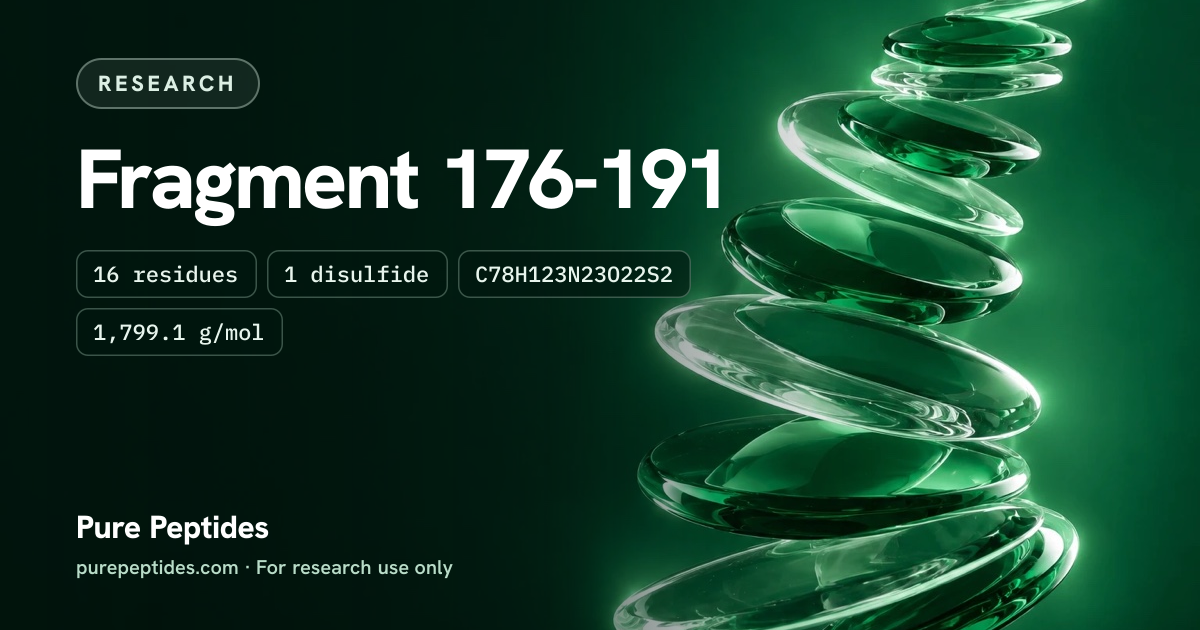
HGH Fragment 176-191 is the C-terminal sixteen-residue fragment of human growth hormone, sold as a research chemical. No published study has given this molecule to a person. This page is short because that is the honest state of the evidence.
HGH Fragment 176-191 is PubChem CID 16131230, CAS 66004-57-7, molecular weight 1799.1, sequence Phe-Leu-Arg-Ile-Val-Gln-Cys-Arg-Ser-Val-Glu-Gly-Ser-Cys-Gly-Phe [1]. It is cyclized by a disulfide bridge between Cys7 and Cys14, which are Cys182 and Cys189 of the full-length hormone [1]. AOD-9604 is a separate record, CID 71300630, CAS 221231-10-3, molecular weight 1815.1, one oxygen atom heavier [1]. It is Tyr-hGH(177-191), carrying a synthetic N-terminal tyrosine in place of the native Phe176 [2].
Essentially all published lipolysis work used AOD-9604, or AOD-9401, a third peptide from the same research program, rather than unmodified 176-191 [1][2]. The World Anti-Doping Agency lists AOD-9604 and hGH 176-191 as separately named growth hormone fragments [3]. A 2026 review nonetheless writes the compound as "AOD9604 (hGH 176-191)", so the merge has reached the peer-reviewed literature [2].
Findings produced with AOD-9604 or AOD-9401 are not findings about 176-191.
Every study below used AOD-9401 or AOD-9604, and all are animal or in vitro.
The earliest primary paper in this program reported a null on the mechanism the product is named for. In rats, synthetic hGH 177-191, the peptide later designated AOD-9401, showed antilipogenic activity but no significant lipolytic effect [4][5]. The authors concluded growth hormone's main lipid effect is on lipogenesis, not lipolysis, and that paper came from the same laboratory as the later positive work [4].
In obese Zucker rats, AOD-9401 and AOD-9604 each reduced body-weight gain, with increased lipolytic activity in isolated adipose tissue [5]. In genetically obese ob/ob mice, thirty days of oral AOD-9401 lowered body-weight gain without any change in food consumption [6]. That mouse study also reported comparable effects on isolated adipose tissue from obese humans, which is tissue in a dish rather than a person [6]. That result is very likely the origin of the circulating claim that this fragment works in humans. The inference is this page's reading, not a conclusion of the paper.
In obese ob/ob mice, with lean controls, AOD-9604 reduced body-weight gain over fourteen days, with increased fat oxidation and raised plasma glycerol [7]. In beta-3 adrenergic receptor knockout mice the chronic weight effect disappeared, while acute energy-expenditure effects persisted [8]. Beta-3 adrenoceptor-mediated lipolysis is strongest in rodent adipocytes, while human fat cells respond poorly, partly because they carry less receptor messenger RNA [9]. That species difference is one general reason why rodent lipolysis results translate poorly to people. The compound's most recent primary animal study concerns cartilage in a rabbit model of osteoarthritis, and not fat at all [10].
In cells transfected with the human growth hormone receptor, AOD-9604 neither competed for that receptor nor induced proliferation [7]. For unmodified 176-191, no receptor or molecular target has been reported. That is an absence in the record rather than a proven absence in biology, and it leaves no mechanism by which these rodent findings could extend to people.
ClinicalTrials.gov lists no interventional trials of HGH Fragment 176-191, and none of AOD-9604, queried 27 August 2026 [11]. The Australian and European registers were not searched, and the 2002 development predates mandatory trial registration [11].
Human development did happen in this program, but it happened for AOD-9604 rather than for this fragment. A 2004 drug-pipeline profile records that phase IIa trials of AOD-9604 in obesity were underway by February 2002 [12]. No efficacy or safety result from that program is retrievable from the indexed peer-reviewed literature [11][12]. Whether those trials succeeded or failed cannot be stated here.
Both AOD-9604 and hGH 176-191 are prohibited at all times under Section S2 of the 2026 WADA Prohibited List, and AOD-9604 has been identified in seized preparations [3][13]. That is a sport-regulation record and an enforcement history, not a medicines-agency finding about safety.
A US regulatory record also exists, and again it is for AOD-9604 rather than for this fragment. AOD-9604 was nominated as a bulk drug substance for use in pharmacy compounding, and that nomination was later withdrawn [14]. FDA states it has identified serious adverse events that may be associated with AOD-9604, though causality is not clear [14].
Tesamorelin is a growth-hormone-releasing-hormone analogue sold alongside this fragment, and unlike it, tesamorelin holds a marketing authorization. FDA approved it on 10 November 2010 under application 022505, for reduction of excess abdominal fat in adults with HIV-associated lipodystrophy [15]. The approval remains in force, with supplements approved as recently as 25 March 2025 [15].
Tesamorelin never obtained a European marketing authorization, because the applicant, Ferrer Internacional, withdrew the application while it was under CHMP review in 2012 [16]. It was not refused, and no refusal decision was ever issued [16]. At the time of the withdrawal the CHMP held the provisional opinion that the benefits did not outweigh the risks [16].
The approval belongs to the molecule tesamorelin and to one indication. It is not a family credential and must never be written as one. There is also no mechanistic bridge here. Tesamorelin acts at the GHRH receptor to raise endogenous growth hormone and, downstream of it, IGF-1 [15]. For this fragment itself, no GH-releasing action and no molecular target of any kind have been reported.
A second approval claim circulates around these compounds. GHRP-2, under the name pralmorelin, is reported to hold a Japanese approval as a diagnostic agent for pituitary function testing [17]. The 2004 development profile behind that report records only that the agent was awaiting Japanese approval [17]. Routine Japanese use of the GHRP-2 diagnostic test is documented in the clinical literature through at least 2023 [17]. The approval itself remains unverified against any primary regulatory database, and a diagnostic provocative-test approval is not comparable to tesamorelin's [17].
The honest contrast is not that tesamorelin works and the others might too. It is that tesamorelin is the only one of these compounds that has been through the process that would let anyone know.
The IGF-1 and cancer epidemiology that accompanies this compound family is deliberately not carried onto this page. That literature rests on endogenous IGF-1 concentrations measured over many years in large prospective cohort studies. This fragment has never been shown to raise IGF-1 in a person.
There is no human pharmacokinetic data for this fragment, so any half-life, duration or active window quoted for it is extrapolated or invented. No chronic safety study of 176-191 itself exists in any species, and no controlled human result exists, published or registered.
No published study administers this molecule to a person, and ClinicalTrials.gov lists no interventional trials of it. The Australian and European registers were not searched, and the 2002 development predates mandatory trial registration. Human development did occur for AOD-9604, a different molecule, which reached phase IIa with no published result.
No. AOD-9604 is Tyr-hGH(177-191), carrying a synthetic N-terminal tyrosine in place of the native Phe176. They are separate PubChem compound records whose molecular formulas differ by exactly one oxygen atom.
It shows effects of AOD-9401 and AOD-9604 in obese rodents and in isolated human adipose tissue, which is a dish not a person. The earliest paper in this program, on the peptide later designated AOD-9401, found no significant lipolytic effect.
References
Sermorelin held two FDA approvals, both withdrawn in 2009. What the primary regulatory record and the small human trial base actually establish.
PEG-MGF research reviewed: one PubMed record, no peer-reviewed human studies, no CAS, and an FDA compounding nomination withdrawn by its nominator.
An evidence-led review of tesamorelin research: what its approval covers and what it does not, and what the human trials actually found.
An evidence-led review of MGF research: what the splice variant is, its contested receptor and laboratory record, and the state of the human evidence.
An evidence-led review of IGF-1 LR3 research: weaker binding at the same receptor, what has been measured, and why the half-life claim runs backwards.
An evidence-led review of IGF-1 DES research: the same receptor as IGF-1 but different binding-protein behaviour, what has been measured, and in what.