Free US standard shipping on orders over $150
HomeResearchIGF-1 LR3 Research
Bioregulator Research

IGF-1 LR3 Research

Published 27 August 2026

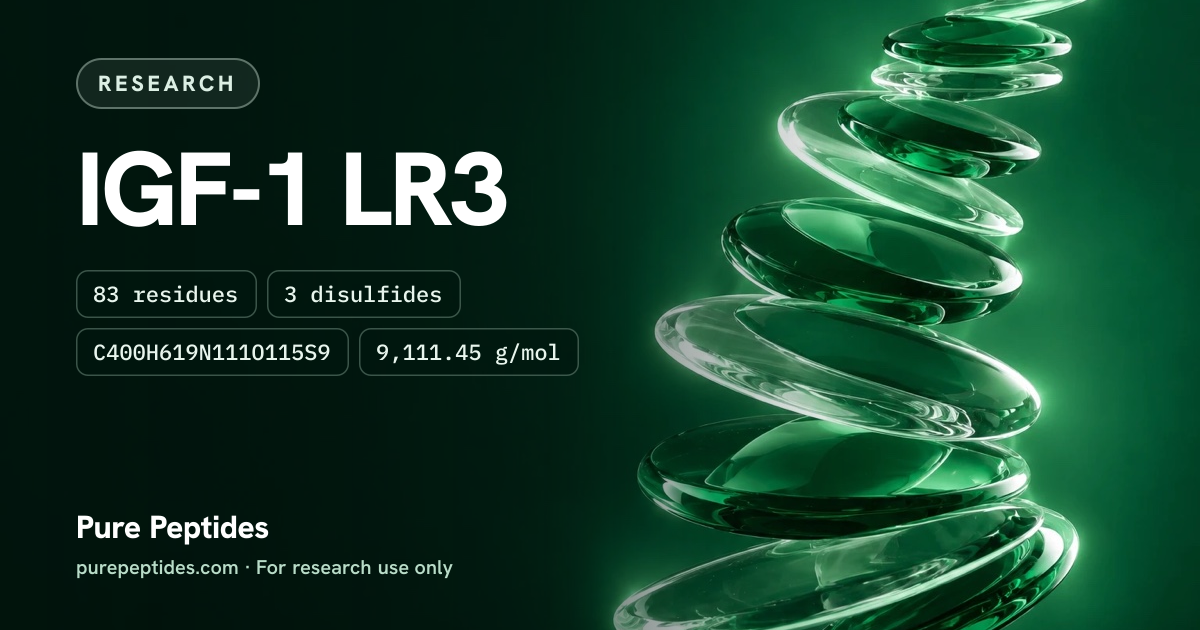
IGF-1 LR3 is an engineered analogue of insulin-like growth factor 1, built as a laboratory reagent. It has a defined structure, a described mechanism, a modest animal literature, and no retrievable record of human administration.

What IGF-1 LR3 is

IGF-1 LR3 is Long [Arg3]-IGF-1, which carries two changes to native human IGF-1.[1] Arginine replaces glutamate at position 3, and a 13-residue N-terminal extension from methionyl porcine growth hormone is added to aid folding and expression yield in E. coli.[1] That extension is a manufacturing feature, not a pharmacological one.

No registry number for IGF-1 LR3 returns a PubChem compound record, which is normal for a protein this size. One circulated number is worse than absent: 946870-92-4 resolves to a cationic lipid, not a protein.[2]

Same receptor, and weaker binding at it

IGF-1 LR3 is not distinguished from IGF-1 by receptor, because it binds the same type 1 IGF receptor. It binds that receptor less well, and rat work recorded it as about threefold weaker there.[3] What the Glu3 substitution changes is affinity for the IGF binding proteins that sequester circulating IGF-1, and the potency difference is attributed to escaping them.[1]

One in vitro result settles it, from the group that built the molecule. In cell lines secreting binding proteins, Long [Arg3]-IGF-1 ranked above native IGF-1 on potency, but in chicken embryo fibroblasts, which secrete none detectably, it was the weaker of the two.[1] The advantage reverses once the binding proteins are gone.

What has been measured, and in what

Everything below is in vitro or animal work, none of it in a person.

In rats made catabolic with dexamethasone, the analogue was about 2.5-fold more potent than IGF-1 at restoring body weight and nitrogen retention.[3] That model carries pathologically elevated binding protein 3, which maximizes the apparent advantage.

Larger animals point the other way. In 55 kg pigs, chronic administration reduced growth rate, depressed food intake, and lowered IGF-1, IGF-2 and binding protein 3, with growth rising only in neonatal pigs.[4] In guinea pigs it raised fractional organ weights without stimulating whole-body growth, and in neonatal calves it lowered both plasma growth hormone and native IGF-1.[5][6]

In pigs and marmosets, the binding-protein-evading variants lowered plasma glucose more potently than IGF-1 and suppressed it far longer.[7] The property marketed as an advantage is what drives that effect.

The half-life claim runs backwards

Half-life and "active window" figures circulate for this compound, and none comes from a human study.[8][9] Every such figure is extrapolated from animal or in vitro work, or invented.

The mechanism also runs the wrong way. IGF-1's plasma residence depends on capture into a large complex with binding protein 3, which this analogue is built to evade. Variants binding those proteins least well clear more rapidly, and what is prolonged in animals is glucose lowering.[7]

Human evidence

There is one human-derived fact about IGF-1 LR3, and it is not about what the compound does.

In 2010, an anti-doping laboratory analyzed a black-market vial sold as IGF-1 Long R3 and found His6-tagged Long-R3-IGF-1 instead.[10] The authors noted that the effects of that research-grade construct in humans have not been described.[10] One vial in one report documents a kind of failure, not a rate.

Everything else is absent. There are no registered interventional trials of IGF-1 LR3, and a 2026 review places it in its lowest evidence tier.[8][9] "No registered interventional trials" is the accurate phrase, and it is not the same claim as never studied.

The nearest human evidence belongs to a different molecule. In a 223-patient randomized trial in type 1 diabetes, recombinant human IGF-1 lowered HbA1c, while higher exposures produced unacceptable edema, jaw pain and worsening retinopathy.[11] Sharing a receptor with an approved medicine names a target rather than a body of evidence.[12]

What the IGF-1 and cancer literature covers

Large observational studies link higher circulating IGF-1 to modestly raised prostate and breast cancer risk.[13][14] A 394,388-participant cohort found raised colorectal, breast, prostate and thyroid risk, alongside reduced ovarian and liver risk.[15]

Those studies measured lifelong endogenous IGF-1 in people who were given nothing, so they are not evidence about IGF-1 LR3. No study has shown this compound raises IGF-1 activity in a human, because none has given it to a human. The literature applies where IGF-1 elevation in people has been shown, as with tesamorelin.[16]

The approved molecule in this family is not a credential for this one

Tesamorelin was approved in the United States in 2010 for reduction of excess abdominal fat in HIV-infected adult patients with lipodystrophy.[16] It never obtained a European authorization: the applicant, Ferrer Internacional S.A., withdrew the application while it was under CHMP review.[17] It was not refused. GHRP-2 has a reported Japanese approval as a diagnostic agent for hypothalamo-pituitary function, unverified from any primary regulatory database.[18] A provocative-test approval is not a therapeutic one.

The approval belongs to the molecule tesamorelin and to one indication. It is not a family credential and must never be written as one. The honest contrast is not that tesamorelin works and the others might too. It is that tesamorelin is the only one of the nine that has been through the process that would let anyone know. IGF-1 LR3 holds no marketing authorization anywhere.

Limitations and research directions

Almost every in vivo result above comes from one Adelaide consortium that commercialized these analogues as reagents, and independent replication is essentially absent.[19] The findings that run against the compound come from those developers themselves.[4][5] IGF-1 analogues are prohibited at all times under Section S2 of the World Anti-Doping Agency Prohibited List.[20] IGF-1 LR3 is for laboratory research use only, not for human consumption.

Frequently Asked Questions

Is IGF-1 LR3 a more powerful version of IGF-1? Not in the sense usually meant, because it binds the same type 1 IGF receptor about threefold less well than IGF-1 does.[3] Its potency in cells depends on evading IGF binding proteins, and in a cell line secreting none detectably it was the weaker of the two.[1]

Has IGF-1 LR3 been given to humans? No administration study is retrievable, there are no registered interventional trials, and a 2026 review places it in its lowest evidence tier.[8][9] The one human-derived finding on record is analytical: a vial sold as IGF-1 Long R3 held a His6-tagged research construct.[10]

What is known about its half-life in humans? Nothing, because no human administration study is retrievable, so every circulating figure is extrapolated from animal or in vitro work, or invented.[8][9] The prolonged effect in pigs and marmosets is glucose lowering, and this type of variant clears from the circulation faster, not slower.[7]


IGF-1 LR3 is available as a research compound, HPLC-verified with a batch-specific COA.

View Product

Certificate of Analysis

Batch PP/IGF/062026 · 99.602% purity by HPLC · certified Aug 2026

Download PDF

References

  1. 1
    Francis GL, Ross M, Ballard FJ, et al. Novel recombinant fusion protein analogues of insulin-like growth factor (IGF)-I indicate the relative importance of IGF-binding protein and receptor binding for enhanced biological potency. J Mol Endocrinol. 1992. doi:10.1677/jme.0.0080213. PMID 1378742.
  2. 2
    PubChem Compound database (NIH/NLM). Query by CAS string 946870-92-4 returns CID 168009904, C80H154N4O6S2, molecular weight 1332.2. Queried 27 August 2026.
  3. 3
    Tomas FM, Knowles SE, Owens PC, et al. Insulin-like growth factor-I (IGF-I) and especially IGF-I variants are anabolic in dexamethasone-treated rats. Biochem J. 1992. doi:10.1042/bj2820091. PMID 1371669.
  4. 4
    Walton PE, Dunshea FR, Ballard FJ. In vivo actions of IGF analogues with poor affinities for IGFBPs: metabolic and growth effects in pigs of different ages and GH responsiveness. Prog Growth Factor Res. 1995. Review. doi:10.1016/0955-2235(95)00007-0. PMID 8817682.
  5. 5
    Conlon MA, Tomas FM, Owens PC, et al. Long R3 insulin-like growth factor-I (IGF-I) infusion stimulates organ growth but reduces plasma IGF-I, IGF-II and IGF binding protein concentrations in the guinea pig. J Endocrinol. 1995. doi:10.1677/joe.0.1460247. PMID 7561636.
  6. 6
    Hammon H, Blum JW. The somatotropic axis in neonatal calves can be modulated by nutrition, growth hormone, and Long-R3-IGF-I. Am J Physiol. 1997. doi:10.1152/ajpendo.1997.273.1.E130. PMID 9252489.
  7. 7
    Tomas FM, Walton PE, Dunshea FR, Ballard FJ. IGF-I variants which bind poorly to IGF-binding proteins show more potent and prolonged hypoglycaemic action than native IGF-I in pigs and marmoset monkeys. J Endocrinol. 1997. doi:10.1677/joe.0.1550377. PMID 9415072.
  8. 8
    Per-compound registry searches for IGF-1 LR3. ClinicalTrials.gov API v2, query.intr and query.term for "IGF-1 LR3" and "LR3-IGF-1", both returning zero studies. Run 27 August 2026.
  9. 9
    Dominikowski A, et al. The emerging landscape of performance-enhancing peptides modulating GH-IGF1 axis: bridging the gap between clinical evidence and patient self-administration. Front Endocrinol (Lausanne). 2026;17:1822475. Review. doi:10.3389/fendo.2026.1822475. PMID 42395176.
  10. 10
    Kohler M, Thomas A, Walpurgis K, Terlouw K, Schaenzer W, Thevis M. Detection of His-tagged Long-R3-IGF-I in a black market product. Growth Horm IGF Res. 2010;20(5):386-90. doi:10.1016/j.ghir.2010.07.001. PMID 20675162.
  11. 11
    Thrailkill KM, Quattrin T, Baker L, et al (RhIGF-I in IDDM Study Group). Cotherapy with recombinant human insulin-like growth factor I and insulin improves glycemic control in type 1 diabetes. Diabetes Care. 1999. doi:10.2337/diacare.22.4.585. PMID 10189536.
  12. 12
    US Food and Drug Administration. Approved application record for mecasermin, the recombinant human IGF-1 product, confirming an approval exists for that molecule. Retrieved from Drugs@FDA via the openFDA drug application endpoint, 27 August 2026.
  13. 13
    Renehan AG, Zwahlen M, Minder C, O'Dwyer ST, Shalet SM, Egger M. Insulin-like growth factor (IGF)-I, IGF binding protein-3, and cancer risk: systematic review and meta-regression analysis. Lancet. 2004. doi:10.1016/S0140-6736(04)16044-3. PMID 15110491. Pooled analysis, including case-control studies.
  14. 14
    Endogenous Hormones and Breast Cancer Collaborative Group (Key TJ, first named author). Insulin-like growth factor 1 (IGF1), IGF binding protein 3 (IGFBP3), and breast cancer risk: pooled individual data analysis of 17 prospective studies. Lancet Oncol. 2010. doi:10.1016/S1470-2045(10)70095-4. PMID 20472501.
  15. 15
    Knuppel A, Fensom GK, Watts EL, et al. Circulating insulin-like growth factor-I concentrations and risk of 30 cancers: prospective analyses in UK Biobank. Cancer Res. 2020. doi:10.1158/0008-5472.CAN-20-1281. PMID 32709735.
  16. 16
    US Food and Drug Administration. Regulatory record and approved prescribing information for tesamorelin (original approval 10 November 2010; labeling current 2026, including the IGF-1 elevation and neoplasm sections). Retrieved from Drugs@FDA and the openFDA drug label endpoint, 27 August 2026.
  17. 17
    European Medicines Agency, Committee for Medicinal Products for Human Use. Withdrawn marketing authorisation application for tesamorelin, withdrawn by the applicant, Ferrer Internacional S.A., on 21 June 2012. EMA withdrawn-applications record.
  18. 18
    Pralmorelin: GHRP 2, GPA 748, growth hormone-releasing peptide 2, KP-102 D, KP-102 LN, KP-102D, KP-102LN. Drugs R D. 2004;5(4):236-9. PMID 15230633. Adis drug profile, no named author; the profile records pralmorelin as awaiting approval in Japan as a diagnostic agent for hypothalamo-pituitary function.
  19. 19
    Affiliation audit of the cited in vivo IGF-1 analogue literature. PubMed E-utilities efetch across the cited PMIDs; all carry affiliations from one Adelaide consortium (CSIRO Division of Human Nutrition, University of Adelaide, CRC for Tissue Growth and Repair, Child Health Research Institute). Run 27 August 2026.
  20. 20
    World Anti-Doping Agency. The 2026 Prohibited List, International Standard, Section S2 (Peptide Hormones, Growth Factors, Related Substances, and Mimetics), which covers IGF-1 and its analogues. In force 1 January 2026.

Related Research

Bioregulator Research

Tesamorelin Research

An evidence-led review of tesamorelin research: what its approval covers and what it does not, and what the human trials actually found.

August 27, 2026
Read More
Bioregulator Research

MGF Research

An evidence-led review of MGF research: what the splice variant is, its contested receptor and laboratory record, and the state of the human evidence.

August 27, 2026
Read More
Bioregulator Research

IGF-1 DES Research

An evidence-led review of IGF-1 DES research: the same receptor as IGF-1 but different binding-protein behaviour, what has been measured, and in what.

August 27, 2026
Read More
Bioregulator Research

HGH Fragment 176-191 Research

An evidence-led review of HGH Fragment 176-191 research: which molecule the work was actually done on, the animal findings, and the human evidence.

August 27, 2026
Read More
Bioregulator Research

Hexarelin Research

An evidence-led review of Hexarelin research: two receptors rather than one, desensitization on repeated dosing, and the human and rat cardiac findings.

August 27, 2026
Read More
Bioregulator Research

GHRP-6 Research

An evidence-led review of GHRP-6 research: its receptor and pathway, what has been measured in humans, and the cortisol and prolactin question.

August 27, 2026
Read More

Your Cart

Your cart is empty

Add some research compounds to get started.

Browse Products