
Published · 6 references
Kisspeptin-10 vs PT-141
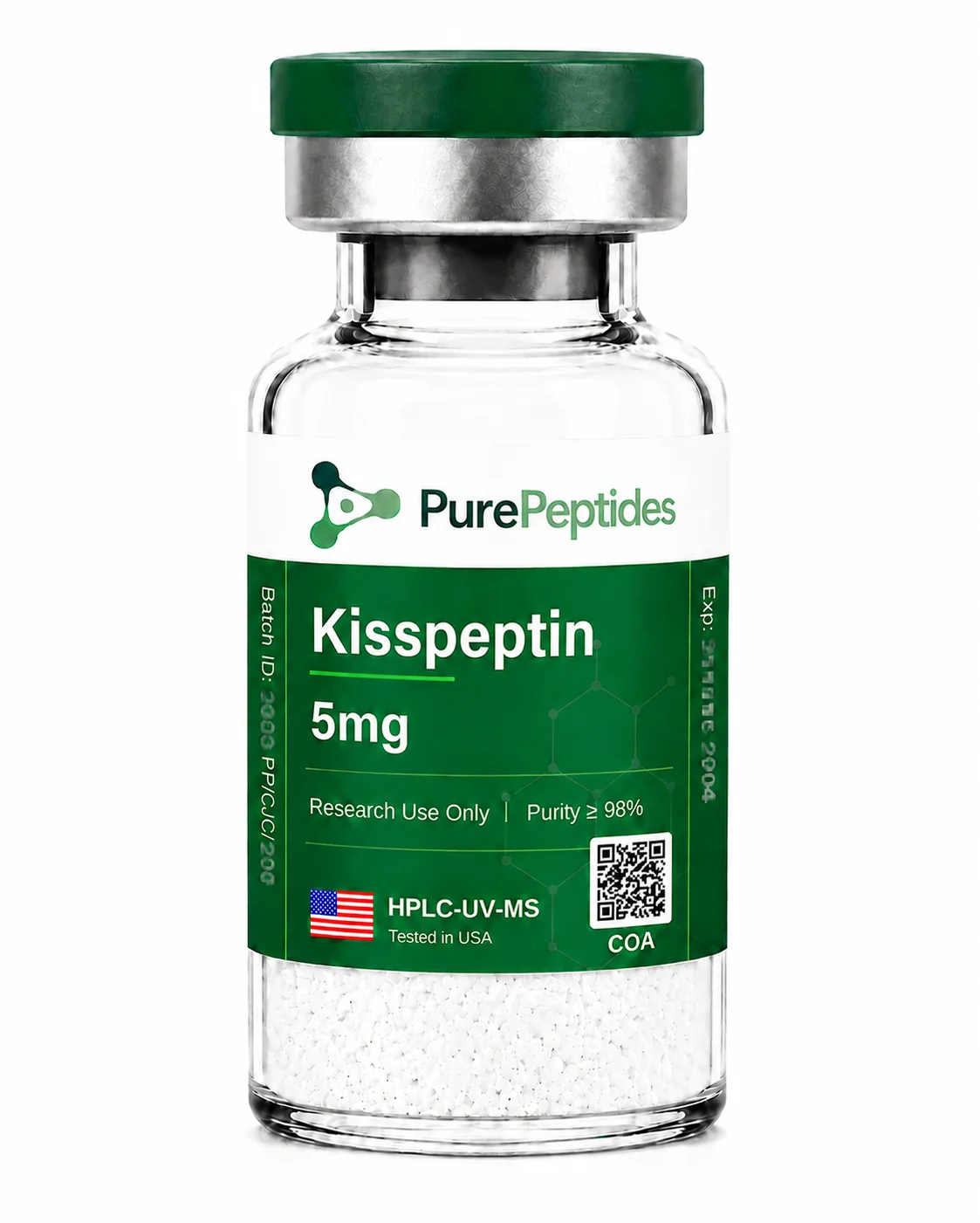
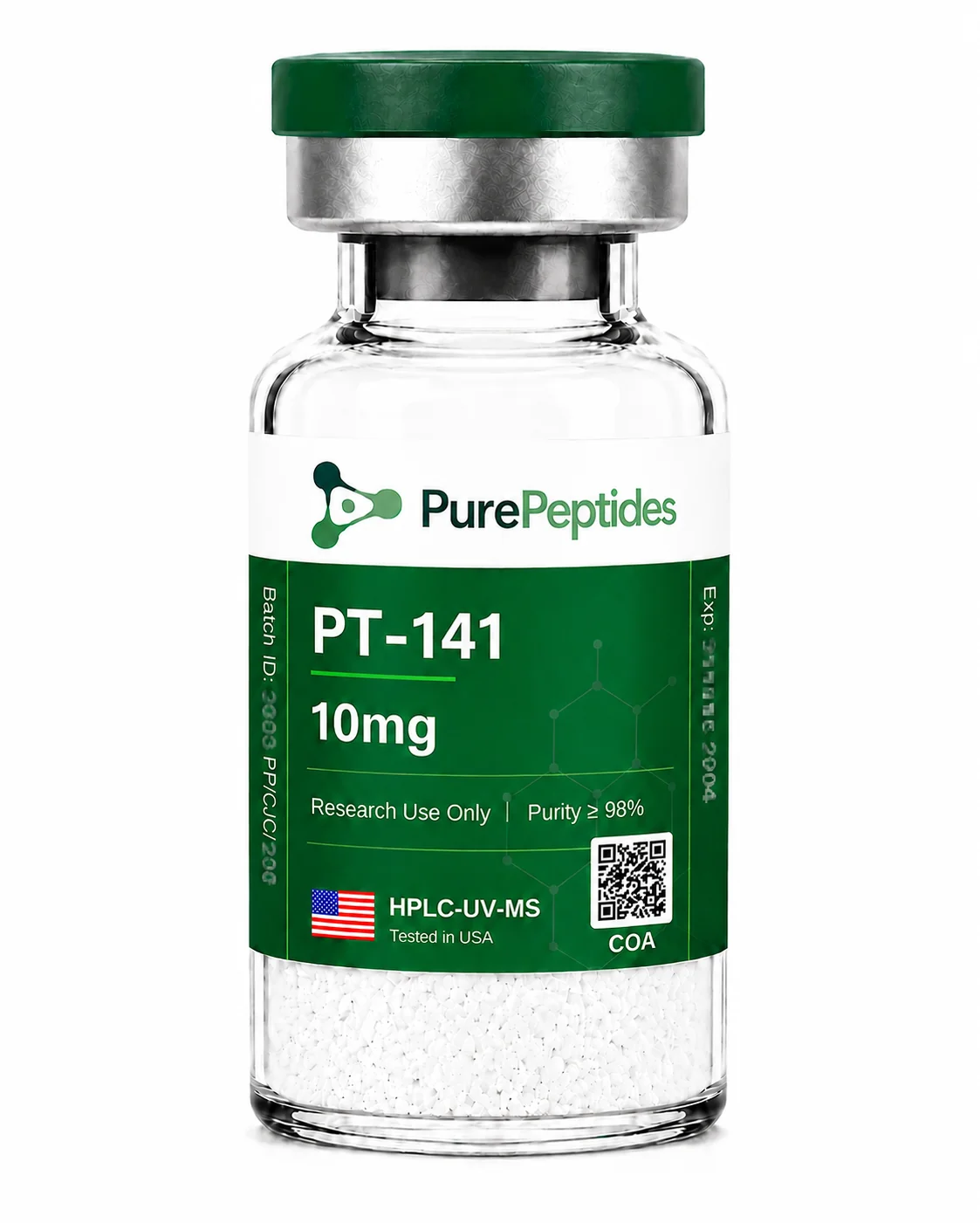
Kisspeptin-10 and PT-141 are different molecules: Kisspeptin-10 is a ten-residue fragment of the human KISS1 gene product, and PT-141 is bremelanotide, a seven-residue cyclic peptide.
Structure at a glance
Kisspeptin-10 · 10 residues
PT-141 · 7 residues
Ac: N-terminal acetyl group. NH2: C-terminal amide. A raised D marks a D-amino acid. Nle: norleucine. Bracket above: residues joined in a ring. Codes are three-letter amino acid codes.
Drawn from the product database. Each measure's bars share one scale.
| Property | Kisspeptin-10 | PT-141 |
|---|---|---|
| What it is | A synthetic ten-residue fragment of the human KISS1 gene product, corresponding to residues 112 to 121 of its precursor. | Bremelanotide: a synthetic cyclic heptapeptide lactam and analog of alpha-melanocyte-stimulating hormone, derived from Melanotan II. |
| How they relate | Different molecules from different parents. Kisspeptin-10 corresponds to residues 112 to 121 of the human KISS1 precursor. PT-141 is bremelanotide, derived from Melanotan II. | |
| CAS number | 374675-21-5 | 189691-06-3 |
| Molecular formula | C63H83N17O14 | C50H68N14O10 |
| Molecular weight | 1,302.44 g/mol | 1,025.17 g/mol |
| Sequence | Tyr-Asn-Trp-Asn-Ser-Phe-Gly-Leu-Arg-Phe-NH2 | Ac-Nle-cyclo[Asp-His-D-Phe-Arg-Trp-Lys] |
| Evidence base | Human research consists almost entirely of small physiological studies.[1][2][3] The largest study identified that tested Kisspeptin-10 in people enrolled 46 healthy volunteers.[4] | Two phase 3 trials randomized 1,267 participants and supported an approval for one indication. The pivotal publications name employees of the two companies that funded them as authors. In the literature reviewed for PT-141, no sponsor-independent replication of those trials was identified. |
| Regulatory status | The FDA has not approved Kisspeptin-10 for human use. | Bremelanotide acetate is the active ingredient of a prescription medicine sold under another name.[5] The material supplied here is a research-grade preparation, is not that medicine, and holds no marketing authorization. That medicine holds a current US approval for one therapeutic indication. |
| Compared head-to-head? | No direct comparison found in PubMed (searched October 2026).[6] | |
| Handling difference | Neither contains sulfur; each has an oxidizable tryptophan. Kisspeptin-10 has two asparagines that can deamidate. PT-141 has none; its specific route, ring opening, is slow near neutral pH, and tryptophan oxidation is likelier in practice. | |
How Kisspeptin-10 and PT-141 differ
Kisspeptin-10 and PT-141 are different molecules from different parents. Kisspeptin-10 is a synthetic ten-residue peptide, a fragment of the human KISS1 gene product. It corresponds to residues 112 to 121 of the KISS1 precursor. PT-141 is bremelanotide, a synthetic cyclic peptide of seven residues and an analog of alpha-melanocyte-stimulating hormone. It was made from Melanotan II by changing one chemical group.
The name kisspeptin covers at least four molecules of different lengths, and results for one are not results for another. Human research on Kisspeptin-10 itself consists almost entirely of small physiological studies.[1][2][3] The largest study identified that tested Kisspeptin-10 in people enrolled 46 healthy volunteers.[4]
The two phase 3 trials reviewed for PT-141 tested bremelanotide and randomized 1,267 participants. Both pivotal publications name employees of the two companies that funded them as authors. The searches behind the literature reviewed for PT-141, run in PubMed and ClinicalTrials.gov on 2 October 2026, identified no sponsor-independent replication of those trials.
The FDA has not approved Kisspeptin-10 for human use. Bremelanotide acetate is the active ingredient of a prescription medicine sold under another name.[5] The material supplied here is a research-grade preparation, is not that medicine, and holds no marketing authorization. That medicine holds a current US approval for one therapeutic indication.
Kisspeptin-10 has a free N-terminal amine and a C-terminal amide. PT-141 carries an N-terminal acetyl group and ends in a free acid, and six of its seven residues form a ring closed by an amide bond. Neither contains sulfur, and each contains a tryptophan, which can oxidize on exposure to air and light. Kisspeptin-10 has two asparagines, each a site of deamidation. PT-141 contains no asparagine or glutamine, so the usual deamidation sites are absent. PT-141's specific degradation route is ring opening, an amide hydrolysis that is slow near neutral pH; in practice, tryptophan oxidation is more likely.
Have Kisspeptin-10 and PT-141 been compared directly?
No direct comparison of Kisspeptin-10 with PT-141 was found in a PubMed search run in October 2026.[6] That search covers PubMed only.
Read more on each compound
Kisspeptin-10
Frequently Asked Questions
Is Kisspeptin-10 the same as PT-141?+−
Kisspeptin-10 and PT-141 are different molecules from different parents. Kisspeptin-10 is a synthetic ten-residue fragment of the human KISS1 gene product. PT-141 is bremelanotide, a synthetic seven-residue cyclic peptide made from Melanotan II.
Is Kisspeptin-10 or PT-141 approved?+−
The FDA has not approved Kisspeptin-10 for human use; PT-141 is bremelanotide, and bremelanotide acetate is the active ingredient of a prescription medicine sold under another name. The material supplied here is a research-grade preparation, is not that medicine, and holds no marketing authorization. That medicine holds a current US approval for one therapeutic indication.
References
- 5US Food and Drug Administration, Drugs@FDA. Approval record whose active ingredient is bremelanotide acetate; marketing status Prescription. Retrieved via api.fda.gov/drug/drugsfda.json on products.active_ingredients.name "BREMELANOTIDE ACETATE", 3 October 2026; one record returned.
- 6PubMed search via NCBI E-utilities, run 3 October 2026; records entered to 2 October 2026. Query: ("kisspeptin-10"[tiab] OR "kisspeptin 10"[tiab] OR "kisspeptin10"[tiab] OR "KP-10"[tiab] OR "KP10"[tiab] OR "metastin 45-54"[tiab] OR "metastin(45-54)"[tiab] OR "kisspeptin 112-121"[tiab] OR "kisspeptin-(112-121)"[tiab]) AND ("PT-141"[tiab] OR "PT141"[tiab] OR "PT 141"[tiab] OR "bremelanotide"[tiab]) AND ("1800/01/01"[edat] : "2026/10/02"[edat]). 0 records; none was a direct comparison of the two compounds.
Related comparisons
Melanotan II vs PT-141
Melanotan II and PT-141 are not the same molecule: they carry the identical lactam ring but differ at the C-terminus.
Read Comparison