
Kisspeptin-10 Research Peptide
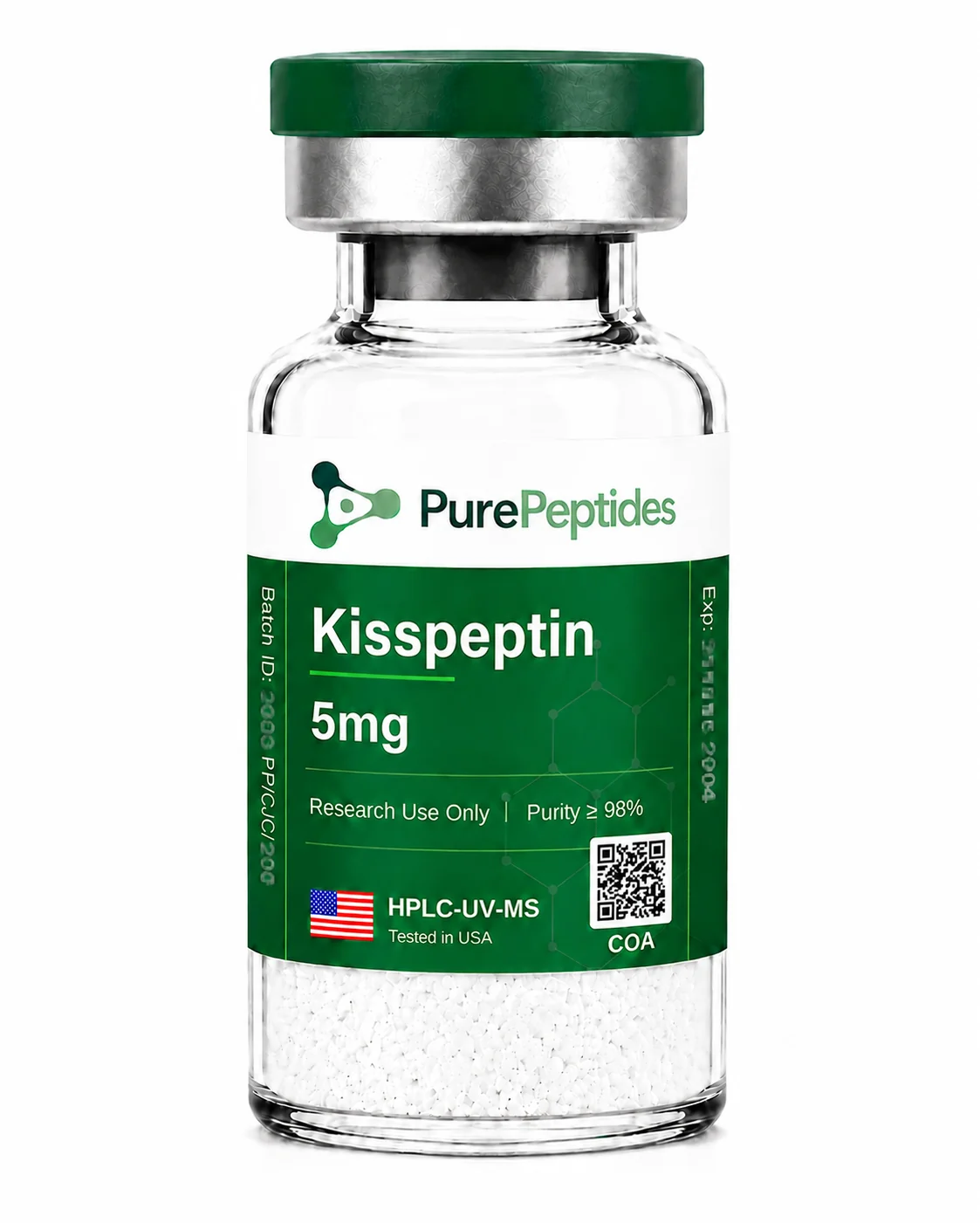
Kisspeptin-10 is a peptide of ten residues.
- Purity
- >99%
- Dispatch
- Dispatched next business day with cold-chain delivery
- Cold chain
- Temperature-controlled packaging from lab to door
- Certificate
- Certificate of Analysis available on request for this batch
Multi-vial Discount Available
Select Size
Ships Next Day
Orders confirmed before 12pm EST ship the same business day; orders after 12pm EST ship the next business day. Monday to Friday.
Quality Guaranteed
Every batch is HPLC-tested to >99% purity. Certificate of Analysis available on request; MSDS available on request.
Certificate of Analysis Available on Request
Request this batch's certificate using your order number.
What is Kisspeptin-10?
Kisspeptin-10 is a peptide of ten residues. The KISS1 gene makes a larger protein. This is the shortest piece of it that still switches on that protein's receptor. The receptor is written KISS1R or GPR54. The name kisspeptin covers at least four molecules. They are 54, 14, 13 and 10 residues long. Results for one are not results for another. This product is the 10.
Technical Specs
Labeled quantity is net peptide content, not gross salt weight.
Kisspeptin-10 Research & Reference
What Kisspeptin-10 does in published studies, and how to work with it in the laboratory, are covered in full on two dedicated pages rather than summarised here, so neither the evidence nor the handling detail is cut short.
Safety Data Sheet
The safety data sheet for Kisspeptin-10 is below as a PDF, in the 16-section GHS format covering identification, hazards, handling, storage and disposal.
Frequently Asked Questions
Is Kisspeptin-10 independently tested for purity?+−
Yes. Every batch of Kisspeptin-10 is tested by an independent third-party laboratory using HPLC and MS-UPLC, confirming purity and mass identity before the batch is released. Pure Peptides does not test its own material.
What does "Research Use Only" mean?+−
It means Kisspeptin-10 is supplied for in-vitro laboratory research and for no other purpose, and must not be administered to humans or animals. Kisspeptin-10 is legal to purchase in the United States for in vitro and non-clinical laboratory research. It has no FDA approval and no approved human use. No approved product containing this peptide was located. Kisspeptin-10 is not a scheduled substance under the Controlled Substances Act. Sold strictly for qualified research use, not human or veterinary administration.
How is Kisspeptin-10 shipped and stored?+−
Kisspeptin-10 ships from US stock with cold-chain packaging and full tracking; orders placed before noon EST on business days are typically dispatched the same business day. On arrival, store the lyophilized powder at -20°C or below, dry and protected from light.
Which kisspeptin is this?+−
Kisspeptin-10, the ten-residue C-terminal form, also indexed as human metastin 45-54. The KISS1 gene product yields several peptides, of which the 54-, 14-, 13- and 10-residue forms are the ones commonly studied. They are different molecules with different lengths and different half-lives. Published work usually specifies which was used, and where it does not, the result cannot safely be attributed to any one of them.
Do published results for kisspeptin-54 apply to kisspeptin-10?+−
Not automatically, and one study tested exactly that question. A 2015 study gave healthy men kisspeptin-10, kisspeptin-54 and gonadotrophin-releasing hormone intravenously on separate days and compared them directly. At the doses tested, the two kisspeptin isoforms produced similar gonadotrophin levels as each other, and both produced substantially less than gonadotrophin-releasing hormone did. Its authors name small sample size as a limitation. That is one measurement in one study, and it is not a license to move other results between the isoforms.
What happens on repeated exposure?+−
It depends on the spacing, and this is one of the better-documented features of the system. In female rats, continuous infusion of kisspeptin-10 caused luteinising hormone responses to fade while follicle-stimulating hormone responses persisted, with the pituitary's own response to gonadotrophin-releasing hormone preserved throughout. In healthy men, five days of continuous subcutaneous infusion left gonadotrophin concentrations no different from vehicle, whereas eight-hour daily infusions over twelve days sustained the increase, and a bolus afterwards still produced a response.
Related Compounds
 >99%
>99% >99%
>99% >99%
>99% >99%
>99% >99%
>99% >99%
>99% >99%
>99% >99%
>99%