
Tissue Repair ResearchRead Research →
Thymosin Beta-4 Research
Thymosin beta-4 (timbetasin) is the 43-residue parent of TB-500, not the same molecule. Review of its Phase 3 record, nulls and conflicts.
August 28, 2026
Shop by category
Growth Hormone Axis ResearchRegeneration ResearchPeptide BioregulatorsCognitive & Neuropeptide ResearchMetabolic & Cellular ResearchMelanocortin & Endocrine ResearchDermal Peptide ResearchImmune & Thymic ResearchResearch & info
Research HubReference LibraryEducationCompareBlogCOAsContactAboutFAQCalculatorGlossary
Reviewed by Dr. Martina Rossi, PhD
Scientific Contributor and Reviewer · Reviewed
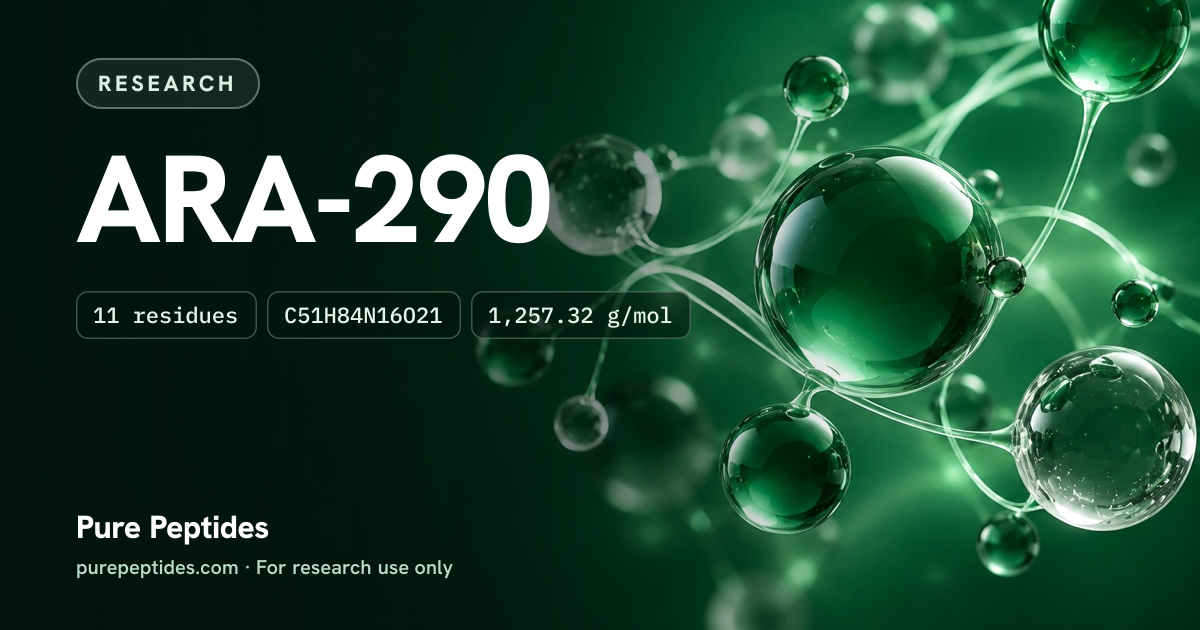
ARA-290 is a synthetic 11-amino-acid peptide, and cibinetide and pHBSP are two further names for the same molecule [16]. PubChem resolves each of those names, and the CAS number 1208243-50-8, to the same record, CID 91810664 [16]. The sequence is pyroGlu-Glu-Gln-Leu-Glu-Arg-Ala-Leu-Asn-Ser-Ser, the formula is C51H84N16O21, and the molecular weight is 1257.3 [16].
That sequence copies the water-facing residues of helix B of human erythropoietin [5][16]. The peptide was engineered to keep erythropoietin's tissue-protective signaling and to lose its blood-forming activity, which is the entire design intent of the molecule [6]. (human) In the first randomized trial, hemoglobin was unchanged in both the active and placebo arms [1]. Erythropoietin's own efficacy and safety record therefore does not transfer to this peptide in either direction. Neither does the approval history of peginesatide, a separate approved-then-discontinued erythropoietin-mimetic peptide that shares no sequence with it.
ARA-290 is usually described as an agonist of the innate repair receptor, a proposed heteromer of the erythropoietin receptor and the beta-common receptor [12]. That proposal is not settled.
(animal) In mice lacking the beta-common receptor gene, ARA-290 lost its long-term effect on neuropathic pain, while normal mice responded [9]. That is pharmacological evidence for receptor dependence.
(in vitro) A biophysical study examined the extracellular regions of both receptors directly, with and without ARA-290 present, and found that they do not specifically associate [10]. That result is hedged in the paper itself, because the same authors report that their computational and genomic work had suggested a possible interaction [10]. Only the biophysical analysis was negative [10]. The same authors state that no biophysical evidence confirms a direct association of the receptors [10]. (animal) They also found no requirement for the beta-common receptor in mice under anemic stress [10]. That paper carries an author correction limited to a figure label, and its conclusion is untouched [10].
The receptor-dependence evidence is genetic and pharmacological, while the direct structural evidence argues against a physical heteromer [9][10]. The innate repair receptor is therefore a proposed model, not an established structure.
Animal and cell work spans kidney injury, brain injury and metabolic disease [13][14][15]. Two prominent papers in that set have been retracted [13][14].
(animal) A paper reporting that delayed pHBSP attenuated acute kidney injury was retracted in February 2026 [13]. The retraction note cites image concerns, and states that the editor no longer has confidence in the presented data [13]. Its author list includes the compound's originators [13].
(animal) A mouse paper reporting reduced susceptibility to diet-induced insulin resistance was retracted in March 2024 [14]. That is the preclinical support for the metabolic finding described below [14].
(animal) A frequently cited paper titled as treatment of mild traumatic brain injury studied 64 rats, not patients [15]. No human trial of this compound in traumatic brain injury exists.
Four randomized placebo-controlled trials in patients have been published, enrolling 22, 38, 49 and 64 people [1][2][5][3]. One randomized trial in 36 healthy volunteers and one terminated 9-patient open-label study complete the record [6][7]. Roughly 218 people were enrolled across all six published studies. Only one of those four randomized trials was industry-sponsored and registered on ClinicalTrials.gov [4]. The other three were investigator-initiated and registered on Dutch and European registries [1][2][5].
(human) In the 22-patient pilot, the small fiber neuropathy screening list score separated from placebo, changing -11.5 against -2.9 (P<0.05) [1]. Pain and fatigue scores improved significantly but equivalently in both arms [1]. Depression scores did not move [1].
(human) The 38-patient trial missed its pre-specified structural primary endpoints [2]. Intraepidermal nerve fiber density did not change significantly in either arm at either biopsy site, and retinal thickness and visual acuity also did not change [2]. The corneal nerve fiber area result the paper headlines is a within-group test against baseline in the treated arm, with no between-group test reported [2]. The screening list score did separate from placebo, changing -12.2 against -3.8 (P=0.005), while Brief Pain Inventory pain intensity showed no between-group difference [2]. Two other secondary measures did separate from placebo, as Brief Pain Inventory pain interference reached P<0.02 and six-minute walk distance rose 18.7 meters against a fall of 15.1 meters (P=0.049) [2]. In a later review, the trial's own senior author summarized the result as regrowth of small nerve fibers in the cornea but not in the epidermis [12]. An erratum states that an arithmetical error made that paper's reported corneal nerve fiber area values too small [2].
(human) The 64-patient phase 2b was randomized, quadruple-masked, placebo-controlled and run at two centers [3][4]. Its primary endpoint was change in corneal nerve fiber area at day 28, and three dose levels were compared against placebo [3]. Only the middle level met that endpoint, with a placebo-corrected mean change of 697 (95% CI 159 to 1236; P=0.012) [3]. The lowest and highest levels both returned confidence intervals crossing zero, and the highest level produced a smaller effect than the middle one [3]. No multiplicity adjustment is described for three comparisons on one primary endpoint [3]. (human) A second nerve measure moved as well, as intraepidermal GAP-43+ regenerating fibers rose in the middle-dose group (P=0.035) [3].
(human) The posted registry results add outcomes the paper does not foreground [4]. Intraepidermal nerve fiber density, the standard structural measure for this condition, favored placebo at +0.8 fibers/mm against +0.5, +0.4 and -0.3 in the active arms [4]. That has to be reconciled with the paper's conclusion that nerve fiber abundance increased in the cornea and skin [3]. The skin half of that conclusion rests on the GAP-43+ regenerating-fiber count, not on total intraepidermal nerve fiber density [3][4]. The two measures are different, and the total count did not favor the treated arms [3][4]. All five patient-reported measures were indistinguishable from placebo [4]. Brief Pain Inventory interference changed -1.657 against -1.732, and fatigue -2.1 against -2.2, both marginally favoring placebo [4]. On the other three the active arms were numerically ahead [4]. The screening list score changed -8.7 in the best active arm against -7.3, the neuropathic pain symptom inventory -14.50 against -12.88, and Brief Pain Inventory pain severity -1.167 against -0.922 [4]. One secondary favored the active arms, as six-minute walk distance rose 19.3, 17.7 and 18.2 meters against 1.2 meters on placebo [4]. No statistical analyses are posted with any of these registry outcomes [4].
(human) Pain intensity has not separated from placebo in any of the three sarcoidosis trials [1][2][3]. The phase 2b paper reports that pain improved significantly in all groups, placebo included [3]. In the moderate-to-severe pain subgroup, the placebo-corrected decrease carried P=0.157 [3].
(human) One trial in 48 analyzed patients with type 2 diabetes and painful neuropathy is the only diabetic-neuropathy dataset for this molecule [5]. Three of its four metabolic endpoints separated from placebo [5]. HbA1c fell 0.16% at day 28 and 0.21% at day 56, against -0.01% and +0.21% on placebo (P=0.002) [5]. The total-cholesterol-to-HDL ratio and triglycerides also separated (P=0.039 and P=0.043) [5]. HDL alone did not (P=0.066) [5]. That metabolic result stands on one trial, and its supporting preclinical paper has been retracted [5][14]. A second registered trial of metabolic endpoints, in prediabetes and drug-naive type 2 diabetes, has never reported [21].
(human) The neuropathy endpoints were mostly null [5]. The screening list score did not change significantly from baseline in either group, and quantitative sensory testing showed no significant differences after treatment [5]. Neuropathic pain inventory scores improved about 20% in both arms at day 28, and neither group remained significantly improved at day 56 [5]. Corneal nerve fiber density was not significant overall, and the significant result comes from a post-hoc subgroup [5]. PainDetect was the one neuropathy measure to separate, improving 3.3 against 1.1 points (P=0.037) [5]. Many of the statistics this paper reports are within-group tests against baseline rather than comparisons with placebo [5].
(human) A randomized double-blind trial in 36 healthy volunteers tested for an antidepressant-like profile and was negative [6]. No effects were observed on mood or affective symptoms [6]. Treated participants showed lower neural responses to happy faces, and tended to recognize happy and disgust expressions less well [6]. The authors conclude that the direction and strength of the effects do not unequivocally support an antidepressant-like profile [6].
(human) A 9-patient open-label phase 2 in diabetic macular edema was negative on every objective outcome [7]. Visual acuity fell 2.9 letters, central retinal thickness rose 10 microns, retinal sensitivity fell 0.53 dB and tear production fell 0.13 mm [7]. Only a vision questionnaire score rose, by 2.7 points [7]. The registry records the trial as terminated, with the stated reason that the study drug expired and no replacement was available [20].
(human) The strongest and most repeated between-group signal is the screening list score, which separated from placebo in both small sarcoidosis trials by roughly 8 points each time [1][2]. The phase 2b was the only attempt to confirm that in a larger sample [4]. There the gap was 1.4 points, and the separation was not reproduced [4].
No meta-analysis or pooled effect estimate for ARA-290 exists. One independent systematic review has formally appraised its fatigue data [8]. In that review, Atkins and Wilson evaluated six interventions for sarcoidosis-associated fatigue, including ARA-290, using risk-of-bias assessment [8]. Their list of interventions with supporting evidence names anti-TNF-alpha therapies and neurostimulants, and excludes ARA-290 [8]. They state that there was no evidence that ARA-290 improved fatigue scores [8]. They qualify that finding in the same breath, noting the trial was not powered for fatigue and was very short [8]. They also record that baseline fatigue was imbalanced, at a mean Fatigue Assessment Scale score of 37.9 on ARA-290 against 33.6 on placebo [8]. Fatigue then fell identically in both arms across the four-week trial [8]. The review's wider caution applies too, as risk of bias was high in five of its eight included studies [8]. The authors declared no conflicts of interest [8].
Conflicts of interest inside this literature are extensive. The compound's originators, who are principals of the developing company, authored the 38-patient sarcoidosis trial and the diabetes trial, and their company sponsored the phase 2b [2][3][5]. They also authored the imaging paper that validates the corneal endpoint on which the phase 2b's primary outcome rests, which is a methodology paper and not efficacy evidence [11]. No unaffiliated group has replicated any human efficacy finding.
ARA-290 holds no marketing approval in the United States or the European Union, for any indication [17][18][19]. Field-qualified openFDA queries on substance name and generic name return no approval record, no label and no listed drug code [19].
The EU register carries two orphan designations. EU/3/13/1191 was granted on 7 October 2013 for treatment of sarcoidosis [17]. EU/3/16/1721 was granted on 29 August 2016 for prevention of graft loss in pancreatic islet transplantation [18]. Both were granted to a United Kingdom entity, and both transferred to an Irish sponsor in April 2019 [17][18]. Both read designation status positive [17][18]. An orphan designation is not a marketing authorization, and no marketing application has followed either one [17][18].
US orphan and Fast Track designations are asserted in a 2017 company press release [23]. FDA's orphan drug database confirms four US orphan designations for this sequence, all held by the developing company: prevention of delayed graft function after kidney transplant (2009), neuropathic pain in sarcoidosis (2011), and sarcoidosis and pancreatic islet transplantation (both 2016) [24]. No public FDA record of the Fast Track was located, so it remains sponsor-asserted. A designation and a Fast Track are not approvals in any case.
No trial registered on ClinicalTrials.gov has started since 2016. Exactly four cibinetide studies are registered there, none of them phase 3 [4][6][20][21]. A registered phase 2 in prediabetes and type 2 diabetes still reads status unknown, with no posted results and no located publication [21]. The most recent trial was terminated because the study drug expired and could not be replaced [20].
The safety record means no signal detected, not safety demonstrated. The longest human exposure in any trial was 12 weeks, in 9 patients [7]. (human) The diabetes trial recorded four serious adverse events in the active arm, two of them judged possibly related [5]. The reported events include a worsening of borderline renal insufficiency that did not recover, and a fatal myocardial infarction judged unrelated to treatment [5]. (human) In the phase 2b, serious treatment-emergent events occurred in 2 of 16 in the lowest-dose arm and 1 of 14 in the highest-dose arm, against 0 of 16 on placebo [4]. The single event in the highest-dose arm was suicidal ideation [4]. The two affected participants in the lowest-dose arm reported syncope, headache, chest tightness, shortness of breath and small bowel enteritis [4]. Anti-drug antibodies were not detected in the two trials that report the result [5][7]. Nothing is known beyond three months of exposure.
Every published trial in a patient population enrolled people with sarcoidosis-associated small fiber neuropathy, type 2 diabetes with painful neuropathy, or diabetic macular edema [1][2][3][5][7]. The neuropathy diagnoses were confirmed by biopsy or by formal criteria before enrollment [1][2][3][5]. The one remaining published study enrolled healthy volunteers [6]. No trial has tested recovery, general inflammation, injury healing, longevity or athletic contexts. All human administration was by injection, and no human data exist for any other route [1][2][3][5][6][7]. Separately, a sports drug testing methods paper lists ARA-290 among peptides under 2 kDa that are covered by the World Anti-Doping Agency list of prohibited substances [22]. That paper presents a urine screening assay for those peptides [22].
ARA-290 carries a genuine registered clinical program, which is unusual for a research peptide. Read closely, that program is also mostly negative. The 38-patient trial missed its pre-specified structural primary endpoints [2]. The phase 2b met its corneal primary at only one of three dose levels, while the skin-biopsy nerve measure favored placebo [3][4]. Pain intensity did not beat placebo in any of the three sarcoidosis trials [1][2][3]. Its one confirmatory attempt did not reproduce the record's strongest signal [4]. The one independent systematic review to appraise its fatigue data found no evidence of a benefit [8]. That review qualified the finding, noting the trial was not powered for fatigue and was very short [8]. No phase 3 has been registered on ClinicalTrials.gov, and no trial registered there has started since 2016.
Yes. ARA-290, cibinetide and pHBSP are three names for one molecule. PubChem resolves each of those names, and the CAS number 1208243-50-8, to the same record, CID 91810664.
It does not transfer in either direction. ARA-290 was engineered to lose erythropoietin's blood-forming activity, and hemoglobin was unchanged in both arms of the first randomized trial. ARA-290 has its own, much smaller, evidence base, and it holds no US or EU marketing approval.
No unaffiliated group has replicated any human efficacy finding. The strongest repeated signal, the small fiber neuropathy screening list score, separated from placebo in the two small sarcoidosis trials. The larger phase 2b did not reproduce that separation.
No marketing approval was found in US or EU records, for any indication. The EU register carries two orphan designations, EU/3/13/1191 and EU/3/16/1721, both with status positive. An orphan designation is not a marketing authorization.
References

Reviewed for scientific accuracy
Dr. Martina Rossi, PhD
PhD, Université Grenoble Alpes · Scientific Contributor and Reviewer
Dr. Rossi's doctoral research at Université Grenoble Alpes examined the vascular functions of bone morphogenetic proteins. Her peer-reviewed work spans cell and molecular biology, vascular biology, and gene therapy, in journals including Cardiovascular Research, Scientific Reports, and Brain Sciences. She reviews Pure Peptides' product, reference, and research pages for scientific accuracy against the sources they cite.
Thymosin beta-4 (timbetasin) is the 43-residue parent of TB-500, not the same molecule. Review of its Phase 3 record, nulls and conflicts.
LL-37 is an endogenous human peptide, and only four human studies have administered it. Its largest placebo-controlled trial missed its primary endpoint.
KPV has never been administered to a human in a published study. A review of its preclinical evidence, its unsettled mechanism and FDA's position.
B7-33 is a single-chain relaxin-2 analog with no published human study. Serelaxin's failed confirmatory trial tested a different molecule.
BPC-157, TB-500 and GHK-Cu in preclinical tissue repair research — angiogenesis, migration and matrix findings, evidence tiered. For research use only.
An evidence-led look at TB-500 research into Thymosin Beta-4 biology, covering the actin-binding domain, proposed mechanisms in cell migration and angiogenesis, and preclinical dermal and cardiac repair studies.