
Tissue Repair ResearchRead Research →
Thymosin Beta-4 Research
Thymosin beta-4 (timbetasin) is the 43-residue parent of TB-500, not the same molecule. Review of its Phase 3 record, nulls and conflicts.
August 28, 2026
Shop by category
Growth Hormone Axis ResearchRegeneration ResearchPeptide BioregulatorsCognitive & Neuropeptide ResearchMetabolic & Cellular ResearchMelanocortin & Endocrine ResearchDermal Peptide ResearchImmune & Thymic ResearchResearch & info
Research HubReference LibraryEducationCompareBlogCOAsContactAboutFAQCalculatorGlossary
Reviewed by Dr. Martina Rossi, PhD
Scientific Contributor and Reviewer · Reviewed
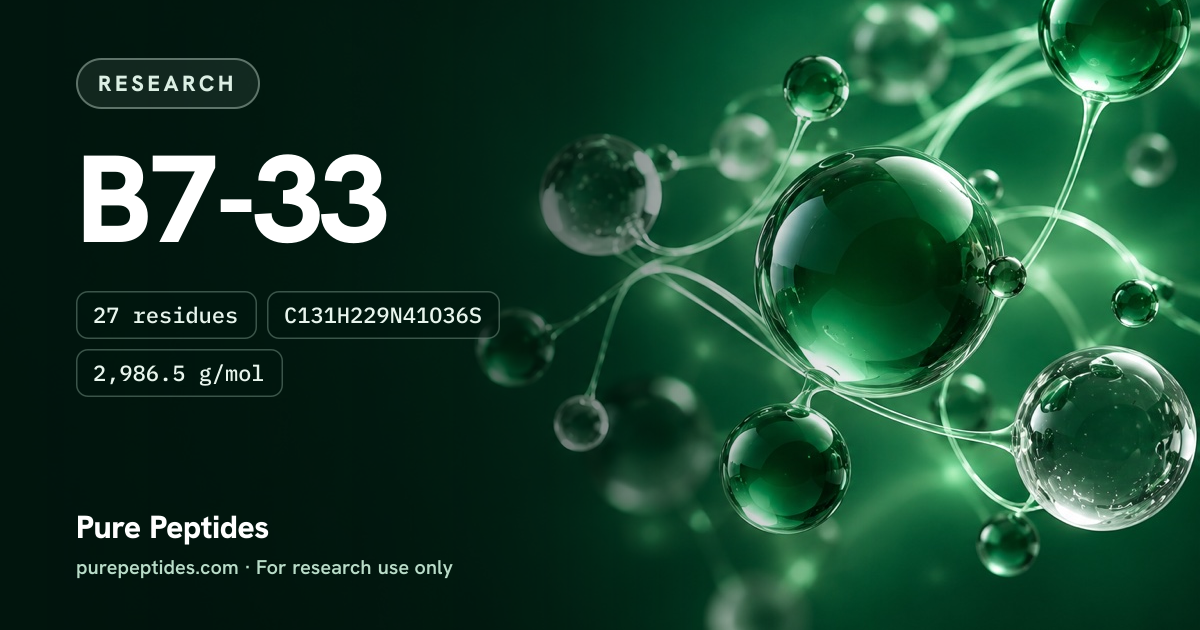
B7-33 research is entirely preclinical, and every experimental B7-33 result below comes from in vitro work or from rats and mice [1][2][3][4][5][6][7][8][9][11][12]. No published study has given B7-33 to a human [16]. Serelaxin is a different substance, the parent hormone made as a drug, and the large human trial record belongs to it rather than to B7-33 [13][14].
B7-33 is a synthetic 27-residue single-chain peptide derived from human gene-2 relaxin [1]. It covers residues 7 to 29 of the relaxin B chain, with both cysteines replaced by serine and four residues, KRSL, added at the C-terminus [1]. It has no A chain and no disulfide bond, so it is neither relaxin nor serelaxin [1]. The design steps described in the founding paper are physical rather than pharmacological [1]. Solution NMR, an in vitro method, then showed that the peptide is largely unstructured [1].
The declared CAS number 1818415-56-3 resolves to PubChem CID 162662592, which returns the formula C131H229N41O36S and a mass of 2,986.5 g/mol [17]. That formula holds one sulfur atom, which matches the one methionine in the B7 to B29 sequence and no cysteine [1][17]. The absence of cysteine is consistent with the two serine substitutions, although a sulfur count alone cannot identify serine [1][17]. One caveat attaches to the identifier. Its only PubChem substance record was deposited by a peptide supplier rather than by a registry [17].
The B7 immune co-stimulatory proteins, including CD80, CD86 and B7-H3, are unrelated to this peptide [16]. A substance-registry search for the name B7-33 returns antibody-drug conjugates directed at those targets instead [16].
B7-33 binds relaxin family peptide receptor 1, or RXFP1, and preferentially drives ERK1/2 phosphorylation over cAMP in vitro, in cells that natively express the receptor [1]. That preference was measured after the peptide was made, rather than designed into it [1]. B7-33 is a full cAMP agonist of weak potency, not a peptide that avoids the cAMP arm [1]. Deliberate design for low cAMP potency begins with the same group's later analog work [11].
In HEK-293T cells expressing human RXFP1, B7-33 gave a pKi of 5.54 against 8.96 for relaxin, roughly 2,600-fold weaker binding in vitro [1]. cAMP potency in those cells was pEC50 5.12 against 10.49, roughly 230,000-fold weaker [1]. Weak cAMP potency also appeared in THP1 cells, which express RXFP1 natively [1]. The claim that B7-33 matches relaxin rests on an ERK1/2 result in fibroblasts and on the founding paper's report of similar anti-fibrotic potency in three rodent models of heart or lung disease, and it does not extend to binding or to cAMP [1]. The originating group's later paper repeats the weakness, reporting that low binding affinity made comparison of B7-33 analogs difficult [11]. That group had to build an engineered receptor ectodomain construct to obtain a measurable B7-33 binding curve in vitro [11].
Free B7-33 has an in vitro serum half-life of about six minutes [12]. Fatty-acid conjugation raised that to about sixty minutes, and the longer half-life belongs to the lipidated analog [12].
In a mouse ischemia-reperfusion model, B7-33 reduced infarct size to 21.99% against 45.32% for vehicle and preserved fractional shortening at 29% against 23%, both at P=0.02 [3]. That study was co-authored with the originating Melbourne group [3]. In mouse isoprenaline-induced cardiomyopathy, B7-33 and relaxin equivalently reduced left ventricular fibrosis, inflammation and cardiomyocyte hypertrophy, and B7-33 reduced fibrosis where perindopril did not [4].
In rats, an equimolar intravenous injection of B7-33 or serelaxin enhanced bradykinin-mediated endothelium-dependent relaxation in the mesenteric artery [2]. Neither had any overall effect in the small renal artery or the abdominal aorta [2]. That vascular result is vessel-bed-selective [2].
The same paper also ran an ex vivo arm using mouse mesenteric arteries [2]. Those arteries were pre-incubated in placental trophoblast conditioned media, which induces the endothelial dysfunction characteristic of preeclampsia [2]. Co-incubation with B7-33 or serelaxin prevented that dysfunction from developing [2]. That result is isolated artery tissue, not a preeclampsia model in a living animal [2].
In a mouse model of renal fibrosis, relaxin, B7-33 and perindopril all reduced collagen fiber thickness and cross-reticulation, while increasing collagen fiber counts [5]. That paper validates an imaging platform, and B7-33 is a tool compound within it [5].
In mice with inflammatory paw pain, B7-33 injected into the cerebral ventricles reduced mechanical and thermal sensitivity at 30 minutes and not thereafter [6]. An RXFP1 antagonist blocked the mechanical component but not the thermal one [6]. That route carries no information about B7-33 reaching the brain from the bloodstream.
Three further animal results belong to formulations rather than to the peptide alone. A coating releasing B7-33 locally cut fibrotic capsule thickness around implants in mice by 49.2% over six weeks [7]. Iron-oxide nanoparticle conjugates stayed anti-fibrotic when given orally to mice, and the oral route belongs to the nanoparticle [8]. B7-33-carrying nanovesicles inhibited tumor growth by 67.7% in a mouse cholangiocarcinoma xenograft (p<0.001), as one part of a combination construct [9].
There is no published or registered human research on B7-33 [16]. ClinicalTrials.gov returns zero studies for the term, and the EU Clinical Trials Register returns no matching protocol [16]. PubMed returns 15 records for the term B7-33, of which 12 concern this peptide and none involve human subjects [16]. openFDA returns no label and no approval record for B7-33 [16]. No US or EU regulatory record for the peptide appears in the registries searched for this article [16].
Serelaxin is recombinant human relaxin-2, the parent hormone manufactured as a drug [13]. In RELAX-AHF-2, 6,545 patients hospitalized for acute heart failure received serelaxin or placebo [13]. Cardiovascular death at 180 days occurred in 8.7% against 8.9% (hazard ratio 0.98, 95% CI 0.83 to 1.15, P=0.77) [13]. Worsening heart failure at day 5 occurred in 6.9% against 7.7% (hazard ratio 0.89, 95% CI 0.75 to 1.07, P=0.19) [13]. Both co-primary endpoints were missed [13]. Death from any cause at 180 days also showed no significant difference between the groups [13]. Nor did the composite of cardiovascular death or heart failure or renal rehospitalization at 180 days [13]. The length of the index hospital stay did not differ either [13]. Novartis Pharma funded the trial [13].
A later fixed-effect meta-analysis of six serelaxin trials reported less 5-day worsening heart failure, 6.0% against 8.1% (hazard ratio 0.77, 95% CI 0.67 to 0.89, P=0.0002) [14]. It also reported that serelaxin was associated with lower all-cause mortality (hazard ratio 0.87, 95% CI 0.77 to 0.98, P=0.0261) [14]. That mortality estimate is borderline, because its confidence interval reaches 0.98 [14]. It is a pooled secondary endpoint [14]. The analysis found no significant effect on length of stay, cardiovascular death or rehospitalization [14]. Four further qualifiers attach to the meta-analysis. It appeared after the confirmatory trial had already missed, and the serelaxin program's own investigators led it [14]. The pooled trials were coordinated by a single sponsor, Corthera, which is a wholly owned Novartis subsidiary [14]. Several of its authors disclose Novartis grants and personal fees during the conduct of the study [14].
Marketing authorization for serelaxin under the name Reasanz was refused in the European Union [18]. The European Medicines Agency's CHMP adopted a negative opinion on 23 January 2014 and confirmed the refusal on re-examination on 22 May 2014 [18]. The European Commission issued the refusal decision, which closes the file, on 5 August 2014 [18]. That was a refusal by the regulator, not a withdrawal by the applicant [18]. openFDA holds no serelaxin approval or label record [16].
Neither half of that record transfers to B7-33. Serelaxin's earlier positive signals are not evidence for B7-33, because no human has been given B7-33 in a published study [16]. Serelaxin's failure is not evidence against B7-33, because the two molecules differ in structure and in receptor pharmacology [1][13]. The founding B7-33 paper's abstract separately states that relaxin gained provisional FDA approval for acute heart failure [1]. Neither that approval nor that regulatory category exists [16].
Eleven of the 12 B7-33 papers indexed in PubMed carry an author from the Florey Institute, the University of Melbourne or Monash University [16]. The twelfth is a Chinese nanomedicine study in which B7-33 is one part of a construct [9]. One independent group, at the University of Pavia, has tested B7-33 on its own in vitro, and reported that it changed profibrotic gene expression in human hypertrophic scar fibroblasts [20]. That study is not indexed in PubMed, and it does not repeat the network's animal experiments, none of which has been independently replicated [16][20]. That is a replication gap rather than a failed replication, because few groups outside the network have tried.
US patent 10,081,662 B2, covering modified relaxin B chain peptides and naming B7-33, was granted in September 2018 to the Florey Institute of Neuroscience and Mental Health [19]. Its named inventors include authors of the founding paper [19]. That paper carries no conflict-of-interest declaration and does not mention the patent [1]. Australian public grants funded it rather than industry, which counts in its favor [1].
Sanofi's published relaxin-mimetic work developed a lipidated single-chain analog rather than B7-33 itself, and that successor's subcutaneous bioavailability and extended half-life belong to it [15]. The originating group records that those Sanofi analogs regained cAMP potency similar to relaxin's, so the successor gave up the signaling preference that distinguishes B7-33 [11]. Short single-chain peptides from the H1 relaxin isoform showed no meaningful RXFP1 affinity and no relaxin-like activity in vitro, while serelaxin worked in the same assays [10]. Those H1 peptides are not B7-33, and that paper does not test B7-33 [10]. Their failure is a caution that short relaxin B-chain peptides are not a reliably active class [10]. The cytotrophoblast line of B7-33 preeclampsia work has no peer-reviewed paper behind it, and exists only as conference abstracts [16]. The only indexed peer-reviewed preeclampsia-related B7-33 result is an ex vivo mouse artery arm in the 2017 vascular study [2][16]. No B7-33 preeclampsia study in a living animal or in a human has been published [16].
B7-33 remains a preclinical tool compound roughly ten years after it was first described [1]. Its receptor binding in vitro is about 2,600-fold weaker than relaxin's, and its free serum half-life in vitro is about six minutes [1][12]. Its evidence base is animal and in vitro, and the group holding the patent produced most of it [16][19]. No human has received B7-33 in a published study [16].
No published study has given B7-33 to a human. ClinicalTrials.gov returns zero studies for the term, and the EU Clinical Trials Register returns no matching protocol. Every published experimental B7-33 result comes from in vitro work or from rodents.
It does not transfer in either direction. Serelaxin is recombinant relaxin-2, while B7-33 is a fragment-derived analog with different receptor pharmacology. Serelaxin's confirmatory trial missed both co-primary endpoints, and that result is about serelaxin. No human has been given B7-33 in a published study, so serelaxin's earlier signals are not evidence for it either.
References

Reviewed for scientific accuracy
Dr. Martina Rossi, PhD
PhD, Université Grenoble Alpes · Scientific Contributor and Reviewer
Dr. Rossi's doctoral research at Université Grenoble Alpes examined the vascular functions of bone morphogenetic proteins. Her peer-reviewed work spans cell and molecular biology, vascular biology, and gene therapy, in journals including Cardiovascular Research, Scientific Reports, and Brain Sciences. She reviews Pure Peptides' product, reference, and research pages for scientific accuracy against the sources they cite.
Thymosin beta-4 (timbetasin) is the 43-residue parent of TB-500, not the same molecule. Review of its Phase 3 record, nulls and conflicts.
LL-37 is an endogenous human peptide, and only four human studies have administered it. Its largest placebo-controlled trial missed its primary endpoint.
KPV has never been administered to a human in a published study. A review of its preclinical evidence, its unsettled mechanism and FDA's position.
ARA-290 (cibinetide) reached phase 2 in humans. An evidence-led review of what its trials found, what they missed, and where development now stands.
BPC-157, TB-500 and GHK-Cu in preclinical tissue repair research — angiogenesis, migration and matrix findings, evidence tiered. For research use only.
An evidence-led look at TB-500 research into Thymosin Beta-4 biology, covering the actin-binding domain, proposed mechanisms in cell migration and angiogenesis, and preclinical dermal and cardiac repair studies.