
Tissue Repair ResearchRead Research →
LL-37 Research
LL-37 is an endogenous human peptide, and only four human studies have administered it. Its largest placebo-controlled trial missed its primary endpoint.
August 28, 2026
Shop by category
Growth Hormone Axis ResearchRegeneration ResearchPeptide BioregulatorsCognitive & Neuropeptide ResearchMetabolic & Cellular ResearchMelanocortin & Endocrine ResearchDermal Peptide ResearchImmune & Thymic ResearchResearch & info
Research HubReference LibraryEducationCompareBlogCOAsContactAboutFAQCalculatorGlossary
Reviewed by Dr. Martina Rossi, PhD
Scientific Contributor and Reviewer · Reviewed
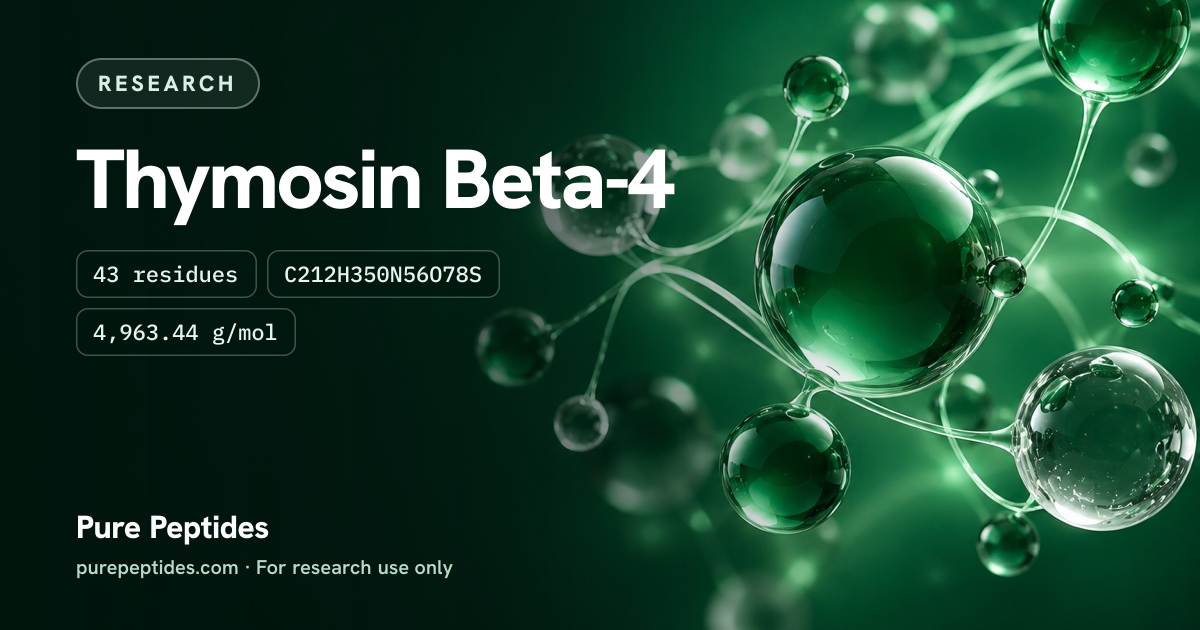
Thymosin beta-4 is a 43-residue peptide found across most human tissues. It is registered under CAS 77591-33-4, PubChem CID 16132341, and carries the International Nonproprietary Name timbetasin. Its molecular weight is 4963.44 g/mol.
Thymosin beta-4 research is unusual among peptides sold for laboratory use. The problem is not an absence of human data. A large clinical program has run for two decades, and most of what has read out has failed. This article reports what has been investigated, not what any reader should expect. This is a research compound.
Thymosin beta-4 is the product of the TMSB4X gene, a small and highly conserved member of the beta-thymosin family.
Two other compounds are routinely confused with it.
The first is TB-500. TB-500 is a synthetic seven-residue peptide corresponding to residues 17 to 23 of thymosin beta-4, registered under CAS 885340-08-9. It carries under a fifth of the parent's mass. In a 2026 briefing document prepared for its Pharmacy Compounding Advisory Committee, the FDA stated that thymosin beta-4 and TB-500 are not the same substance. None of the clinical evidence in this article was generated with the fragment.
The second is thymosin alpha-1, also called thymalfasin. That is a 28-residue peptide from a different precursor gene, with immunomodulatory rather than actin-binding biology. It is marketed in a number of countries outside the United States. That marketing status belongs to thymosin alpha-1 alone. It is not an approval of thymosin beta-4. Between 1981 and 2007, fourteen studies each applied both thymosin beta-4 and thymosin alpha-1 in the same experimental system. Seven used human cells in vitro, among them blood cells and sperm cells.[14][15][16][17][18][19][20] Four used rat cells in vitro, among them adrenal and spleen cells.[21][22][23][24] One used rat hypothalamic tissue, superfused ex vivo.[25] Two more included work in vivo. One exposed mouse macrophages to both in culture, then transferred cells from those cultures into mice.[26] The other applied both peptides to the chick chorioallantoic membrane.[27] One of the human cell studies also gave both peptides to mice.[19] Each of these papers reports results for each peptide. For two further papers, the abstracts do not establish that both peptides were applied.[28][29]
Inside cells, thymosin beta-4 is the principal sequestering protein for monomeric G-actin. Goldstein and colleagues reviewed that role in 2005.[1] Binding G-actin influences how the actin cytoskeleton assembles and disassembles.
The literature proposes effects on cell migration, new blood vessel formation, and cell survival signaling. Those proposals rest on cell culture and animal work. No human trial has tested any of those proposed mechanisms directly.
Smart and colleagues reported in Nature in 2011 that thymosin beta-4 primed adult mouse hearts to generate new cardiomyocytes after injury.[2] That animal result made the molecule widely known. Two later studies challenged it, although neither repeated the original experiment.
Zhou and colleagues used genetic lineage tracing in mice to test a related question: whether treatment given after infarction had the same effect. Treatment after infarction thickened the epicardium and raised capillary density in those animals. Epicardium-derived cells did not adopt a cardiomyocyte fate.[3] The authors note the original protocol required treatment before the infarct, which they call clinically impractical.
Banerjee and colleagues built global and cardiac-specific knockout mice and reported the result in Circulation Research in 2012. The global knockouts were born at Mendelian ratios with normal hearts and vessels. The authors concluded that thymosin beta-4 is dispensable for murine heart development and adult cardiac function.[4] The study removed the gene and did not test treatment with the peptide.
That knockout picture is not settled. Six months later the same journal published Rossdeutsch and colleagues, reporting that thymosin beta-4 is required for vascular smooth muscle development in mice.[5] The two papers have not been reconciled.
The Nature paper has not been retracted and carries no correction notice. It stands unreplicated rather than withdrawn.
Most human data on thymosin beta-4 comes from a topical eye drop, RGN-259. Two Phase 2 trials in dry eye came first.
One reported significant improvements in signs and symptoms of severe dry eye.[6] It treated nine patients at two sites, and its registered primary outcome was safety. The second Phase 2, in 72 patients, missed both of its prespecified primary endpoints.[7] Its published conclusion argued for efficacy on secondary endpoints.
Three larger dry eye trials followed, randomizing 1,618 patients between them. ARISE-1 (n=317), registered as Phase 2/3, was reported positive by its sponsor and never published. ARISE-2 (n=601) posted registry results in which both co-primary endpoints numerically favored placebo. ARISE-3 (n=700) failed its co-primary endpoints, in the words of the RegeneRx annual report for fiscal 2022. No peer-reviewed publication exists for any of the three.
After ARISE-3, the trial sponsor pooled all three trials and announced significant improvements across a stated 1,500 to 1,600 patients. That pooled figure still circulates widely. The same annual report states that the FDA would not accept the analysis for a Biologics License Application.
Neurotrophic keratopathy is the second eye indication. SEER-1 was a Phase 3 trial that terminated at 18 patients for a stated business decision. Its prespecified primary analysis returned p=0.0656 by Fisher's exact test, which is a miss. The published paper presents that trial as a positive Phase III result.[8] The annual report discloses that a different statistical test on the same endpoint returned p=0.0400. Changing the test after seeing the result exploits an analytical degree of freedom.
A Cochrane systematic review assessed that same 18-patient dataset in 2025. It found no significant effect on corneal re-epithelialization, risk ratio 9.00, 95% confidence interval 0.57 to 141.88. That evidence was rated low-certainty.[9] The review covered seven randomized human trials and 494 participants in this indication, and rated the field low to very low certainty overall. Five of the seven trials that reported their funding were industry-sponsored.[9]
SEER-3, a European Phase 3 in the same indication, missed its prespecified primary endpoint, the difference in complete healing after four weeks, according to topline results the US originator relayed to its stockholders in June 2025.[30] The trial is not registered on ClinicalTrials.gov and has not been published. SEER-2 is still recruiting and has not reported results.
A third eye indication was attempted and abandoned. A Phase 2 in diabetic corneal wounds terminated for slow recruitment after 12 human patients. Its posted results are adverse event counts only, with no efficacy outcome reported.
The topical gel program produced no positive efficacy trial in the United States. A US pressure ulcer Phase 2 and a US venous stasis ulcer Phase 2 each registered safety and tolerability as the primary endpoint. Posted healing results were null in both of those human trials, and both numerically favored placebo. In the venous ulcer trial, 4 of 17 placebo patients healed, 23.5 percent, against 12 of 55 on thymosin beta-4, 21.8 percent. In the pressure ulcer trial the figures were 3 of 18 on placebo, 16.7 percent, against 8 of 54 on thymosin beta-4, 14.8 percent.
A third ulcer trial ran in Europe, and it is a separate study from the US venous ulcer trial. Guarnera and colleagues randomized 73 human patients across eight sites in Italy and Poland, in a double-blind, placebo-controlled, dose-escalation Phase 2 of the topical gel.[10] Safety was reported as comparable to placebo. Its published efficacy conclusion is hedged, stating that one of the tested concentrations may have potential to accelerate healing. The paper reports complete healing within three months in about 25 percent of patients, especially those whose wounds were smaller or less severe.[10]
Two epidermolysis bullosa Phase 2 trials terminated early, one of them after four patients. A third, open-label trial in that disease enrolled three patients. One of the terminated trials was registered to Lenus Therapeutics, a sponsor since dissolved. The RegeneRx annual report states that the rights reverted to HLB Therapeutics.
The injectable formulation, RGN-352, has a thinner human record. The sponsor's annual report describes a completed Phase 1a and Phase 1b in 60 healthy subjects in 2009, given intravenously. That completion does not appear in ClinicalTrials.gov. Two registered RGN-352 records were withdrawn with zero enrollment. One of them was registered in 2008 and describes a Phase 1 intravenous study in healthy volunteers, matching the scope of that completed program. The public record does not reconcile that withdrawn registration with the completion the filing reports. The other was registered in 2011 and was the Phase 2 in acute myocardial infarction. In March 2011 the FDA placed that Phase 2 on clinical hold. The stated reason was the contract manufacturer's alleged failure to comply with current Good Manufacturing Practice regulations. The US injectable has been given to healthy volunteers only, never to patients.
A separate Chinese recombinant program has gone further. Its first-in-human Phase 1 enrolled 84 healthy volunteers across single and multiple ascending dose cohorts. Adverse events were mild to moderate, with no dose-limiting toxicities and no serious adverse events reported.[11] That is a safety and pharmacokinetic dataset, not an efficacy one.
A randomized, placebo-controlled trial in 96 human patients with ST-elevation myocardial infarction found no significant difference in infarct area overall.[12] The significant result was confined to a 43-patient subgroup. That subgroup was defined by starting treatment within eight hours after percutaneous coronary intervention.[12] The authors report the full-trial null explicitly and call for further rigorous studies. The paper's abstract names no registry record for the trial. Two completed Phase 2 trials in that Chinese program enrolled 62 and 90 patients. The published figure of 96 matches neither, and the public record does not say whether this was a third study. A further Phase 2 is registered but not yet recruiting.
Thymosin beta-4 is not FDA approved in any formulation, and no marketing application for it was identified in the sponsor filings and FDA databases reviewed here. The FDA drug approval database holds no record of this molecule under any of its name forms.
Orphan drug designation was granted for neurotrophic keratopathy in 2013. A second orphan designation is associated with the topical gel program in epidermolysis bullosa. A designation is a development incentive granted before efficacy is shown. It is not a marketing authorization.
An FDA label database record names a thymosin beta-4 fusion construct in a Korean cosmetic face pack. That entry is an unapproved listing, not an approval.
FDA's 2026 compounding briefing document evaluated TB-500 and proposed not adding it to the 503A bulks list. The Pharmacy Compounding Advisory Committee then voted in July 2026 to recommend adding it, and FDA decides whether to accept that recommendation.[13] Both concern the fragment, not the 43-residue parent.
The US originator stopped reporting in 2023. RegeneRx Biopharmaceuticals filed to deregister its securities in August 2023, ending its SEC reporting obligations. Its fiscal 2022 annual report is the last full public account of the program from that company. Development continues under Korean and Chinese sponsors.
Almost every favorable human result on this molecule carries sponsor authorship. The positive neurotrophic keratopathy paper declares authors employed by the developer and by its parent company.[8] One of those declared developer employees is also a co-author of the 2005 mechanism review.[1] One investigator is lead or senior author on essentially the whole favorable ophthalmic literature. The Chinese Phase 1 paper opens by declaring no conflicts and then names three sponsor employees among its authors.[11] Sponsor employees also co-author the myocardial infarction trial.[12] The Cochrane review shares no author with any of those papers, and its verdict is negative. Its declared external funders are the National Eye Institute of the National Institutes of Health, the UK Public Health Agency, Queen's University Belfast, and Birmingham Health Partners.[9] The review reports no internal source of support. None of its nine authors declares a commercial or industry interest. The interests they do declare are those public research grants and two Cochrane editorial roles recused from this review.[9]
Thymosin beta-4 has a well-documented clinical history in humans. ARISE-2 and ARISE-3 missed their co-primary endpoints, and SEER-1 missed its prespecified primary. SEER-3 was reported to miss as well, and SEER-2 has not read out. Its most famous animal finding has not been replicated, and the lineage-tracing and knockout studies that challenged it did not repeat the original experiment. Anyone working with Thymosin Beta-4 should read the registry records and sponsor filings alongside the journal literature.
No, they are different molecules. TB-500 is a synthetic seven-residue peptide corresponding to residues 17 to 23 of thymosin beta-4, registered under CAS 885340-08-9. The FDA stated in a 2026 compounding briefing document that the two are not the same substance.
No, they are different molecules. Thymosin alpha-1, also called thymalfasin, is a 28-residue peptide from a different precursor gene, with immunomodulatory rather than actin-binding biology. It is marketed in a number of countries outside the United States, and that marketing status is not an approval of thymosin beta-4.
No, and it has also not been retracted. Genetic lineage tracing in mice found that, with treatment given after infarction rather than before it, epicardium-derived cells did not adopt a cardiomyocyte fate. Global knockout mice, which lacked the gene and received no treatment, were born with normal hearts and vessels. The 2011 Nature paper stands unreplicated rather than withdrawn.
No. Thymosin beta-4 is not FDA approved in any formulation, and no marketing application for it was identified in the sponsor filings and FDA databases reviewed here. Orphan drug designation was granted for neurotrophic keratopathy in 2013. A designation is a development incentive granted before efficacy is shown, and it is not a marketing authorization.
References

Reviewed for scientific accuracy
Dr. Martina Rossi, PhD
PhD, Université Grenoble Alpes · Scientific Contributor and Reviewer
Dr. Rossi's doctoral research at Université Grenoble Alpes examined the vascular functions of bone morphogenetic proteins. Her peer-reviewed work spans cell and molecular biology, vascular biology, and gene therapy, in journals including Cardiovascular Research, Scientific Reports, and Brain Sciences. She reviews Pure Peptides' product, reference, and research pages for scientific accuracy against the sources they cite.
LL-37 is an endogenous human peptide, and only four human studies have administered it. Its largest placebo-controlled trial missed its primary endpoint.
KPV has never been administered to a human in a published study. A review of its preclinical evidence, its unsettled mechanism and FDA's position.
B7-33 is a single-chain relaxin-2 analog with no published human study. Serelaxin's failed confirmatory trial tested a different molecule.
ARA-290 (cibinetide) reached phase 2 in humans. An evidence-led review of what its trials found, what they missed, and where development now stands.
BPC-157, TB-500 and GHK-Cu in preclinical tissue repair research — angiogenesis, migration and matrix findings, evidence tiered. For research use only.
An evidence-led look at TB-500 research into Thymosin Beta-4 biology, covering the actin-binding domain, proposed mechanisms in cell migration and angiogenesis, and preclinical dermal and cardiac repair studies.