
Published · 9 references
AOD-9604 vs Tesamorelin
AOD-9604 and Tesamorelin are different molecules: AOD-9604 is a modified 16-residue peptide from the C-terminal end of human growth hormone; Tesamorelin is a 44-residue analog of human growth hormone-releasing hormone.
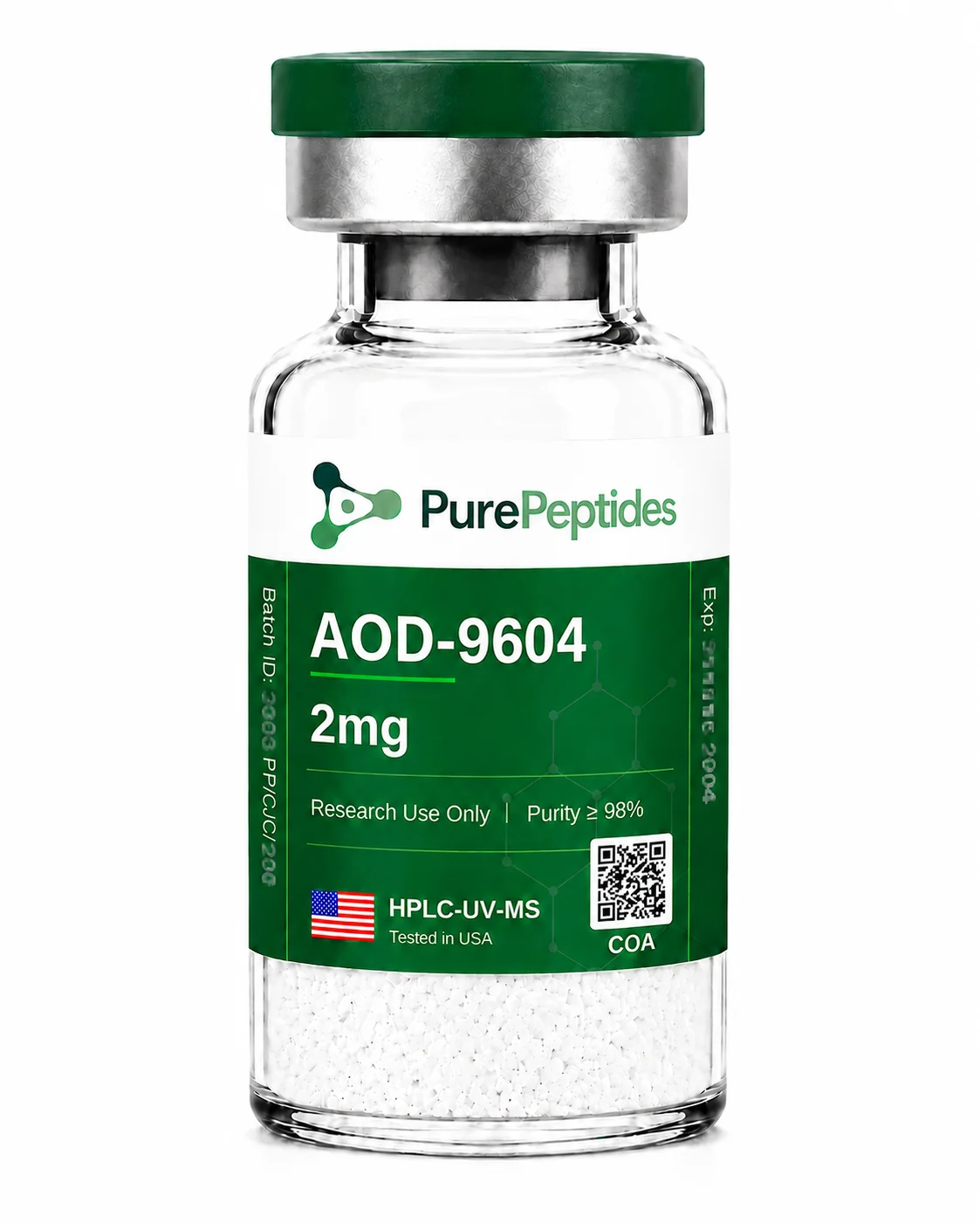
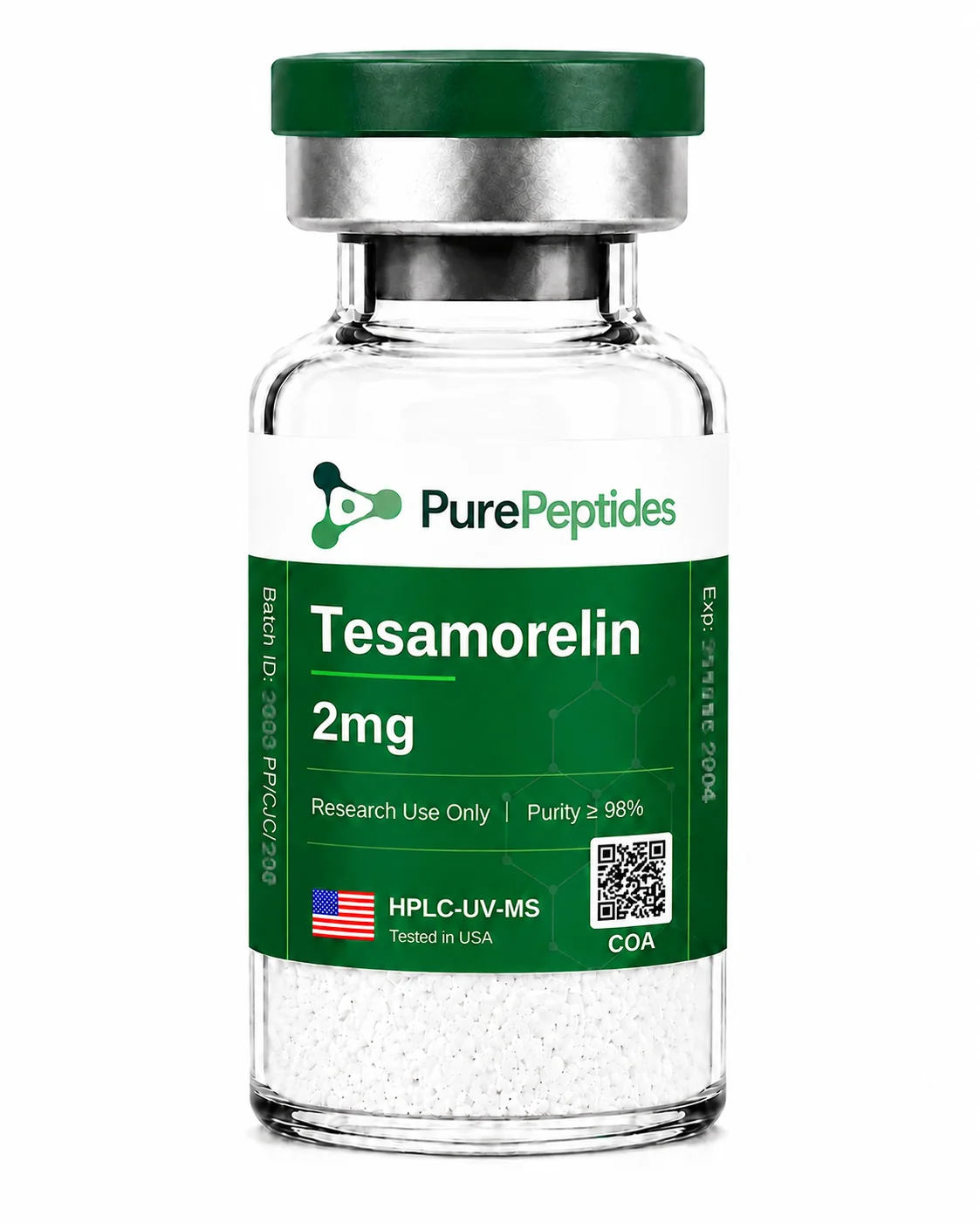
Structure at a glance
AOD-9604 · 16 residues
Tesamorelin · 44 residues
Hex: N-terminal trans-3-hexenoyl group. NH2: C-terminal amide. Letters are one-letter amino acid codes.
Drawn from the product database. Each measure's bars share one scale.
| Property | AOD-9604 | Tesamorelin |
|---|---|---|
| What it is | A 16-residue peptide: residues 177 to 191 at the C-terminal end of human growth hormone, with a tyrosine in place of the phenylalanine at position 176.[1] | A 44-residue peptide: an analog of human growth hormone-releasing hormone with an N-terminal trans-3-hexenoyl group. |
| How they relate | Different molecules from different parents. AOD-9604 corresponds to residues 177 to 191 of human growth hormone, with an N-terminal tyrosine in place of phenylalanine 176.[1] Tesamorelin is an analog of the full 44-residue human growth hormone-releasing hormone. | |
| CAS number | 221231-10-3 | 218949-48-5 |
| Molecular formula | C78H123N23O23S2 | C221H366N72O67S |
| Molecular weight | 1,815.10 g/mol | 5,135.86 g/mol |
| Sequence | YLRIVQCRSVEGSCGF | trans-3-hexenoyl-YADAIFTNSYRKVLGQLSARKLLQDIMSRQQGESNQERGARARL-NH2 |
| Evidence base | Human trials: six randomized trials in about 900 adults; the one peer-reviewed report of their pooled data covers safety only.[2] That report was developer-funded.[2] The pivotal trial missed its primary endpoint; its developer terminated development for that trial's indication in 2007.[3] | Human studies, which supported an approval for one indication. A pooled analysis of two phase 3 trials covered 806 randomized participants.[4] Their primary endpoints were imaging surrogates. The trial papers were manufacturer-sponsored. |
| Regulatory status | No drug approval anywhere.[5] FDA states that neither its free base nor its acetate is a component of an approved drug.[5] | The FDA approved tesamorelin acetate in 2010 for one therapeutic indication.[6][7] That approval is current. |
| Compared head-to-head? | No direct comparison found in PubMed (searched October 2026).[8] | |
| Handling difference | AOD-9604 contains one disulfide bridge, which reducing agents open. Tesamorelin contains no cysteine, so it has no disulfide; its single methionine oxidizes on air exposure. | |
How AOD-9604 and Tesamorelin differ
AOD-9604 and Tesamorelin are different molecules from different parents. AOD-9604 is a synthetic 16-residue peptide from the C-terminal end of human growth hormone. It corresponds to residues 177 to 191 of that hormone, with a tyrosine in place of the phenylalanine at position 176.[1] Its two cysteines are joined in a disulfide bridge, so part of the chain is a closed loop. Tesamorelin is a synthetic analog of the full 44-residue human growth hormone-releasing hormone, with a trans-3-hexenoyl group on its N-terminus. It contains no cysteine, so no disulfide is possible.
In people, AOD-9604 was tested in six randomized trials in about 900 adults.[2] The one peer-reviewed report of their pooled data covers safety only.[2] The compound's developer funded both safety papers, that report among them, and its chief executive, who held a stake in the parent company, co-authored them.[2] In a 2024 briefing document, FDA reported that AOD-9604's phase 2b trial missed its primary endpoint, and that the developer terminated development for that trial's indication in 2007.[3]
A pooled analysis of Tesamorelin's two phase 3 trials covered 806 randomized participants.[4] In the literature reviewed for Tesamorelin, those trials used imaging surrogates as primary endpoints, not clinical outcomes. The two trial papers and the pooled analysis were manufacturer-sponsored, with sponsor-affiliated co-authors. A randomized phase 2 trial of 73 participants, in another indication, found no significant difference on the measure reported for it.[9]
AOD-9604 has no drug approval anywhere.[5] FDA states that neither its free base nor its acetate is a component of an approved drug.[5] The FDA approved tesamorelin acetate in 2010 for one therapeutic indication.[6][7] That approval is current, and it belongs to tesamorelin acetate and that one indication. Tesamorelin acetate is the active ingredient of a prescription medicine sold under another name. The material supplied here is a research-grade preparation, is not that medicine, and holds no marketing authorization.
The disulfide bridge is AOD-9604's main stability concern. Reducing agents open it, and at alkaline pH disulfides exchange between molecules, giving dimers and larger aggregates. Tesamorelin's single sulfur is in a methionine, which oxidizes to a sulfoxide on air exposure, adding sixteen mass units. Its principal stability concern is physical rather than chemical: a chain long enough to fold can misfold and aggregate on repeated freezing and thawing.
Have AOD-9604 and Tesamorelin been compared directly?
No direct comparison of AOD-9604 with Tesamorelin was found in a PubMed search run in October 2026.[8] That search covers PubMed only.
Read more on each compound
AOD-9604
Frequently Asked Questions
Is AOD-9604 the same as Tesamorelin?+−
AOD-9604 and Tesamorelin are different molecules from different parents. AOD-9604 is a 16-residue peptide from the C-terminal end of human growth hormone, with a tyrosine in place of the phenylalanine at position 176. Tesamorelin is an analog of the full 44-residue human growth hormone-releasing hormone, with a trans-3-hexenoyl group on its N-terminus.
Is AOD-9604 or Tesamorelin approved?+−
AOD-9604 has no drug approval anywhere; the FDA approved tesamorelin acetate in 2010 for one therapeutic indication. Tesamorelin acetate is the active ingredient of a prescription medicine sold under another name. The material supplied here is a research-grade preparation, is not that medicine, and holds no marketing authorization.
References
- 1Cox HD, Smeal SJ, Hughes CM, Cox JE, Eichner D. Drug Testing and Analysis. 2015. PMID 25208511. DOI: 10.1002/dta.1715.
- 2Stier H, et al. 2013;3(1-2):7-15. DOI: 10.4021/jem157w. Not indexed in PubMed; no PMID, so the DOI was resolved on Crossref on 28 August 2026 and the title and author line confirmed there. The only peer-reviewed publication reporting primary pooled data from the AOD-9604 human program; it reports safety only. doi.org
- 3US Food and Drug Administration. Briefing Document, Pharmacy Compounding Advisory Committee meeting, 4 December 2024 (memo dated 5 November 2024), including its Nonclinical Assessment section. Underlying disclosure by the compound's developer, 21 February 2007, SEC-filed. No PMID or DOI. fda.gov
- 4Falutz J, Mamputu JC, Potvin D, Moyle G, Soulban G, Loughrey H, et al. 2010;95(9):4291-4304. PMID 20554713.
- 5openFDA drug/label and drug/drugsfda endpoints, field-qualified on openfda.substance_name, openfda.generic_name and openfda.brand_name, queried 27 August 2026, with control queries confirming the fields are populated; EMA European Public Assessment Report dataset, same date; FDA Briefing Document 4 December 2024, p. 7; the developer's ASX announcement, 26 April 2013.
- 6US Food and Drug Administration, Center for Drug Evaluation and Research. Approval letter for tesamorelin, 10 November 2010 (Reference ID 2863003).
- 7US Food and Drug Administration, Drugs@FDA. Approval record whose active ingredient is tesamorelin acetate; marketing status Prescription. Retrieved via api.fda.gov/drug/drugsfda.json on products.active_ingredients.name "TESAMORELIN ACETATE", 3 October 2026.
- 8PubMed search via NCBI E-utilities, run 3 October 2026; records entered to 2 October 2026. Query: ("AOD-9604"[tiab] OR "AOD9604"[tiab] OR "AOD 9604"[tiab] OR "Tyr-hGH"[tiab]) AND ("tesamorelin"[tiab] OR "hexenoyl"[tiab] OR "trans-3-hexenoyl"[tiab]) AND ("1800/01/01"[edat] : "2026/10/02"[edat]). 3 records; none was a direct comparison of the two compounds.
Related comparisons
AOD-9604 vs HGH Fragment 176-191
AOD-9604 and HGH Fragment 176-191 are 16-residue peptides from the C-terminal end of human growth hormone that differ at one position.
Read ComparisonCJC-1295 (No DAC) vs Tesamorelin
CJC-1295 (No DAC) carries four substitutions in human GHRH's first 29 residues; Tesamorelin is an analog of the full 44-residue hormone.
Read ComparisonHGH Fragment 176-191 vs Tesamorelin
HGH Fragment 176-191 is a 16-residue fragment of human growth hormone; Tesamorelin is a 44-residue analog of human GHRH.
Read Comparison