
Published · 9 references
AOD-9604 vs HGH Fragment 176-191
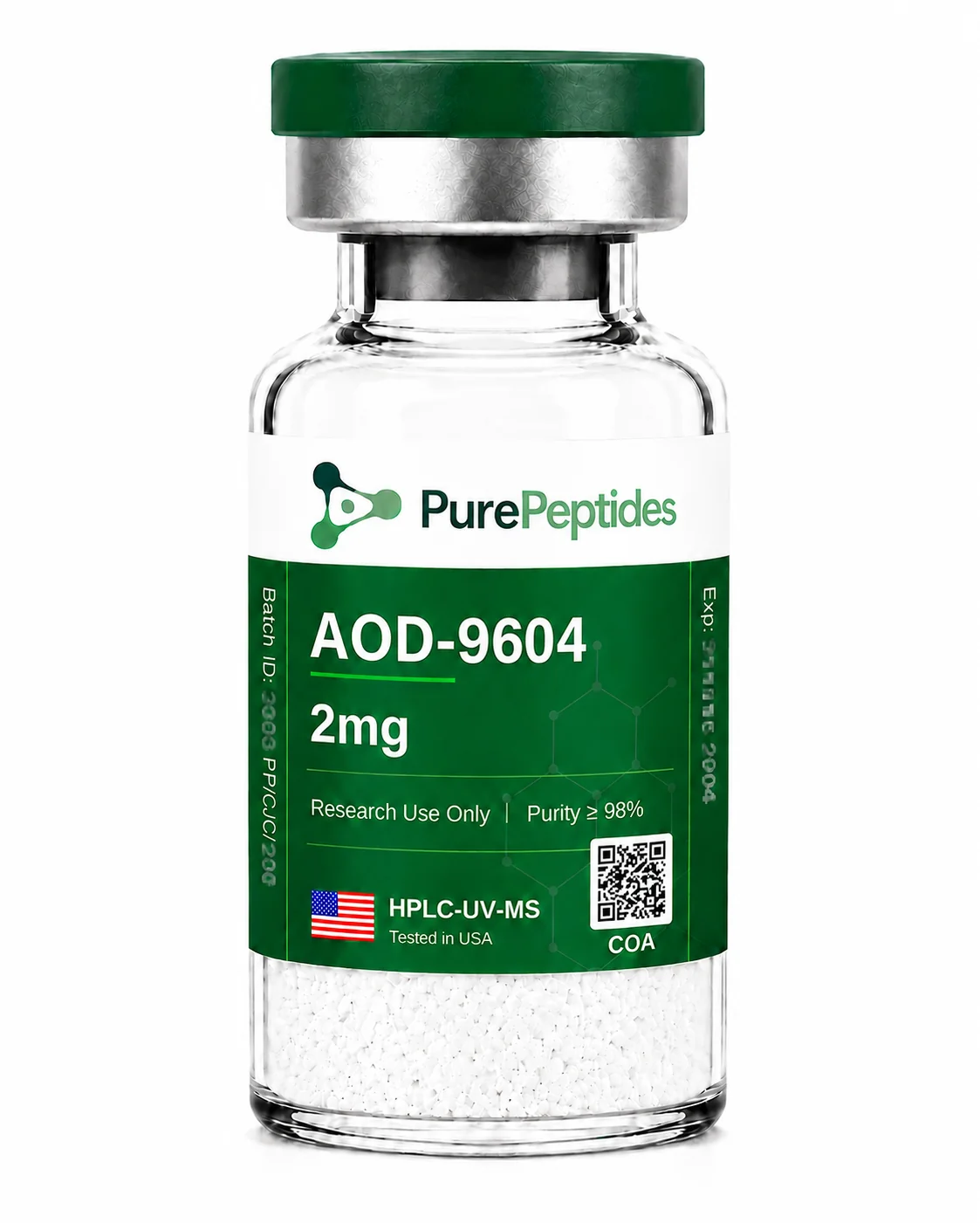
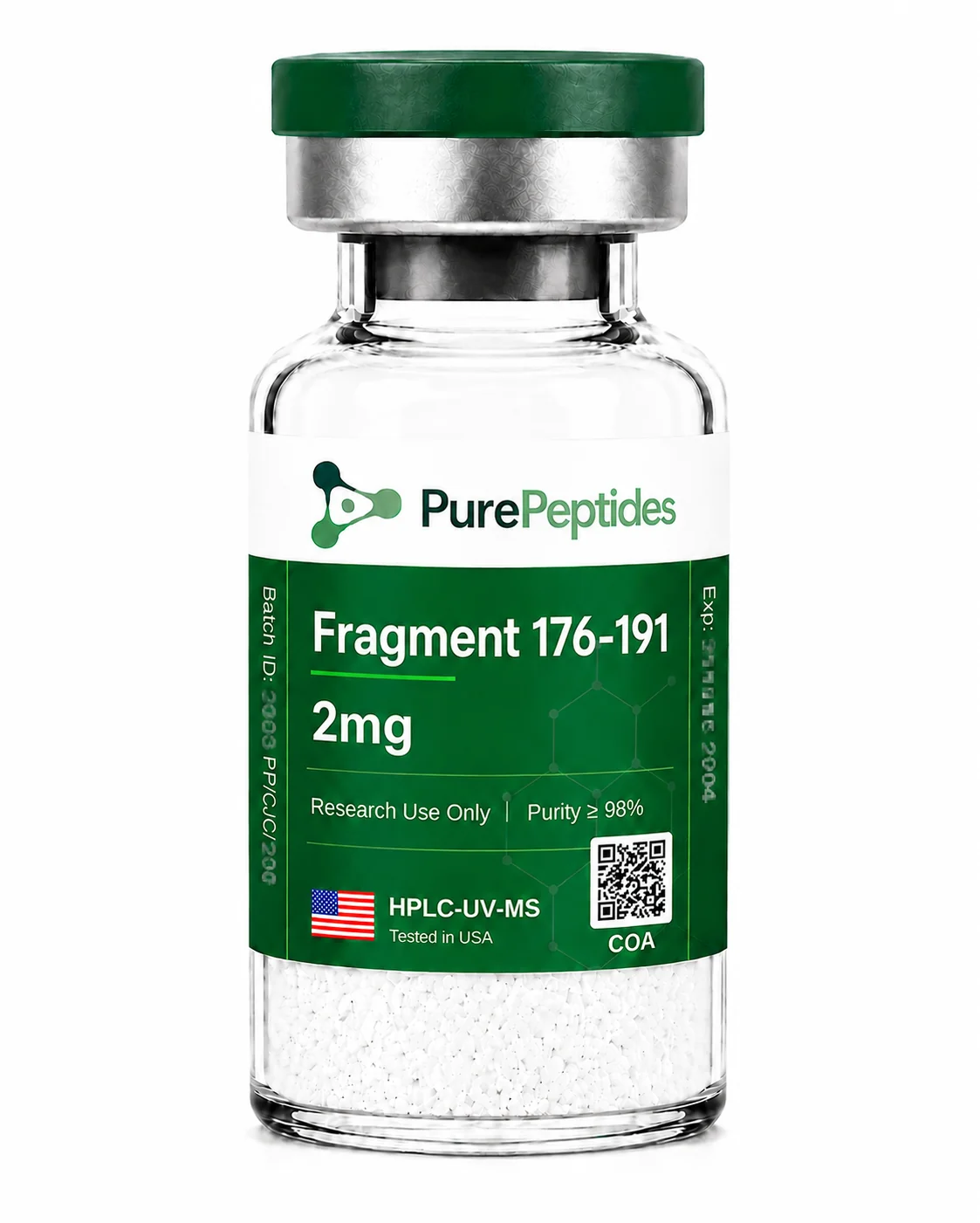
AOD-9604 and HGH Fragment 176-191 are different molecules: both are 16-residue peptides from the C-terminal end of human growth hormone, and AOD-9604 carries a tyrosine in place of phenylalanine at position 176.
Structure at a glance
AOD-9604
HGH Fragment 176-191
Letters are one-letter amino acid codes.
Drawn from the product database. Each measure's bars share one scale.
| Property | AOD-9604 | HGH Fragment 176-191 |
|---|---|---|
| What it is | A 16-residue peptide: residues 177 to 191 at the C-terminal end of human growth hormone, with a tyrosine in place of the phenylalanine at position 176.[1] | A 16-residue peptide: residues 176 to 191 at the C-terminal end of human growth hormone. |
| How they relate | Two molecules derived from the same parent, human growth hormone. Their formulas differ by one oxygen atom, the difference between tyrosine and phenylalanine. | |
| CAS number | 221231-10-3 | 66004-57-7 |
| Molecular formula | C78H123N23O23S2 | C78H123N23O22S2 |
| Molecular weight | 1,815.10 g/mol | 1,799.10 g/mol |
| Sequence | YLRIVQCRSVEGSCGF | FLRIVQCRSVEGSCGF |
| Target | No target established for AOD-9604. FDA concluded that its molecular target and mechanism of action remain unknown.[2] | No target established for HGH Fragment 176-191. None reported; an absence in the record, not a demonstrated absence in biology. |
| Evidence base | Human trials: six randomized trials in about 900 adults; the one peer-reviewed report of their pooled data covers safety only.[3] The pivotal trial, in one indication, missed its primary endpoint; its developer terminated development in that indication in 2007.[2] | No published study has tested HGH Fragment 176-191 in people. In the literature reviewed for it, every laboratory and animal study described used AOD-9604 or a separate peptide, growth hormone residues 177 to 191. |
| Regulatory status | No drug approval anywhere.[4] FDA states that neither its free base nor its acetate is a component of an approved drug.[4] | No marketing authorization, and no FDA approval for human use. |
| Compared head-to-head? | No direct comparison found in PubMed (searched October 2026).[5] | |
| Handling difference | Both formulas carry two sulfur atoms, enough to form one disulfide bridge, which a reducing agent opens. | |
| Where they get confused | A 2026 review gives hGH 176-191 as another name for AOD-9604, so the merge of the two names has reached the peer-reviewed literature.[6] Two papers in the literature reviewed for AOD-9604 studied a separate peptide, growth hormone residues 177 to 191 without the tyrosine, rather than AOD-9604. | |
How AOD-9604 and HGH Fragment 176-191 differ
AOD-9604 and HGH Fragment 176-191 are not the same molecule. Both are 16-residue peptides from the C-terminal end of human growth hormone. HGH Fragment 176-191 corresponds to residues 176 to 191 of the hormone, so it keeps the hormone's own phenylalanine at position 176. AOD-9604 corresponds to residues 177 to 191, with a tyrosine at its N-terminus in place of that phenylalanine.[1] Tyrosine is phenylalanine carrying an extra hydroxyl group, so the two formulas differ by one oxygen atom. Each compound has its own PubChem record. A 2026 review nonetheless gives hGH 176-191 as another name for AOD-9604, so the merge of the two names has reached the peer-reviewed literature.[6]
In the research program behind AOD-9604, clinical development was carried out with AOD-9604, not with HGH Fragment 176-191. No published study has tested HGH Fragment 176-191 in people. In the literature reviewed for HGH Fragment 176-191, every laboratory and animal study described used AOD-9604 or a separate peptide from the same program, growth hormone residues 177 to 191 without the tyrosine. Findings produced with either of those are not findings about HGH Fragment 176-191. In the literature reviewed for AOD-9604, the rodent work came from the laboratory that originated the compound, and independent replication is essentially absent.[7][8][9] Two papers in that literature studied the separate peptide rather than AOD-9604, in animal or in vitro work.
In people, AOD-9604 was tested in six randomized trials in about 900 adults; the one peer-reviewed report of their pooled data covers safety only.[3] In a 2024 briefing document, FDA reported that the pivotal trial, in one indication, missed its primary endpoint, and that its developer terminated development in that indication in 2007.[2]
Have AOD-9604 and HGH Fragment 176-191 been compared directly?
No direct comparison of AOD-9604 and HGH Fragment 176-191 was found in a PubMed search run in October 2026.[5] That search covers PubMed only.
Read more on each compound
AOD-9604
Frequently Asked Questions
Is AOD-9604 the same as HGH Fragment 176-191?+−
AOD-9604 is not the same molecule as HGH Fragment 176-191, though both are 16-residue peptides from the C-terminal end of human growth hormone. AOD-9604 carries a tyrosine in place of the phenylalanine at position 176. Their formulas differ by one oxygen atom, and each compound has its own PubChem record.
Does research on AOD-9604 apply to HGH Fragment 176-191?+−
Findings produced with AOD-9604, or with a separate peptide from the same research program, are not findings about HGH Fragment 176-191. No published study has tested HGH Fragment 176-191 in people. In the literature reviewed for HGH Fragment 176-191, every laboratory and animal study described used AOD-9604 or that separate peptide.
References
- 1Cox HD, Smeal SJ, Hughes CM, Cox JE, Eichner D. Detection and in vitro metabolism of AOD9604. Drug Testing and Analysis. 2015. PMID 25208511. DOI: 10.1002/dta.1715.
- 2US Food and Drug Administration. Briefing Document, Pharmacy Compounding Advisory Committee meeting, 4 December 2024 (memo dated 5 November 2024), including its Nonclinical Assessment section. Underlying disclosure by the compound's developer, 21 February 2007, SEC-filed. No PMID or DOI. fda.gov
- 3Stier H, Vos E, Kenley D. "Safety and Tolerability of the Hexadecapeptide AOD9604 in Humans". Journal of Endocrinology and Metabolism. 2013;3(1-2):7-15. DOI: 10.4021/jem157w. Not indexed in PubMed; no PMID, so the DOI was resolved on Crossref on 28 August 2026 and the title and author line confirmed there. The only peer-reviewed publication reporting primary pooled data from the AOD-9604 human program, and it reports safety only, as its own title says. doi.org
- 4openFDA drug/label and drug/drugsfda endpoints, field-qualified on openfda.substance_name, openfda.generic_name and openfda.brand_name, queried 27 August 2026, with control queries confirming the fields are populated; EMA European Public Assessment Report dataset, same date; FDA Briefing Document 4 December 2024, p. 7; the developer's ASX announcement, 26 April 2013.
- 5PubMed search via NCBI E-utilities, run 3 October 2026; records entered to 2 October 2026. Query: ("AOD-9604"[tiab] OR "AOD9604"[tiab] OR "AOD 9604"[tiab] OR "Tyr-hGH"[tiab]) AND ("176-191"[tiab] OR "fragment 176-191"[tiab] OR "frag 176-191"[tiab] OR "hGH fragment"[tiab] OR "hGH 176-191"[tiab] OR "somatotropin (176-191)"[tiab]) AND ("1800/01/01"[edat] : "2026/10/02"[edat]). 2 records; none was a direct comparison of the two compounds.
- 6Dominikowski A, et al. Frontiers in Endocrinology. 2026. PMID 42395176. DOI: 10.3389/fendo.2026.1822475.
- 7Heffernan MA, et al. A 2001 rodent study from the compound's originating laboratory. PMID 11673763.
- 8Heffernan M, et al. Endocrinology. 2001;142(12):5182-9. PMID 11713213. DOI: 10.1210/endo.142.12.8522.
Related comparisons
CJC-1295 (No DAC) vs CJC-1295 with DAC
CJC-1295 with DAC is a chemically modified form of CJC-1295 (No DAC); the DAC-free peptide is essentially uncharacterized in humans.
Read ComparisonSermorelin vs Tesamorelin
Sermorelin is the 29-residue N-terminal fragment of human GHRH; Tesamorelin is a modified analog of the full 44-residue hormone.
Read Comparison