
Published · 6 references
CJC-1295 (No DAC) vs Tesamorelin
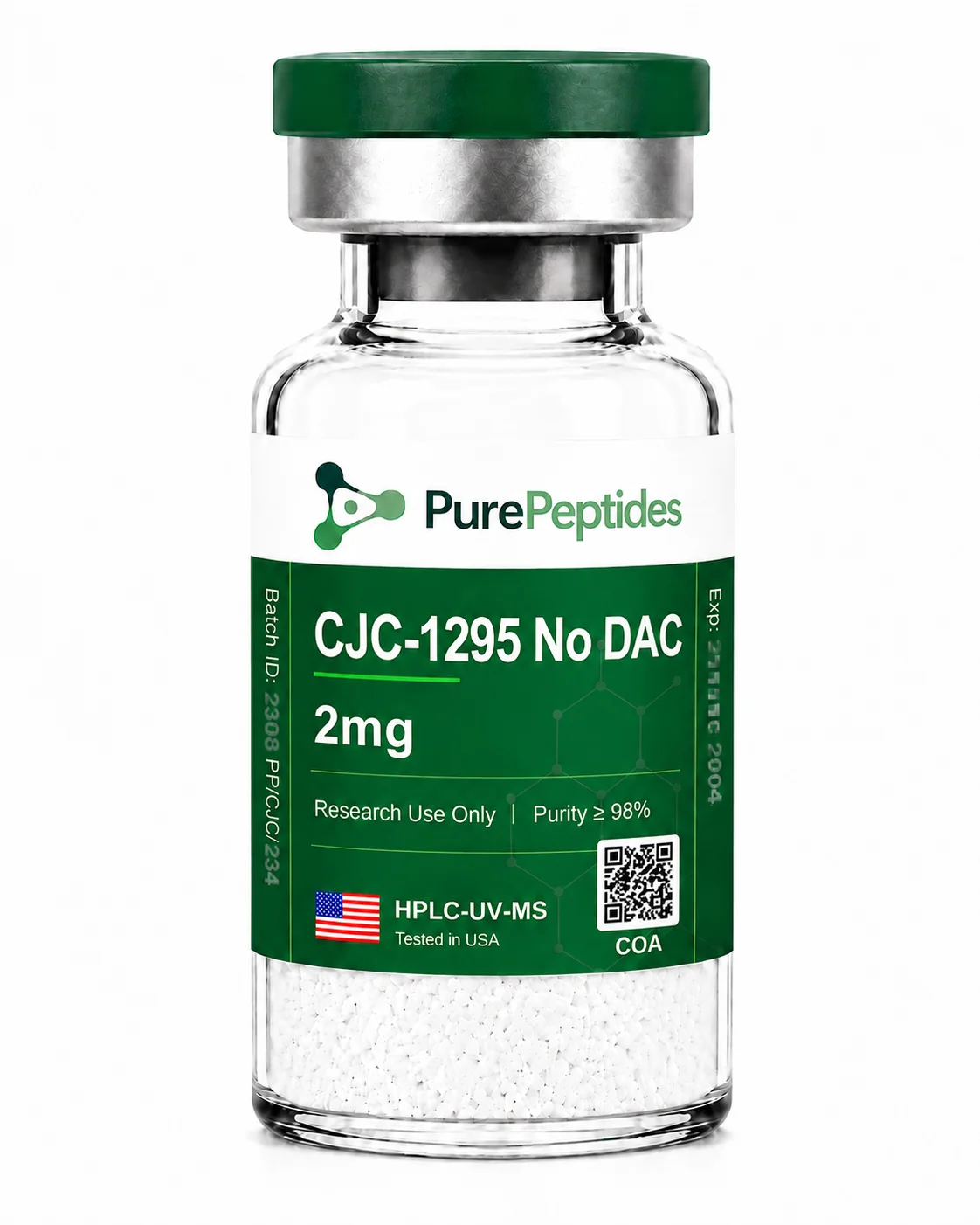
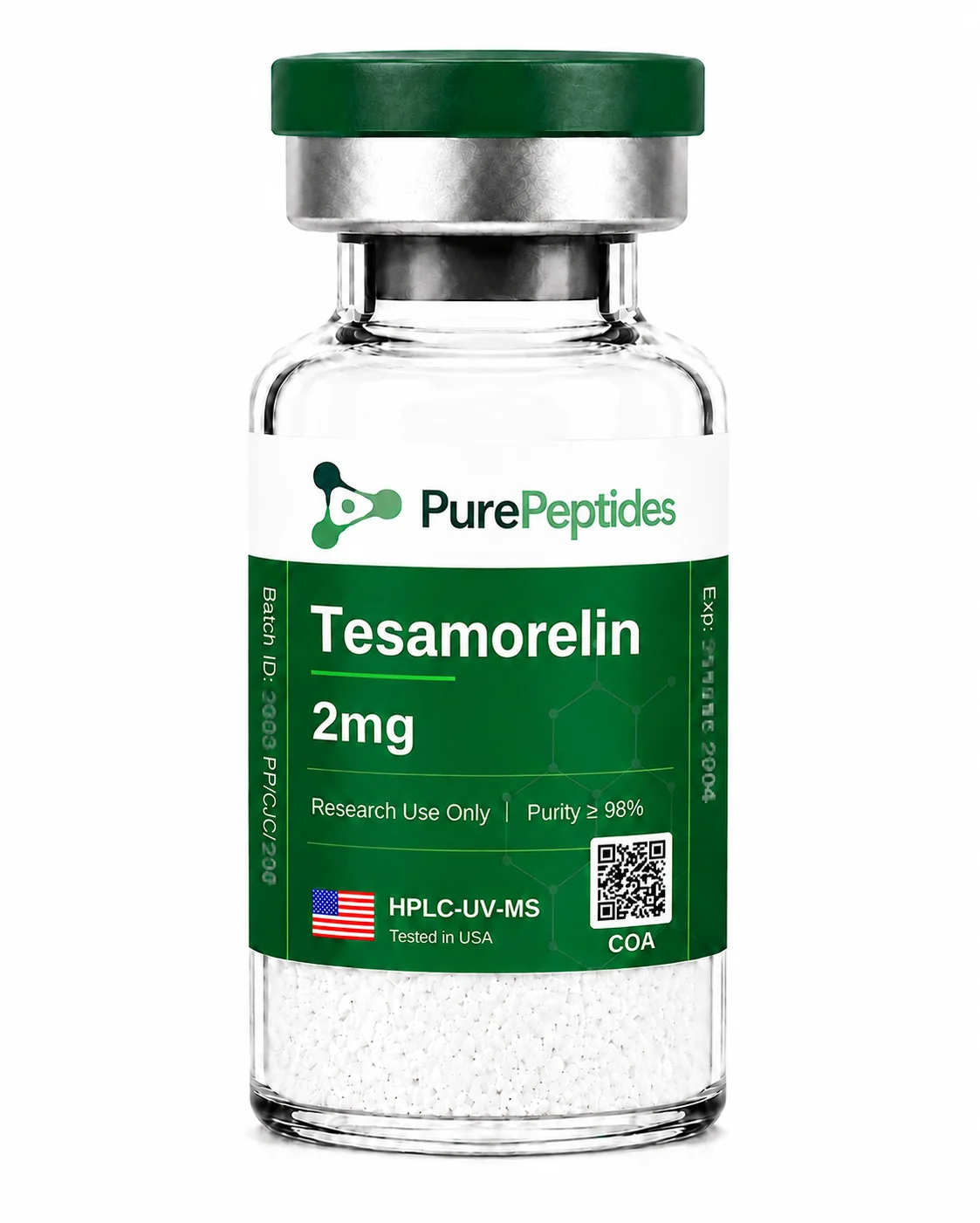
CJC-1295 (No DAC) and Tesamorelin are different molecules: CJC-1295 (No DAC) is human GHRH's first 29 residues with four substitutions; Tesamorelin is an analog of the full 44-residue hormone.
Structure at a glance
CJC-1295 (No DAC) · 29 residues
Tesamorelin · 44 residues
Hex: N-terminal trans-3-hexenoyl group. NH2: C-terminal amide. A raised D marks a D-amino acid. Codes are three-letter amino acid codes.
Drawn from the product database. Each measure's bars share one scale.
| Property | CJC-1295 (No DAC) | Tesamorelin |
|---|---|---|
| What it is | A synthetic analog of growth hormone-releasing hormone. Built on the GRF(1-29) backbone, with four amino acid substitutions.[1] | A 44-residue peptide: a synthetic analog of human growth hormone-releasing hormone with an N-terminal trans-3-hexenoyl group. |
| How they relate | Two molecules derived from the same parent, human growth hormone-releasing hormone. CJC-1295 (No DAC) is built on its first 29 residues, with four substitutions; Tesamorelin is an analog of the full 44-residue hormone. | |
| CAS number | 863288-34-0 | 218949-48-5 |
| Molecular formula | C152H252N44O42 | C221H366N72O67S |
| Molecular weight | 3,367.97 g/mol | 5,135.86 g/mol |
| Sequence | Tyr-D-Ala-Asp-Ala-Ile-Phe-Thr-Gln-Ser-Tyr-Arg-Lys-Val-Leu-Ala-Gln-Leu-Ser-Ala-Arg-Lys-Leu-Leu-Gln-Asp-Ile-Leu-Ser-Arg-NH2 | trans-3-hexenoyl-Tyr-Ala-Asp-Ala-Ile-Phe-Thr-Asn-Ser-Tyr-Arg-Lys-Val-Leu-Gly-Gln-Leu-Ser-Ala-Arg-Lys-Leu-Leu-Gln-Asp-Ile-Met-Ser-Arg-Gln-Gln-Gly-Glu-Ser-Asn-Gln-Glu-Arg-Gly-Ala-Arg-Ala-Arg-Leu-NH2 |
| Target | The GHRH receptor, a class B G protein-coupled receptor on anterior pituitary somatotrophs. | The pituitary GHRH receptor. |
| Evidence base | In the literature reviewed for CJC-1295 (No DAC), the pharmacokinetic findings were generated with the DAC form. Essentially uncharacterized in humans.[2] | Human studies, which supported an approval for one indication. A pooled analysis of two phase 3 trials covered 806 randomized participants.[3] Their primary endpoints were imaging surrogates. The trial papers were manufacturer-sponsored. |
| Regulatory status | No approval history of any kind. | The FDA approved tesamorelin acetate in 2010 for one therapeutic indication.[4][5] That approval is current. |
| Compared head-to-head? | No direct comparison found in PubMed (searched October 2026).[6] | |
| Handling difference | CJC-1295 (No DAC) contains no sulfur, so it carries neither methionine nor cysteine. Tesamorelin contains one methionine, which oxidizes on air exposure, and no cysteine. | |
How CJC-1295 (No DAC) and Tesamorelin differ
CJC-1295 (No DAC) and Tesamorelin are different molecules derived from the same parent, human growth hormone-releasing hormone (GHRH), a 44-residue hypothalamic hormone. CJC-1295 (No DAC) corresponds to the hormone's first 29 residues, the stretch named GRF(1-29), with four of those positions substituted. It is also sold as Modified GRF(1-29), a name that states that construction more plainly. Tesamorelin is an analog of the full 44-residue hormone, with a trans-3-hexenoyl group on its N-terminus. Both act at the GHRH receptor, a class B G protein-coupled receptor on the somatotroph cells of the anterior pituitary.
In the literature reviewed for CJC-1295 (No DAC), the pharmacokinetic findings, in rats and healthy volunteers, came from CJC-1295 with DAC, whose albumin-binding linker CJC-1295 (No DAC) lacks. CJC-1295 (No DAC) itself is essentially uncharacterized in humans.[2] In the literature reviewed for Tesamorelin, a pooled analysis of its two phase 3 trials covered 806 randomized participants.[3] The two trials' primary endpoints were imaging surrogates, not clinical outcomes. The two trial papers and the pooled analysis were manufacturer-sponsored, with sponsor-affiliated co-authors.
CJC-1295 (No DAC) has no approval history of any kind. The FDA approved tesamorelin acetate in 2010 for one therapeutic indication.[4][5] That approval is current. It belongs to tesamorelin acetate and that one indication, is not a family credential, and says nothing about other GHRH analogs. Tesamorelin acetate is the active ingredient of a prescription medicine sold under another name. The material supplied here is a research-grade preparation, is not that medicine, and holds no marketing authorization.
CJC-1295 (No DAC) contains no sulfur, so it carries neither methionine nor cysteine, and no disulfide or sulfoxide can form. Tesamorelin contains a single methionine, which oxidizes to a sulfoxide on air exposure, and no cysteine, so no disulfide is possible. Both contain residues that deamidate, and both chains have conformational structure to lose and can aggregate.
Have CJC-1295 (No DAC) and Tesamorelin been compared directly?
No direct comparison of CJC-1295 (No DAC) with Tesamorelin was found in a PubMed search run in October 2026.[6] That search covers PubMed only.
Read more on each compound
CJC-1295 (No DAC)
Frequently Asked Questions
Is CJC-1295 (No DAC) the same as Tesamorelin?+−
CJC-1295 (No DAC) and Tesamorelin are different molecules derived from the same parent, human growth hormone-releasing hormone. CJC-1295 (No DAC) is built on that hormone's first 29 residues, with four amino acid substitutions. Tesamorelin is an analog of the full 44-residue hormone, with a trans-3-hexenoyl group on its N-terminus.
Is CJC-1295 (No DAC) or Tesamorelin approved?+−
CJC-1295 (No DAC) has no approval history of any kind, while tesamorelin acetate is the active ingredient of a prescription medicine sold under another name. The material supplied here is a research-grade preparation, is not that medicine, and holds no marketing authorization. The FDA approval behind that medicine belongs to tesamorelin acetate and one indication.
References
- 1Jetté L, Léger R, Thibaudeau K, Benquet C, Robitaille M, Pellerin I, et al. Endocrinology. 2005;146(7):3052-3058. doi:10.1210/en.2004-1286. PMID 15817669.
- 2Dominikowski A, et al. Front Endocrinol (Lausanne) 2026. PMID 42395176. DOI 10.3389/fendo.2026.1822475. Narrative review.
- 3Falutz J, Mamputu JC, Potvin D, Moyle G, Soulban G, Loughrey H, et al. J Clin Endocrinol Metab. 2010;95(9):4291-4304. PMID 20554713.
- 4US Food and Drug Administration, Center for Drug Evaluation and Research. Approval letter for tesamorelin, 10 November 2010 (Reference ID 2863003).
- 5US Food and Drug Administration, Drugs@FDA. Approval record whose active ingredient is tesamorelin acetate; marketing status Prescription. Retrieved via api.fda.gov/drug/drugsfda.json on products.active_ingredients.name "TESAMORELIN ACETATE", 3 October 2026.
- 6PubMed search via NCBI E-utilities, run 3 October 2026; records entered to 2 October 2026. Query: ("CJC-1295"[tiab] OR "CJC 1295"[tiab] OR "CJC1295"[tiab] OR "modified GRF"[tiab] OR "mod GRF"[tiab] OR "modGRF"[tiab] OR "tetrasubstituted"[tiab] OR "DAC-free"[tiab] OR "non-DAC"[tiab] OR "without DAC"[tiab] OR "no DAC"[tiab]) AND ("tesamorelin"[tiab] OR "hexenoyl"[tiab] OR "trans-3-hexenoyl"[tiab]) AND ("1800/01/01"[edat] : "2026/10/02"[edat]). 15 records; none was a direct comparison of the two compounds.
Related comparisons
CJC-1295 (No DAC) vs CJC-1295 with DAC
CJC-1295 with DAC is a chemically modified form of CJC-1295 (No DAC); the DAC-free peptide is essentially uncharacterized in humans.
Read ComparisonIpamorelin vs Tesamorelin
Ipamorelin is a synthetic five-residue peptide; Tesamorelin is a synthetic 44-residue analog of human GHRH.
Read ComparisonSermorelin vs Tesamorelin
Sermorelin is the 29-residue N-terminal fragment of human GHRH; Tesamorelin is a modified analog of the full 44-residue hormone.
Read Comparison