
Published · 8 references
CJC-1295 (No DAC) vs CJC-1295 with DAC
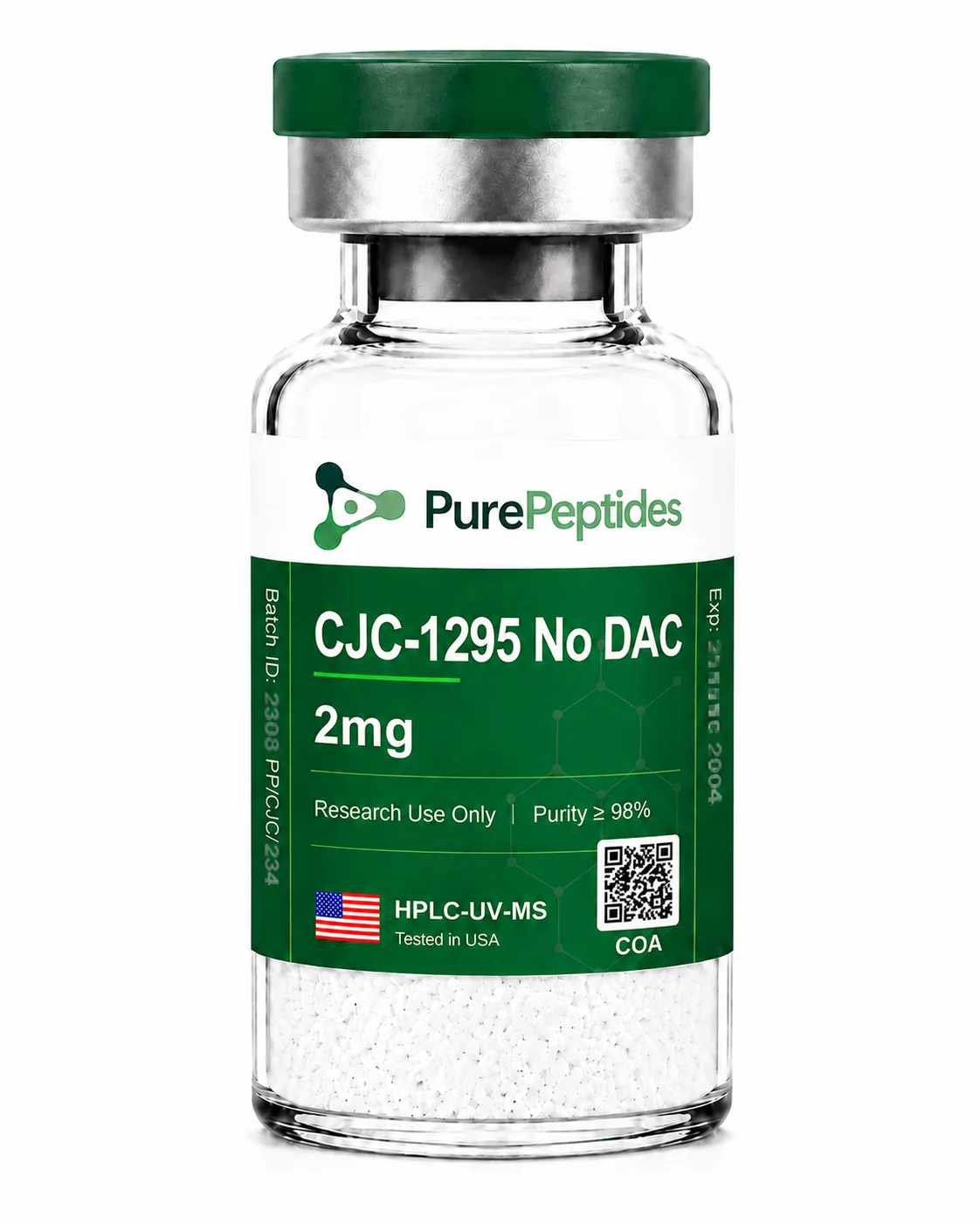
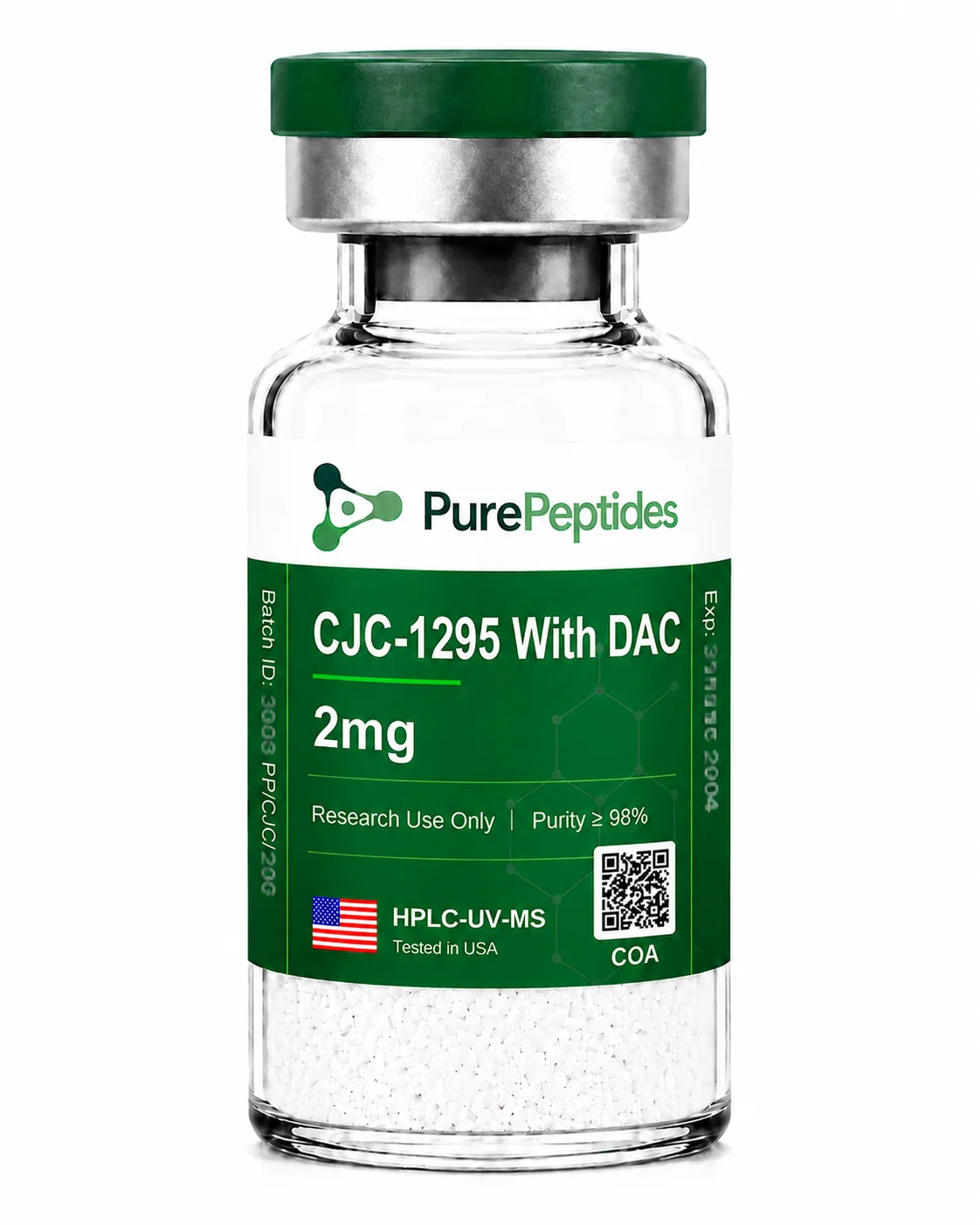
CJC-1295 (No DAC) and CJC-1295 with DAC are two different molecules: CJC-1295 with DAC is a chemically modified form carrying an albumin-binding group that CJC-1295 (No DAC) lacks.
Structure at a glance
Drawn from the product database. Each measure's bars share one scale.
| Property | CJC-1295 (No DAC) | CJC-1295 with DAC |
|---|---|---|
| What it is | A synthetic analog of growth hormone-releasing hormone. Built on the GRF(1-29) backbone, with four amino acid substitutions.[1] | The same substituted GRF(1-29) backbone, with an added group that reacts with a free thiol on albumin.[1] |
| How they relate | CJC-1295 with DAC is a chemically modified form of CJC-1295 (No DAC). The added group binds covalently to albumin.[1] | |
| CAS number | 863288-34-0 | 446262-90-4 |
| Molecular formula | C152H252N44O42 | C165H269N47O46 |
| Molecular weight | 3,367.97 g/mol | 3,647.28 g/mol |
| Target | The GHRH receptor, a class B G protein-coupled receptor on anterior pituitary somatotrophs. | The same GHRH receptor. The albumin conjugate activated it on the anterior pituitary, in rats.[1] |
| Reported half-life | Essentially uncharacterized in humans.[2] | Estimated half-life 5.8 to 8.1 days, in healthy volunteers.[3][4] |
| Evidence base | In the literature reviewed for CJC-1295 (No DAC), the pharmacokinetic findings were generated with the DAC form. Essentially uncharacterized in humans.[2] | Three published human studies, in 63 healthy volunteers.[4] The third analyzed a subset of the second cohort, not an independent third group.[5][4] Independent replication is limited. They were not designed to test a clinical endpoint. |
| Regulatory status | No approval history of any kind. | No marketing authorization anywhere, and no marketing application has ever been filed.[4] |
| Compared head-to-head? | No direct comparison found in PubMed (searched October 2026).[6] | |
| Handling difference | Neither molecule contains sulfur, so no disulfide chemistry applies to either. The bond attaching the group on CJC-1295 with DAC can hydrolyze, leaving two separate species. | |
| Where they get confused | Jette and colleagues identified the albumin-binding conjugate as CJC-1295.[1] A widely circulated CAS number for that conjugate resolves instead to the DAC-free peptide. That peptide is also sold as Modified GRF(1-29). | |
How CJC-1295 (No DAC) and CJC-1295 with DAC differ
CJC-1295 (No DAC) and CJC-1295 with DAC are not the same molecule. Both are built on the same substituted GRF(1-29) backbone.[1] CJC-1295 with DAC also carries an added group that reacts with a free thiol on albumin.[1] The core sold as CJC-1295 (No DAC) lacks that group. Jette and colleagues identified the albumin-binding conjugate under the name CJC-1295, in work in rats.[1]
In the literature reviewed for CJC-1295 with DAC, every figure was obtained with the DAC form alone, and CJC-1295 (No DAC) is essentially uncharacterized in humans.[2] In the literature reviewed for CJC-1295 (No DAC), the pharmacokinetic findings were generated with the DAC form as well. Much of that DAC-form work is preclinical, and independent replication is limited. The human record for the DAC form is three published studies in 63 healthy volunteers.[4] They were not designed to test a clinical endpoint. The third analyzed a subset of the second cohort, not an independent third group.[5][4] None of the three published studies included anyone with a disease or condition.[4] One interventional trial for the DAC form is on the US and EU registers, recorded as terminated.[7][8]
Neither compound holds an approval. CJC-1295 (No DAC) has no approval history of any kind. CJC-1295 with DAC holds no marketing authorization anywhere, and no marketing application has ever been filed for it.[4]
The DAC-free peptide is sold as CJC-1295 (No DAC) and also as Modified GRF(1-29), which states the construction more plainly. A widely circulated CAS number for the conjugate resolves instead to that DAC-free peptide, so an identifier check can point at the other molecule.
Neither molecule contains sulfur, so no disulfide chemistry applies to either. The bond attaching the group on CJC-1295 with DAC can hydrolyze, which leaves two separate species, and the DAC-free peptide carries no such bond.
Have CJC-1295 (No DAC) and CJC-1295 with DAC been compared directly?
No direct comparison was found in a PubMed search run in October 2026.[6] That search covers PubMed only.
Read more on each compound
CJC-1295 (No DAC)
Frequently Asked Questions
Is CJC-1295 (No DAC) the same as CJC-1295 with DAC?+−
CJC-1295 (No DAC) is not the same molecule as CJC-1295 with DAC. CJC-1295 with DAC is a chemically modified form of it, carrying an added group that binds covalently to albumin. Jette and colleagues identified that conjugate as CJC-1295.
Does research on CJC-1295 with DAC apply to CJC-1295 (No DAC)?+−
In the literature reviewed for CJC-1295 with DAC, every figure was obtained with the DAC form alone, and CJC-1295 (No DAC) is essentially uncharacterized in humans. In the literature reviewed for CJC-1295 (No DAC), the pharmacokinetic findings were generated with the DAC form as well.
References
- 1Jetté L, Léger R, Thibaudeau K, Benquet C, Robitaille M, Pellerin I, et al. Human growth hormone-releasing factor (hGRF)1-29-albumin bioconjugates activate the GRF receptor on the anterior pituitary in rats: identification of CJC-1295 as a long-lasting GRF analog. Endocrinology. 2005 Jul;146(7):3052-8. doi:10.1210/en.2004-1286. PMID 15817669.
- 2Dominikowski A, et al. Front Endocrinol (Lausanne) 2026. PMID 42395176. DOI 10.3389/fendo.2026.1822475. Narrative review.
- 4FDA Briefing Document for CJC-1295-Related Bulk Drug Substances, Center for Drug Evaluation and Research, Pharmacy Compounding Advisory Committee meeting 4 December 2024, 72 pages, docket FDA-2024-N-4777. Regulatory document, not peer-reviewed. fda.gov
- 5Sackmann-Sala L, et al. Growth Horm IGF Res 2009. PMID 19386527. DOI 10.1016/j.ghir.2009.03.001. Human.
- 6PubMed search via NCBI E-utilities, run 3 October 2026; records entered to 2 October 2026. Query: ("CJC-1295"[tiab] OR "CJC 1295"[tiab] OR "CJC1295"[tiab] OR "drug affinity complex"[tiab] OR "albumin bioconjugate"[tiab] OR "albumin bioconjugates"[tiab]) AND ("modified GRF"[tiab] OR "mod GRF"[tiab] OR "modGRF"[tiab] OR "without DAC"[tiab] OR "no DAC"[tiab] OR "DAC-free"[tiab] OR "non-DAC"[tiab] OR "GRF(1-29)"[tiab] OR "GRF 1-29"[tiab] OR "GRF1-29"[tiab] OR "GHRH(1-29)"[tiab] OR "tetrasubstituted"[tiab]) AND ("1800/01/01"[edat] : "2026/10/02"[edat]). 3 records; none was a direct comparison of the two compounds.
- 7NCT00267527, ClinicalTrials.gov registry record, last updated 12 October 2006. Not independently verified.
- 8ClinicalTrials.gov and EU Clinical Trials Register searches for CJC-1295, re-run 27 August 2026. Covers the US and EU registers only.
Related comparisons
AOD-9604 vs HGH Fragment 176-191
AOD-9604 and HGH Fragment 176-191 are 16-residue peptides from the C-terminal end of human growth hormone that differ at one position.
Read ComparisonSermorelin vs Tesamorelin
Sermorelin is the 29-residue N-terminal fragment of human GHRH; Tesamorelin is a modified analog of the full 44-residue hormone.
Read Comparison