
Published · 11 references
Sermorelin vs Tesamorelin
Sermorelin and Tesamorelin are different molecules: Sermorelin is the 29-residue N-terminal fragment of human growth hormone-releasing hormone, and Tesamorelin is a modified analog of the full 44-residue hormone.
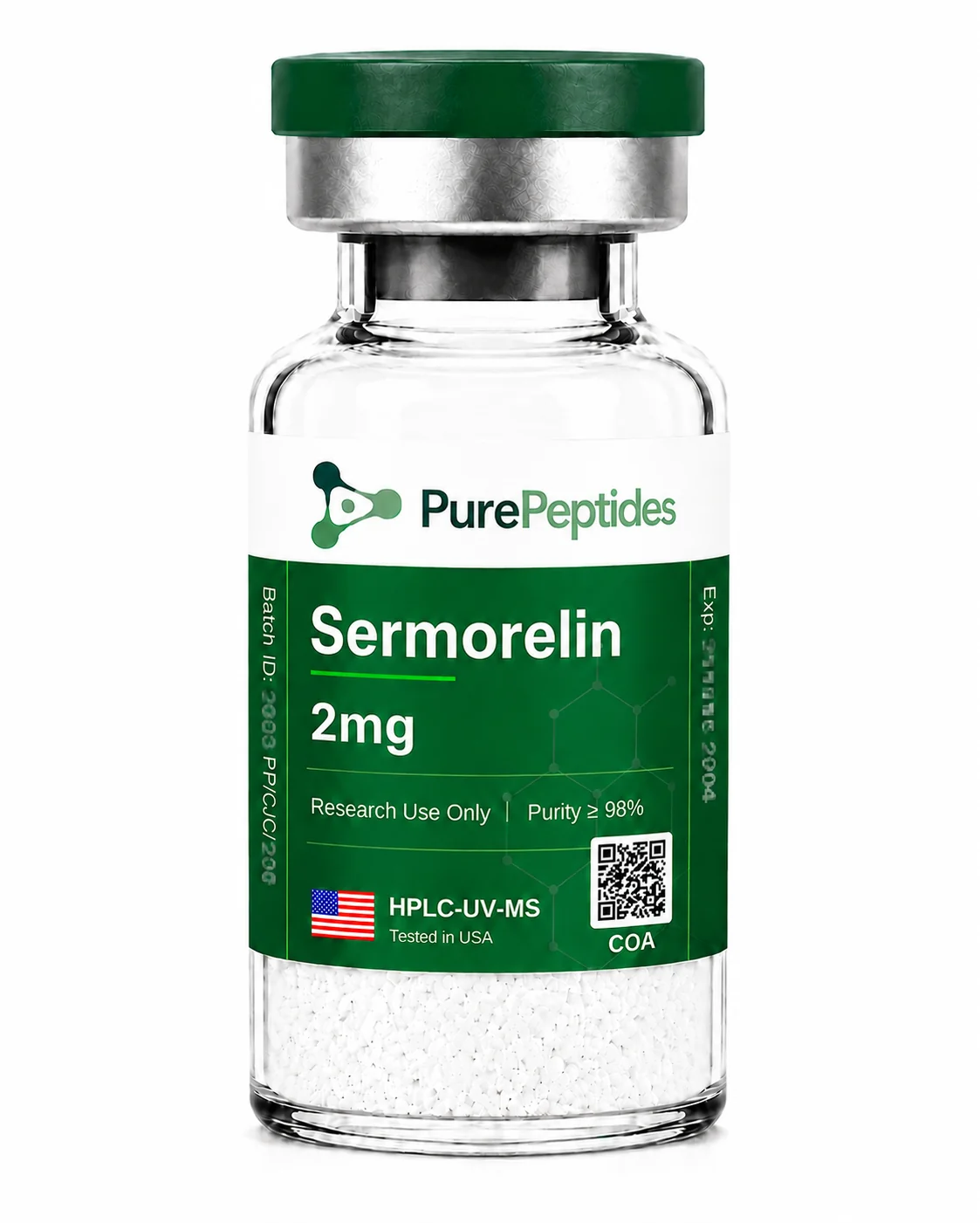
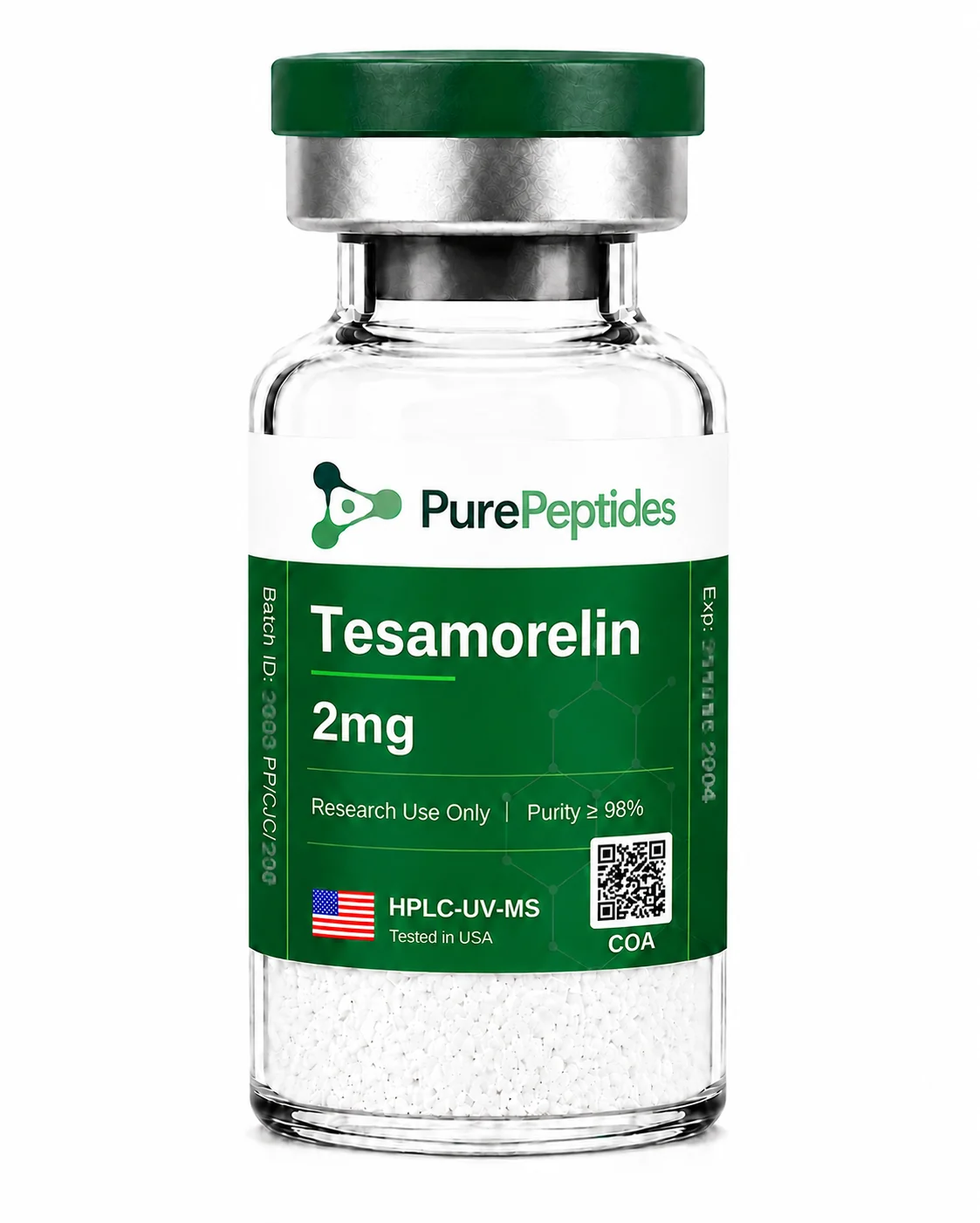
Structure at a glance
Drawn from the product database. Each measure's bars share one scale.
| Property | Sermorelin | Tesamorelin |
|---|---|---|
| What it is | A 29-residue peptide: the N-terminal fragment of the 44-residue human growth hormone-releasing hormone. | A 44-residue peptide: an analog of human growth hormone-releasing hormone with an N-terminal trans-3-hexenoyl group. |
| How they relate | Two molecules derived from the same parent, human growth hormone-releasing hormone. Sermorelin corresponds to its first 29 residues; Tesamorelin is an analog of the full 44-residue hormone, with an N-terminal trans-3-hexenoyl group. | |
| CAS number | 86168-78-7 | 218949-48-5 |
| Molecular formula | C149H246N44O42S | C221H366N72O67S |
| Molecular weight | 3,357.93 g/mol | 5,135.86 g/mol |
| Target | The pituitary GHRH receptor. | The pituitary GHRH receptor. |
| Evidence base | Human studies, which supported two US approvals, each for one indication: one diagnostic, one therapeutic.[1][2] | Human studies, which supported an approval for one indication. A pooled analysis of two phase 3 trials covered 806 randomized participants.[3] Their primary endpoints were imaging surrogates. The trial papers were manufacturer-sponsored. |
| Regulatory status | Sermorelin acetate held two US approvals, each for one indication: a diagnostic one in 1990 and a therapeutic one in 1997.[1][2] Both were withdrawn at the sponsor's request, as of June 2009.[1][2] No FDA-approved product containing it has existed since.[1] | The FDA approved tesamorelin acetate in 2010 for one therapeutic indication.[4][5] That approval is current. |
| Compared head-to-head? | No direct comparison found in PubMed (searched October 2026).[6] | |
| Handling difference | Both contain one methionine, which oxidizes on air exposure, and no cysteine. | |
| Where they get confused | The most widely known "GHRH" findings are not Sermorelin findings. One such human trial used Tesamorelin.[7] Some trial registry records returned by a Sermorelin search name the intervention only as GHRH, and at least two completed ones name Tesamorelin or its development code.[8] | |
How Sermorelin and Tesamorelin differ
Sermorelin and Tesamorelin are different molecules derived from the same parent, human growth hormone-releasing hormone (GHRH), a 44-residue hypothalamic hormone. Sermorelin is the N-terminal 29-residue fragment of that hormone, and the names GRF(1-29) and GHRH(1-29) both refer to it. Tesamorelin is an analog of the full 44-residue hormone, carrying a trans-3-hexenoyl group on its N-terminus. Sermorelin carries no such group; its N-terminus is free. Both act at the pituitary GHRH receptor.
In the literature reviewed for Sermorelin, the most widely known "GHRH" findings are not Sermorelin findings. One such human trial used Tesamorelin, and its abstract names that compound.[7] Nothing from that Tesamorelin literature transfers to Sermorelin. Other human "GHRH" trials in the literature reviewed for Sermorelin used a different molecule, a norleucine-substituted analog.[9][10] On the evidence available, those trials do not apply to Sermorelin either. In an August 2026 PubMed search, most of the 331 records naming Sermorelin used it as a diagnostic reagent rather than as the compound under study.[11]
In the literature reviewed for Tesamorelin, its two phase 3 trials used imaging surrogates as primary endpoints, not clinical outcomes. Those two papers and the pooled analysis of both were manufacturer-sponsored, with sponsor-affiliated co-authors.
The trial registry adds to the confusion. Some records returned by a Sermorelin search name the intervention only as GHRH.[8] At least two completed records in that search name Tesamorelin, directly or by its development code.[8]
Saying sermorelin acetate is FDA approved is false, and saying it was never FDA approved is equally false. It held two US approvals, each for one indication: a diagnostic one in 1990 and a therapeutic one in 1997.[1][2] Both were withdrawn at the sponsor's request, as of June 2009.[1][2] The FDA approved tesamorelin acetate in 2010 for one therapeutic indication.[4][5] That approval is current, and it belongs to tesamorelin acetate and that one indication. The sermorelin acetate record likewise belongs to that molecule alone, so neither record extends to the other. Both compounds, as supplied for research, are bulk material rather than finished medicines. Sermorelin acetate was the active ingredient of prescription medicines, since withdrawn; tesamorelin acetate is the active ingredient of a prescription medicine sold under another name. Neither material supplied here is one of those medicines: each is a research-grade preparation and holds no marketing authorization.
Have Sermorelin and Tesamorelin been compared directly?
No direct comparison of Sermorelin with Tesamorelin was found in a PubMed search run in October 2026.[6] That search covers PubMed only.
Read more on each compound
Sermorelin
Frequently Asked Questions
Is Sermorelin the same as Tesamorelin?+−
Sermorelin and Tesamorelin are different molecules derived from the same parent, human growth hormone-releasing hormone. Sermorelin is that hormone's N-terminal 29-residue fragment. Tesamorelin is an analog of the full 44-residue hormone, with a trans-3-hexenoyl group on its N-terminus.
Does research on Tesamorelin apply to Sermorelin?+−
In the literature reviewed for Sermorelin, one of the most widely known "GHRH" human trials used Tesamorelin, and nothing from that Tesamorelin literature transfers to Sermorelin. That trial's abstract names Tesamorelin as the compound it used.
Is Sermorelin or Tesamorelin approved?+−
Sermorelin acetate was the active ingredient of prescription medicines, since withdrawn; tesamorelin acetate is the active ingredient of a prescription medicine sold under another name. Neither material supplied here is one of those medicines: each is a research-grade preparation and holds no marketing authorization. Calling sermorelin acetate FDA approved is false; so is saying it was never approved.
References
- 1US Food and Drug Administration, Drugs@FDA. Records for the two sermorelin acetate applications; retrieved via the openFDA drug/drugsfda endpoint, 28 August 2026. Two applications and three products, all marketing status Discontinued.
- 2US Food and Drug Administration. Federal Register notice on the withdrawn sermorelin acetate products. 78 FR 14095, 4 March 2013, document 2013-04827. Full text retrieved from govinfo.gov, 28 August 2026.
- 3Falutz J, Mamputu JC, Potvin D, Moyle G, Soulban G, Loughrey H, et al. J Clin Endocrinol Metab. 2010;95(9):4291-4304. PMID 20554713.
- 4US Food and Drug Administration, Center for Drug Evaluation and Research. Approval letter for tesamorelin, 10 November 2010 (Reference ID 2863003).
- 5US Food and Drug Administration, Drugs@FDA. Approval record whose active ingredient is tesamorelin acetate; marketing status Prescription. Retrieved via api.fda.gov/drug/drugsfda.json on products.active_ingredients.name "TESAMORELIN ACETATE", 3 October 2026.
- 6PubMed search via NCBI E-utilities, run 3 October 2026; records entered to 2 October 2026. Query: ("sermorelin"[tiab] OR "GRF(1-29)"[tiab] OR "GHRH(1-29)"[tiab] OR "GRF 1-29"[tiab] OR "GHRH 1-29"[tiab] OR "hGRF(1-29)"[tiab] OR "growth hormone releasing hormone 1-29"[tiab] OR "growth hormone releasing factor 1-29"[tiab]) AND ("tesamorelin"[tiab]) AND ("1800/01/01"[edat] : "2026/10/02"[edat]). 12 records; none was a direct comparison of the two compounds.
- 7Baker LD, Barsness SM, Borson S, et al. Arch Neurol. 2012;69(11):1420-1429. PMID 22869065. The abstract identifies the intervention as tesamorelin.
- 8ClinicalTrials.gov, API v2, query.term=sermorelin, retrieved 28 August 2026; the query returns 42 records. Records cited here include NCT00257712 (completed; intervention named by tesamorelin's development code) and NCT00850564 (completed; intervention named as tesamorelin). The same query returns completed records whose only named intervention is "GHRH" with no molecule specified.
- 10Khorram O, Yeung M, Vu L, Yen SS. J Clin Endocrinol Metab. 1997;82(11):3590-3596. PMID 9360512. Companion paper from the same cohort.
- 11PubMed searches via NCBI E-utilities, 28 August 2026. "sermorelin" returns 331 records, most using it as a diagnostic reagent.
Related comparisons
AOD-9604 vs HGH Fragment 176-191
AOD-9604 and HGH Fragment 176-191 are 16-residue peptides from the C-terminal end of human growth hormone that differ at one position.
Read ComparisonCJC-1295 (No DAC) vs CJC-1295 with DAC
CJC-1295 with DAC is a chemically modified form of CJC-1295 (No DAC); the DAC-free peptide is essentially uncharacterized in humans.
Read Comparison