
Epitalon vs N-Acetyl Epitalon
Written by the Pure Peptides editorial team

Reviewed by Dr. Martina Rossi, PhD
Scientific Contributor and Reviewer · Reviewed
Published · Updated · 6 references
Epitalon and N-Acetyl Epitalon are different molecules: N-Acetyl Epitalon carries an N-terminal acetyl group and a C-terminal amide, and results reported for Epitalon cannot be assumed to hold for it.
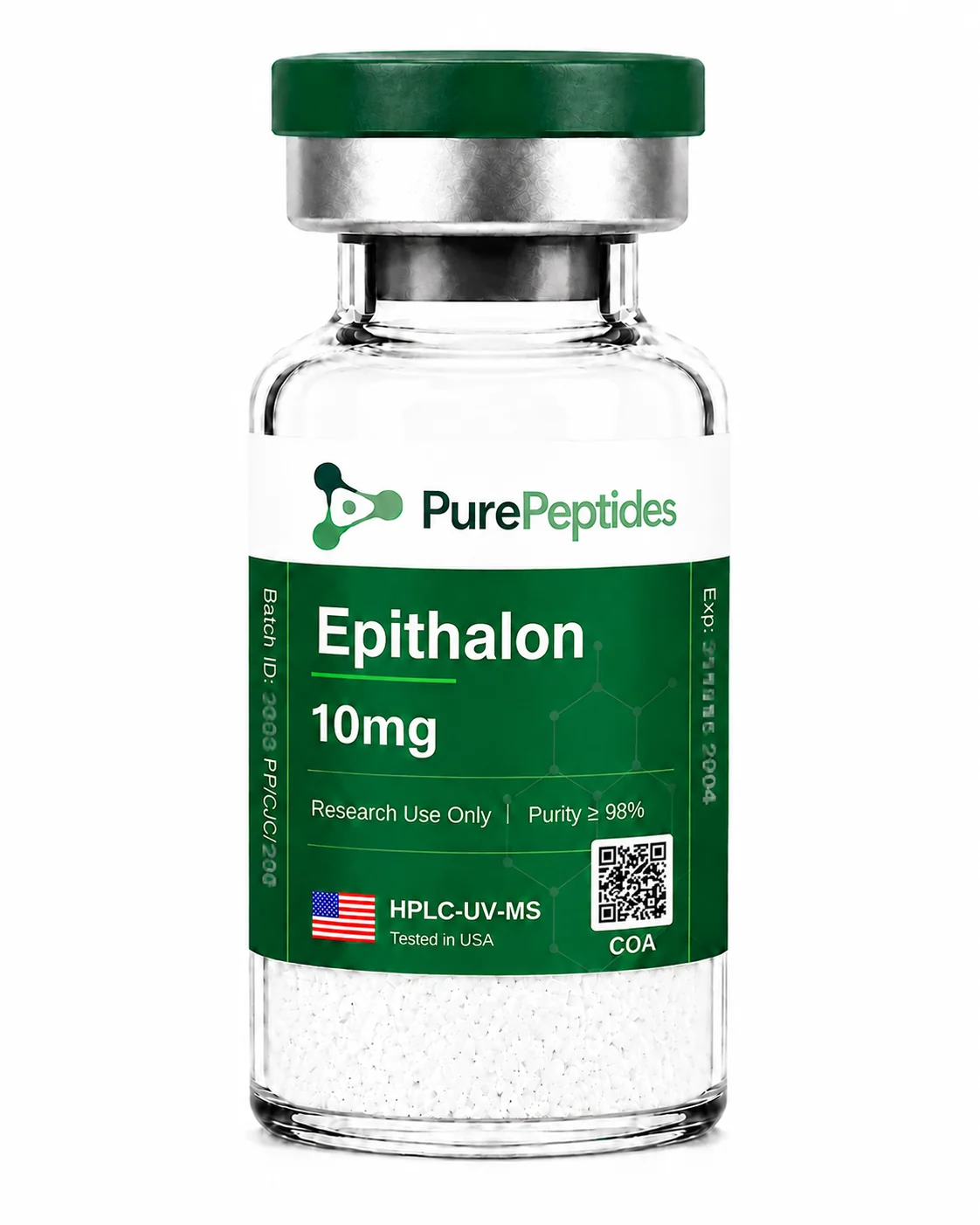
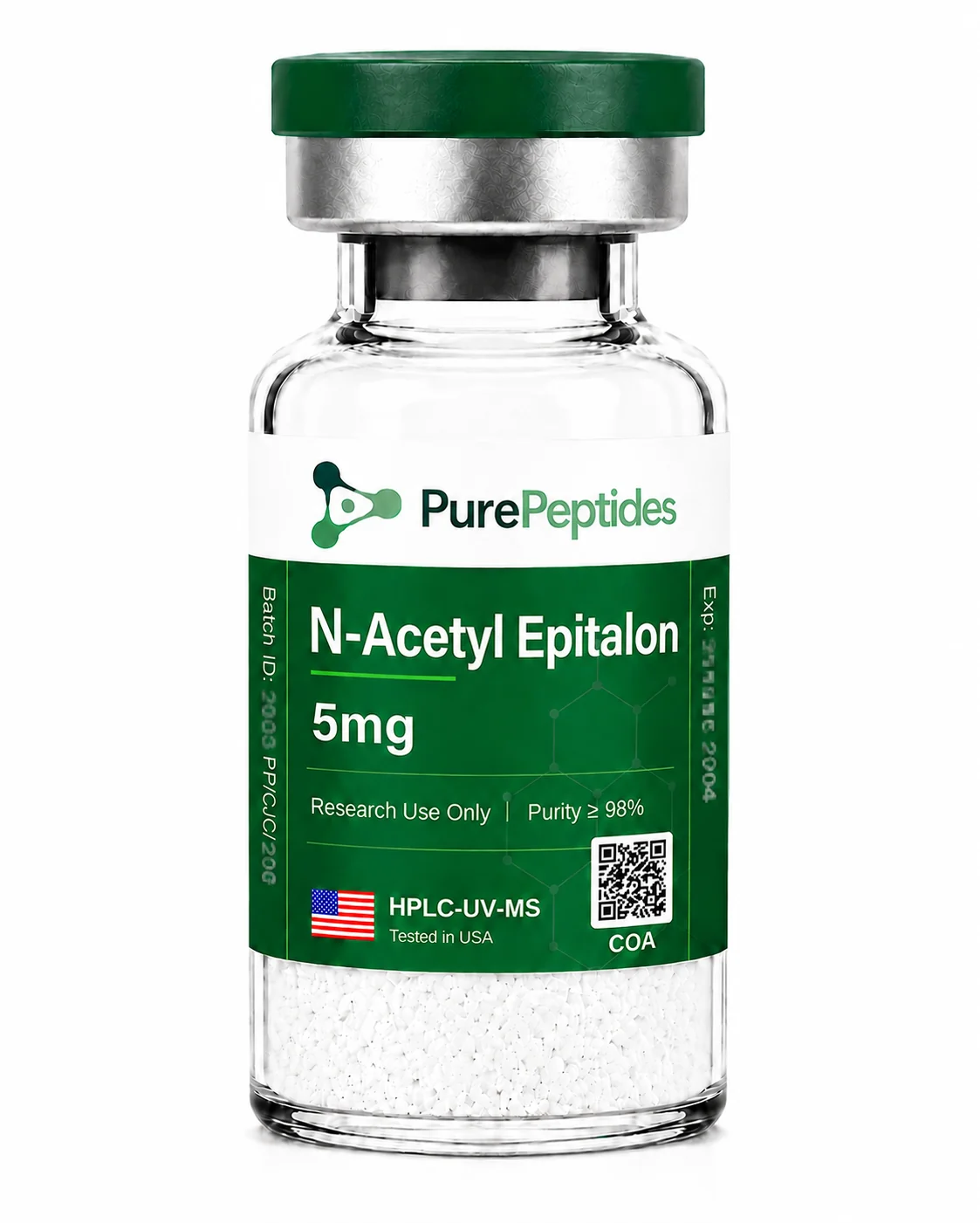
Structure at a glance
Epitalon
N-Acetyl Epitalon
Ac: N-terminal acetyl group. NH2: C-terminal amide. Letters are one-letter amino acid codes.
Drawn from the product database. Each measure's bars share one scale.
| Property | Epitalon | N-Acetyl Epitalon |
|---|---|---|
| What it is | A four-residue peptide, designed from the amino acid composition of Epithalamin, a bovine pineal gland extract.[1] Also written Epithalon. | The same four residues as Epitalon, with an acetyl group at the N-terminus and an amide at the C-terminus. PubChem's record titled N-Acetyl Epitalon is a different molecule, the free acid without that amide.[6] |
| How they relate | N-Acetyl Epitalon is a chemically modified form of Epitalon. Two caps distinguish it from the unmodified tetrapeptide: the acetyl at the N-terminus and the amide at the C-terminus. | |
| CAS number | 307297-39-8 | N/A (modified Epitalon form) |
| Molecular formula | C14H22N4O9 | C16H25N5O9 |
| Molecular weight | 390.35 g/mol | 431.40 g/mol |
| Sequence | AEDG | Ac-AEDG-NH2 |
| Target | No target established for Epitalon. Binding to DNA at gene promoters is a proposal, not a demonstrated mechanism. | No target established for N-Acetyl Epitalon. |
| Evidence base | FDA's literature search found three human studies.[2] The strongest of them did not specify blinding.[2] Russian-language journals hold at least six more, mostly small.[5] Also animal and in vitro studies. One research group produced almost all of the literature. | PubMed searches run in August 2026 returned zero records under every name variant of N-Acetyl Epitalon tried.[3] That shows absence from PubMed, not from all peer review. |
| Regulatory status | The FDA has not approved Epitalon for human use. A US orphan drug designation was granted in 2010 and withdrawn or revoked in 2016.[2] Designation is not approval. | The FDA has not approved N-Acetyl Epitalon for human use. |
| Compared head-to-head? | No direct comparison found in PubMed (searched October 2026).[4] | |
| Handling difference | Both contain an aspartate followed by glycine, which can rearrange to isoaspartate. | |
How Epitalon and N-Acetyl Epitalon differ
Epitalon and N-Acetyl Epitalon are not the same molecule. Both are four-residue peptides, and the four residues are the same. In N-Acetyl Epitalon, the N-terminus carries an acetyl group in place of a free amine, and the C-terminus is an amide in place of a free acid. Capping a peptide in this way makes a new compound with its own name and its own weight.
PubMed searches run in August 2026 returned zero records under every name variant of N-Acetyl Epitalon tried.[3] That establishes absence from PubMed, not absence from all peer review, and unindexed or non-English work may exist. No in vitro, animal or human study of N-Acetyl Epitalon could be located. The literature reviewed for N-Acetyl Epitalon reports no human safety data. For Epitalon, FDA's literature search found three human studies, and the strongest of them did not specify blinding.[2] Russian-language journals hold at least six more, most of them small and written by or with the developer's institute or at one Russian medical academy.[5] One research group produced almost all of the literature on Epitalon. In the literature reviewed for Epitalon, two of the Russian-language studies reported no side effects, though none was designed to detect harm.[5]
Acetylating the N-terminus removes the free alpha-amino group. In the literature reviewed for N-Acetyl Epitalon, results reported for Epitalon cannot be assumed to hold for the acetylated form, even taking the proposed DNA-binding mechanism at face value.
Epitalon was designed from the amino acid composition of Epithalamin, a bovine pineal gland extract.[1] Because Epithalamin is an undefined animal-tissue mixture and Epitalon one defined synthetic molecule, a result for one is not a result for the other. An independent 2025 review found structural work on Epitalon very limited.[1]
Both peptides carry an aspartate followed by glycine, which can rearrange to isoaspartate in solution. In N-Acetyl Epitalon, one impurity class is specific to an acetylated peptide: incompletely capped material, where the acetylation step did not go to completion.
Have Epitalon and N-Acetyl Epitalon been compared directly?
No direct comparison was found in a PubMed search run in October 2026.[4] That search covers PubMed only.
Read more on each compound
Epitalon
Frequently Asked Questions
Is Epitalon the same as N-Acetyl Epitalon?+−
Epitalon and N-Acetyl Epitalon are not the same molecule. N-Acetyl Epitalon has the same four residues, with an acetyl group at the N-terminus and an amide at the C-terminus. Capping a peptide in this way makes a new compound with its own name and its own weight.
Does research on Epitalon apply to N-Acetyl Epitalon?+−
Results reported for Epitalon cannot be assumed to hold for N-Acetyl Epitalon. Acetylating the N-terminus removes the free alpha-amino group. PubMed searches run in August 2026 returned zero records under every name variant of N-Acetyl Epitalon tried.
References
- 1Araj SK, Brzezik J, Madra-Gackowska K, Szeleszczuk L. International Journal of Molecular Sciences. 2025;26(6):2691. PMID 40141333.
- 2US Food and Drug Administration, Center for Drug Evaluation and Research. Briefing Document, Pharmacy Compounding Advisory Committee, July 2026. fda.gov
- 3PubMed E-utilities absence searches, run 27 August 2026. (Zero records for n-acetyl-epitalon and each further name variant listed.)
- 4
PubMed search, 3 October 2026 (records to 2 October 2026)
1 record; none was a direct comparison of the two compounds.
Exact query (NCBI E-utilities): ("N-acetyl epitalon"[tiab] OR "N-acetyl-epitalon"[tiab] OR "N-acetyl epithalon"[tiab] OR "acetyl epitalon"[tiab] OR "acetylated epitalon"[tiab] OR "Ac-AEDG"[tiab] OR "N-acetyl-Ala-Glu-Asp-Gly"[tiab] OR acetyl*[tiab] OR acetylated[tiab] OR acetylation[tiab]) AND ("epitalon"[tiab] OR "epithalon"[tiab] OR "epithalone"[tiab] OR "epitalone"[tiab] OR "AEDG"[tiab] OR "Ala-Glu-Asp-Gly"[tiab] OR "alanyl glutamyl aspartyl glycine"[nm]) AND ("1800/01/01"[edat] : "2026/10/02"[edat])
View this search on PubMed - 5Russian-language studies giving Epitalon to people beyond FDA's three, found through PubMed and CyberLeninka, 16 October 2026: a 2007 randomized, saline-controlled study in 40 people aged 60 to 79; a 2021 randomized, placebo-controlled study of a capsule supplement in 560 adults; and four smaller reports, mostly without a comparison group or blinding.
- 6PubChem Compound record CID 171390141, titled N-Acetyl Epitalon: C16H24N4O10, 432.38 g/mol, N-acetylated free acid; UNII UXR7AF6R4F. NIH/NLM, queried 3 November 2026. pubchem.ncbi.nlm.nih.gov
Reviewed for scientific accuracy
Dr. Martina Rossi, PhD
PhD, Université Grenoble Alpes · Scientific Contributor and Reviewer
Dr. Rossi's doctoral research at Université Grenoble Alpes examined the vascular functions of bone morphogenetic proteins. Her peer-reviewed work spans cell and molecular biology, vascular biology, and gene therapy, in journals including Cardiovascular Research, Scientific Reports, and Brain Sciences. She reviews Pure Peptides' product, reference, and research pages for scientific accuracy against the sources they cite.
Related comparisons
DSIP vs Epitalon
DSIP and Epitalon are different molecules: DSIP is a nine-residue peptide, and Epitalon is a four-residue peptide.
Read ComparisonEpitalon vs Pinealon
Epitalon and Pinealon are different molecules: a synthetic four-residue peptide and a synthetic three-residue one.
Read Comparison