Published · Updated · 9 references
GHK-Cu vs NAD+
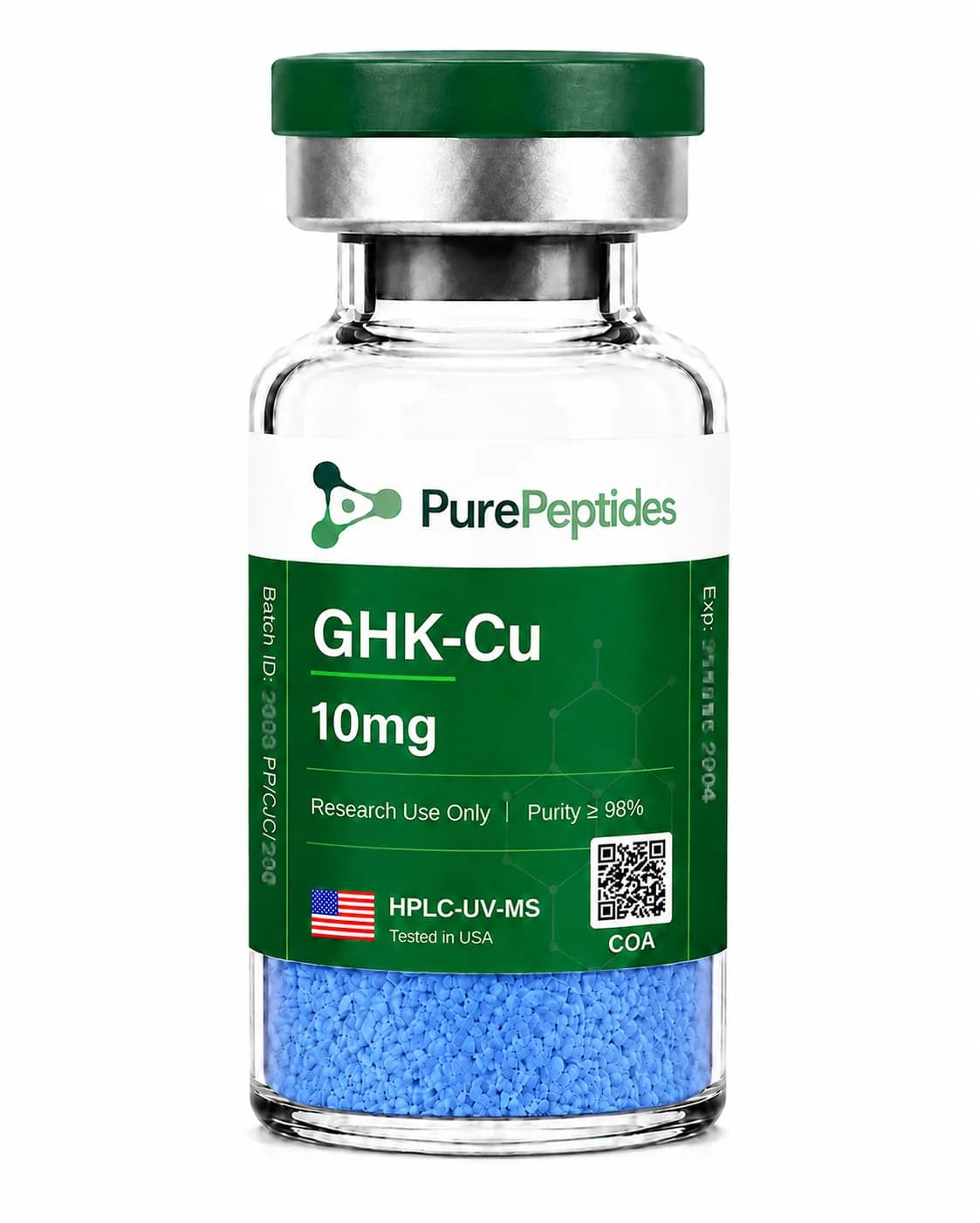
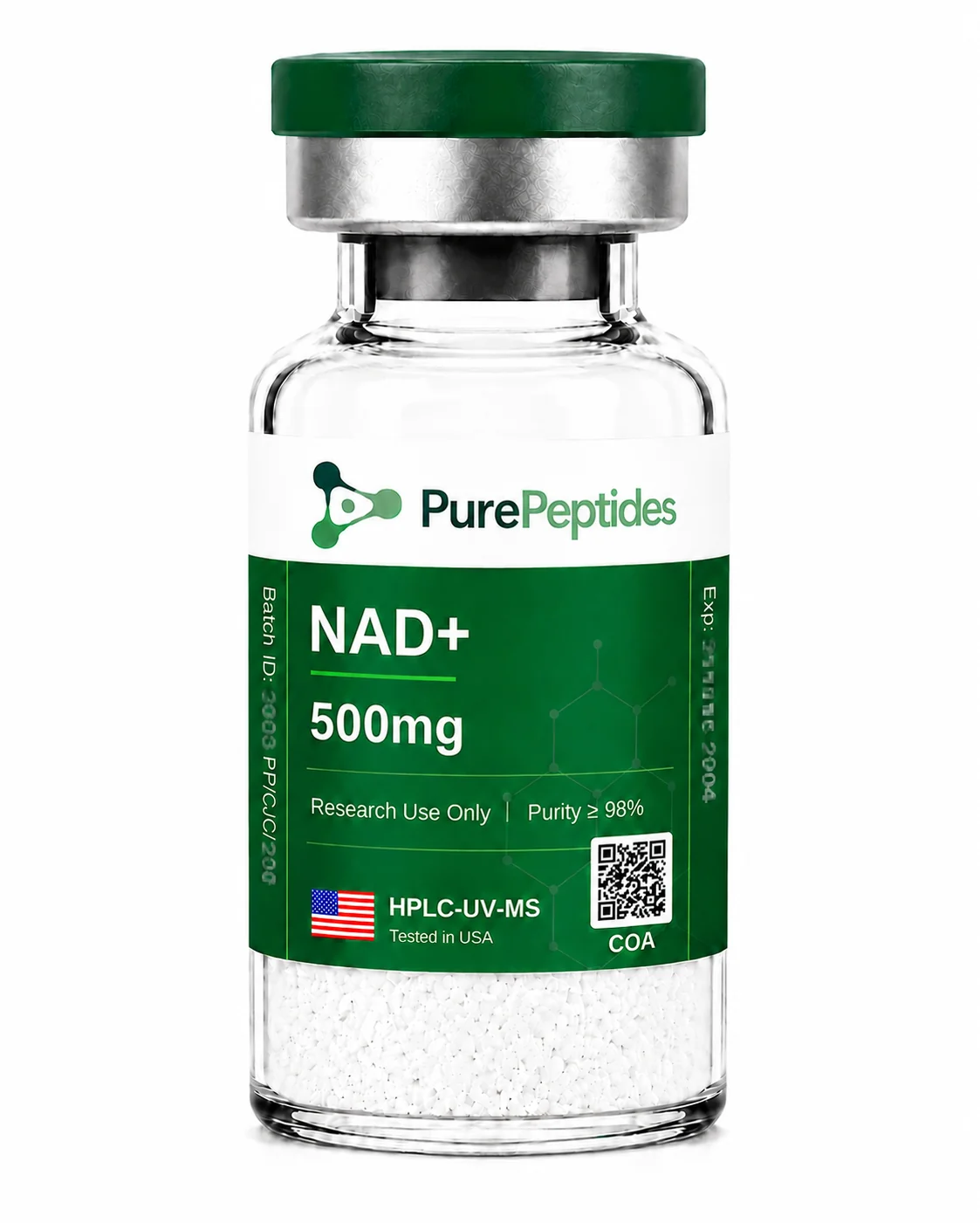
GHK-Cu and NAD+ are different molecules: GHK-Cu is a copper coordination complex of the three-residue peptide GHK, and NAD+ is a dinucleotide, not a peptide.
Structure at a glance
GHK-Cu: C 14, N 6, O 4, Cu 1. NAD+: C 21, N 7, O 14, P 2.
Drawn from the product database. Each measure's bars share one scale.
| Property | GHK-Cu | NAD+ |
|---|---|---|
| What it is | A copper coordination complex: the tripeptide GHK holding a single copper ion. The tripeptide was first reported in 1973, isolated from human serum.[1] | A dinucleotide, not a peptide.[2] Two nucleotide units joined through a pyrophosphate bridge. |
| How they relate | Different molecules. GHK-Cu is a copper coordination complex of the tripeptide GHK. NAD+ is a dinucleotide, not a peptide.[2] | |
| CAS number | 89030-95-5 | 53-84-9 |
| Molecular formula | C14H23CuN6O4+ | C21H27N7O14P2 |
| Molecular weight | 402.92 g/mol | 663.43 g/mol |
| Sequence | Gly-His-Lys | Not applicable (not a peptide) |
| Evidence base | Most of what is known comes from cell culture and animal models. Two controlled human trials isolated a copper tripeptide preparation as the variable; both were negative on their objective endpoints. | Human studies of NAD+ itself, in the literature reviewed for it, include one randomized trial.[3] The trial, in one indication, was single-center and unreplicated, and used a surrogate endpoint.[3] |
| Regulatory status | GHK-Cu holds no FDA approval. | NAD+ holds no FDA approval.[4] |
| Compared head-to-head? | No direct comparison found in PubMed (searched October 2026).[5] | |
| Handling difference | Competing chelators and pH extremes dissociate GHK-Cu's metal-ligand bond. NAD+ has two structural weak points that fail under opposite conditions: acid cleaves its pyrophosphate bridge, and alkaline conditions cleave its nicotinamide-ribose bond. | |
How GHK-Cu and NAD+ differ
GHK-Cu and NAD+ are different molecules. GHK-Cu is a copper coordination complex: the tripeptide GHK holding a single copper ion. NAD+ is nicotinamide adenine dinucleotide, a dinucleotide rather than a peptide.[2] It consists of two nucleotide units joined through a pyrophosphate bridge. The plus sign in its name denotes a permanent positive charge on the nitrogen of its nicotinamide ring.
In the literature reviewed for GHK-Cu, copper-loaded GHK-Cu and metal-free GHK are different test articles, and paper titles do not always make the difference clear. Some of the newer cell and animal work in that literature used metal-free GHK instead. In the literature reviewed for NAD+, a much larger body of work concerns two precursors, nicotinamide riboside and nicotinamide mononucleotide.[6][7] The two precursors are chemically distinct from NAD+, so a trial of either is not evidence about NAD+.[6][7]
For GHK-Cu, most of what is known comes from cell culture and animal models. Two controlled human trials isolated a copper tripeptide preparation as the variable, and both were negative on their objective endpoints. Other human reports on GHK-Cu are case reports, single-arm studies or trials of multi-ingredient formulations. In those designs it cannot be separated from the other active ingredients. One body of the cell and animal work comes substantially from one research group. That body of work used the copper complex throughout, and so did both controlled human trials. The compound's original discoverer, a commercially interested party, appears across the early work. The literature reviewed for GHK-Cu reports no human safety data.
In the literature reviewed for NAD+, the human studies of NAD+ itself are one randomized trial, one pharmacokinetic pilot and one retrospective record review.[3][8][9] The trial, in one indication, was single-center and has not been replicated.[3] Its primary endpoint was a surrogate imaging measure rather than a hard clinical outcome.[3] The pilot had three controls, and it reported no clinical outcome.[8] It was partly funded by a business with a commercial interest in NAD+ and run at a clinic with the same interest, and one author held roles at both.[8] The review was written by employees of a company with a commercial interest in NAD+, whose records it reviewed.[9] In the retrospective record review, which was not randomized, people exposed to NAD+ reported moderate to severe gastrointestinal symptoms, raised heart rate and chest pressure.[9]
GHK-Cu holds no FDA approval. NAD+ holds no FDA approval.[4]
GHK-Cu's vulnerable feature is its metal-ligand bond, which competing chelators and pH extremes dissociate. NAD+ has no metal center. NAD+ has two structural weak points, and they fail under opposite conditions. Acid cleaves its pyrophosphate bridge into two mononucleotide halves. Alkaline conditions instead cleave the glycosidic bond that holds its nicotinamide to a ribose.
Have GHK-Cu and NAD+ been compared directly?
No direct comparison of GHK-Cu with NAD+ was found in a PubMed search run in October 2026.[5] That search covers PubMed only.
Read more on each compound
GHK-Cu
Frequently Asked Questions
Is GHK-Cu the same as NAD+?+−
GHK-Cu and NAD+ are different molecules. GHK-Cu is a copper coordination complex: the tripeptide GHK holding a single copper ion. NAD+ is nicotinamide adenine dinucleotide, a dinucleotide rather than a peptide.
References
- 2PubChem Compound records, NCBI (PUG-REST), for NAD+, NADH and NADP.
- 4US FDA, openFDA drug/label and drug/drugsfda endpoints. Snapshot last updated 2026-08-26.
- 5PubMed search via NCBI E-utilities, run 3 October 2026; records entered to 2 October 2026. Query: ("GHK-Cu"[tiab] OR "GHK Cu"[tiab] OR "GHK-copper"[tiab] OR "copper GHK"[tiab] OR "Cu-GHK"[tiab] OR "copper tripeptide"[tiab] OR "copper tripeptide-1"[tiab] OR "copper peptide"[tiab] OR "copper peptides"[tiab] OR "prezatide"[tiab] OR "prezatide copper"[tiab] OR "glycyl-L-histidyl-L-lysine-copper"[tiab] OR "tripeptide-copper complex"[tiab]) AND ("NAD"[tiab] OR "NAD+"[tiab] OR "nicotinamide adenine dinucleotide"[tiab] OR "nadide"[tiab]) AND ("1800/01/01"[edat] : "2026/10/02"[edat]). 2 records; none was a direct comparison of the two compounds.
Related comparisons
MOTS-c vs NAD+
MOTS-c and NAD+ are different molecules: a 16-residue peptide encoded in a ribosomal RNA gene and a dinucleotide, not a peptide.
Read ComparisonAOD-9604 vs HGH Fragment 176-191
AOD-9604 and HGH Fragment 176-191 are 16-residue peptides from the C-terminal end of human growth hormone that differ at one position.
Read ComparisonAOD-9604 vs Tesamorelin
AOD-9604 is a modified 16-residue peptide from the C-terminal end of human growth hormone; Tesamorelin is a 44-residue analog of human GHRH.
Read Comparison