
Published · 10 references
GHRP-6 vs Ipamorelin
GHRP-6 and Ipamorelin are two different molecules: GHRP-6 is a synthetic six-residue peptide, and Ipamorelin is a synthetic five-residue peptide.
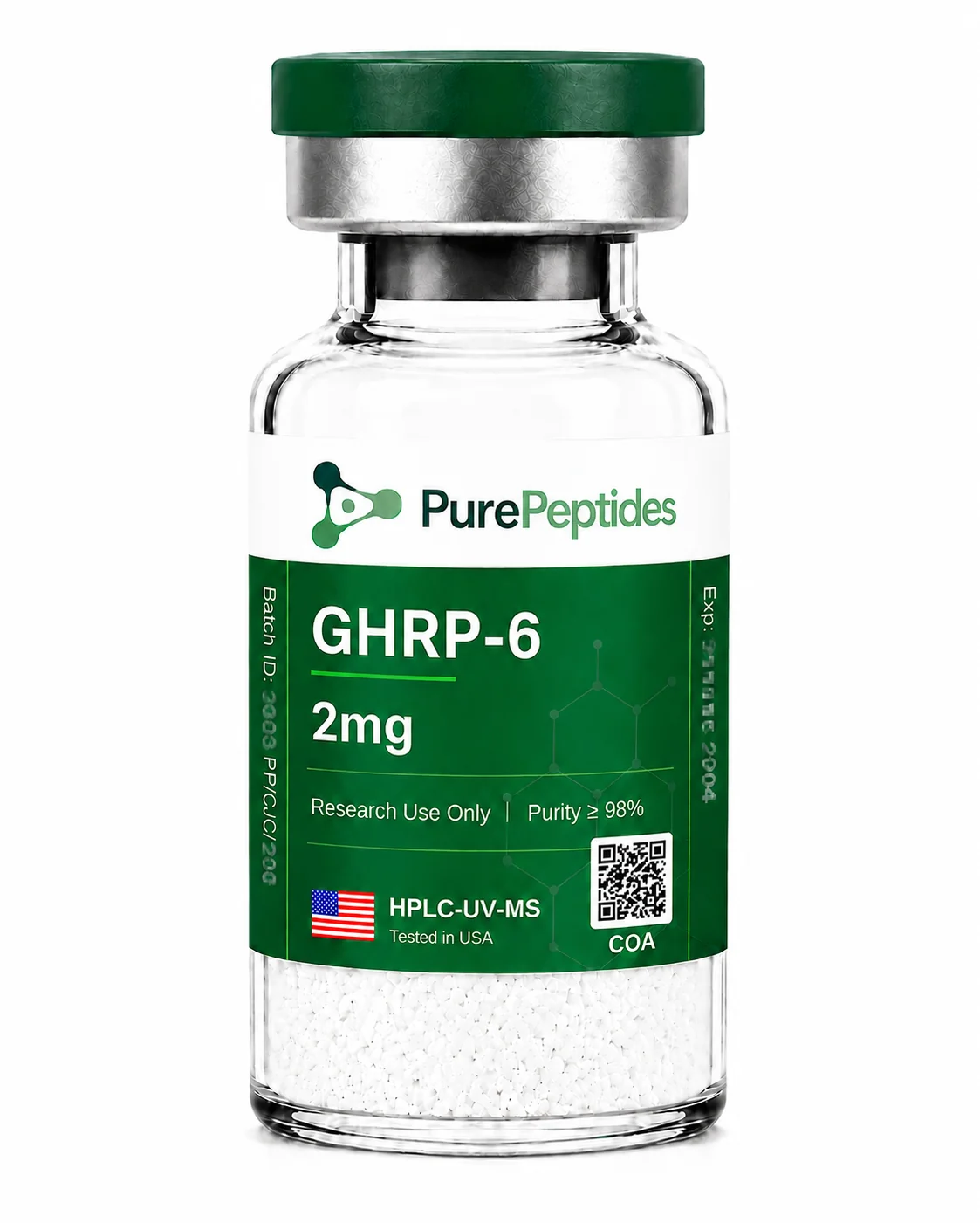
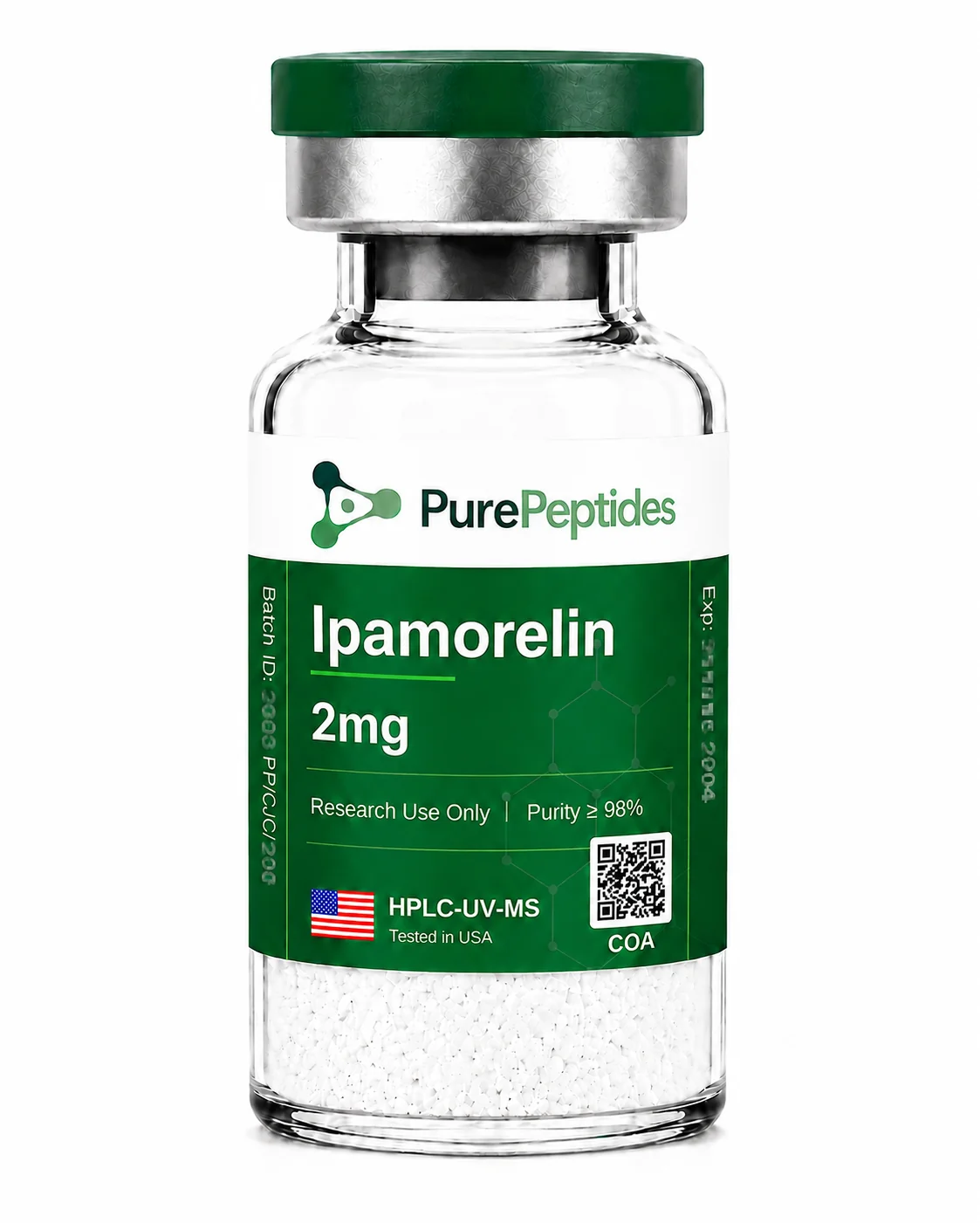
Structure at a glance
GHRP-6 · 6 residues
Ipamorelin · 5 residues
NH2: C-terminal amide. A raised D marks a D-amino acid. 2Nal: 2-naphthylalanine. Aib: alpha-aminoisobutyric acid. Codes are three-letter amino acid codes.
Drawn from the product database. Each measure's bars share one scale.
| Property | GHRP-6 | Ipamorelin |
|---|---|---|
| What it is | A synthetic six-residue peptide with a free N-terminal amine and a C-terminal amide. | A synthetic five-residue peptide that does not correspond to any natural peptide sequence. |
| How they relate | Different molecules. GHRP-6 is a synthetic hexapeptide in which two of the six residues are D-configured. Ipamorelin is a synthetic pentapeptide containing non-natural and D-configured amino acids, including alpha-aminoisobutyric acid. | |
| CAS number | 87616-84-0 | 170851-70-4 |
| Molecular formula | C46H56N12O6 | C38H49N9O5 |
| Molecular weight | 873.01 g/mol | 711.85 g/mol |
| Sequence | His-D-Trp-Ala-Trp-D-Phe-Lys-NH2 | Aib-His-D-2Nal-D-Phe-Lys-NH2 |
| Evidence base | In the literature reviewed for it, the human data come from acute studies. Registry searches return no registered interventional trials for it.[1] | Two human studies in the literature reviewed for it. One was a pharmacokinetic-pharmacodynamic study in healthy male volunteers.[2] The other, a randomized phase 2 trial, missed its key endpoint and its secondary analyses.[3] |
| Regulatory status | The FDA has not approved GHRP-6 for human use. | The FDA has not approved Ipamorelin for human use. |
| Compared head-to-head? | Yes: a 1998 study tested GHRP-6 and Ipamorelin in conscious swine.[4] The paper came from Ipamorelin's developer.[4] A 2000 study tested each in young adult female rats.[5] Further comparisons found in PubMed (searched October 2026).[6] | |
| Handling difference | Neither contains cysteine or methionine. GHRP-6 carries two tryptophans, whose oxidation is its main stability concern. Ipamorelin's aromatic side chains oxidize far more slowly than a tryptophan. | |
How GHRP-6 and Ipamorelin differ
GHRP-6 and Ipamorelin are different molecules. GHRP-6 is a synthetic six-residue peptide with a free N-terminal amine and a C-terminal amide. Ipamorelin is a synthetic five-residue peptide that does not correspond to any natural peptide sequence. Two of GHRP-6's six residues are D-configured, and it carries two tryptophans. Ipamorelin contains non-natural and D-configured amino acids, including alpha-aminoisobutyric acid and a D-configured naphthylalanine.
In the literature reviewed for GHRP-6, the human data come from acute studies. Registry searches return no registered interventional trials for it.[1] An author of the 1990 human study of GHRP-6 held an inventor interest.[7] The literature reviewed for GHRP-6 reports no serious safety finding from its human studies.
The literature reviewed for Ipamorelin includes two published human studies. One was an early-phase pharmacokinetic-pharmacodynamic study in healthy male volunteers.[2] The other was a randomized phase 2 trial of 114 participants, in one indication, and it missed its key endpoint and its secondary analyses.[3] Almost everything else known about Ipamorelin comes from preclinical pharmacology. Much of the defining preclinical work on Ipamorelin comes from its original developer, which raises the usual question of independent replication. The literature reviewed for Ipamorelin reports no serious safety finding from its human studies.
The FDA has not approved either GHRP-6 or Ipamorelin for human use.
Neither peptide contains cysteine, methionine, asparagine, glutamine or aspartate, so in each the degradation routes that dominate most peptides are closed. What remains in GHRP-6 is oxidation of its two tryptophan indoles, driven by air, light and trace metals. In Ipamorelin, the remaining routes are general. Its amide bonds hydrolyze under strong acid or alkali, slowly near neutral pH, and its aromatic side chains oxidize far more slowly than a tryptophan does. Each is cationic and carries aromatic rings, so each can adsorb to surfaces both electrostatically and hydrophobically. In each, mass spectrometry cannot verify the configuration of the D-residues, since a D-residue and its L-form are identical in mass.
Have GHRP-6 and Ipamorelin been compared directly?
A 1998 study tested GHRP-6 and Ipamorelin in conscious swine.[4] The paper came from Ipamorelin's developer.[4] A 2000 study tested each in young adult female rats.[5] A 2001 study tested each in mice.[8] A 2002 study tested each in vitro, in pituitary cell cultures from young female rats given one of three pretreatments.[9] A 2009 study tested each in a rat surgical model.[10] Results are reported for each compound in each paper.
Read more on each compound
GHRP-6
Frequently Asked Questions
Is GHRP-6 the same as Ipamorelin?+−
GHRP-6 and Ipamorelin are different molecules: GHRP-6 is a synthetic six-residue peptide, and Ipamorelin is a synthetic five-residue peptide. GHRP-6 has two D-configured residues and carries two tryptophans. Ipamorelin contains non-natural and D-configured amino acids, including alpha-aminoisobutyric acid.
References
- 1ClinicalTrials.gov v2 API, per-compound queries by intervention and general term, 27 August 2026. GHRP-6 returns zero registered studies.
- 2Gobburu JV, Agerso H, Jusko WJ, Ynddal L. Pharm Res. 1999;16(9):1412-6. doi:10.1023/a:1018955126402. PMID 10496658.
- 3Beck DE, Sweeney WB, McCarter MD. 2014;29(12):1527-1534. doi:10.1007/s00384-014-2030-8. PMID 25331030.
- 5Svensson J, Lall S, Dickson SL, Bengtsson BA, Rømer J, Ahnfelt-Rønne I, Ohlsson C, Jansson JO. J Endocrinol. 2000;165(3):569-577. PMID 10828840.
- 6PubMed search via NCBI E-utilities, run 3 October 2026; records entered to 2 October 2026. Query: ("GHRP-6"[tiab] OR "GHRP 6"[tiab] OR "GHRP6"[tiab] OR "growth hormone-releasing peptide-6"[tiab] OR "growth hormone releasing peptide-6"[tiab] OR "growth hormone releasing peptide 6"[tiab]) AND ("ipamorelin"[tiab]) AND ("1800/01/01"[edat] : "2026/10/02"[edat]). 22 records, including the 5 direct comparisons described above.
- 8Lall S, Tung LY, Ohlsson C, Jansson JO, Dickson SL. Biochem Biophys Res Commun. 2001;280(1):132-138. PMID 11162489.
- 9Jiménez-Reina L, Cañete R, de la Torre MJ, Bernal G. Histol Histopathol. 2002;17(3):707-714. PMID 12168778.
- 10Venkova K, Mann W, Nelson R, Greenwood-Van Meerveld B. J Pharmacol Exp Ther. 2009;329(3):1110-1116. PMID 19289567.
Related comparisons
CJC-1295 (No DAC) vs Ipamorelin
CJC-1295 (No DAC) is a synthetic peptide built on human GHRH's first 29 residues; Ipamorelin is a synthetic five-residue peptide.
Read ComparisonGHRP-2 vs GHRP-6
GHRP-2 and GHRP-6 are different molecules: six-residue peptides differing in composition, including how many residues are D-configured.
Read ComparisonIpamorelin vs Sermorelin
Ipamorelin is a five-residue peptide; Sermorelin is the 29-residue N-terminal fragment of human GHRH.
Read Comparison