
Published · 12 references
GHRP-2 vs GHRP-6
GHRP-2 and GHRP-6 are different molecules: each is a synthetic six-residue peptide, and they differ in composition, including how many of their residues are D-configured.
Structure at a glance
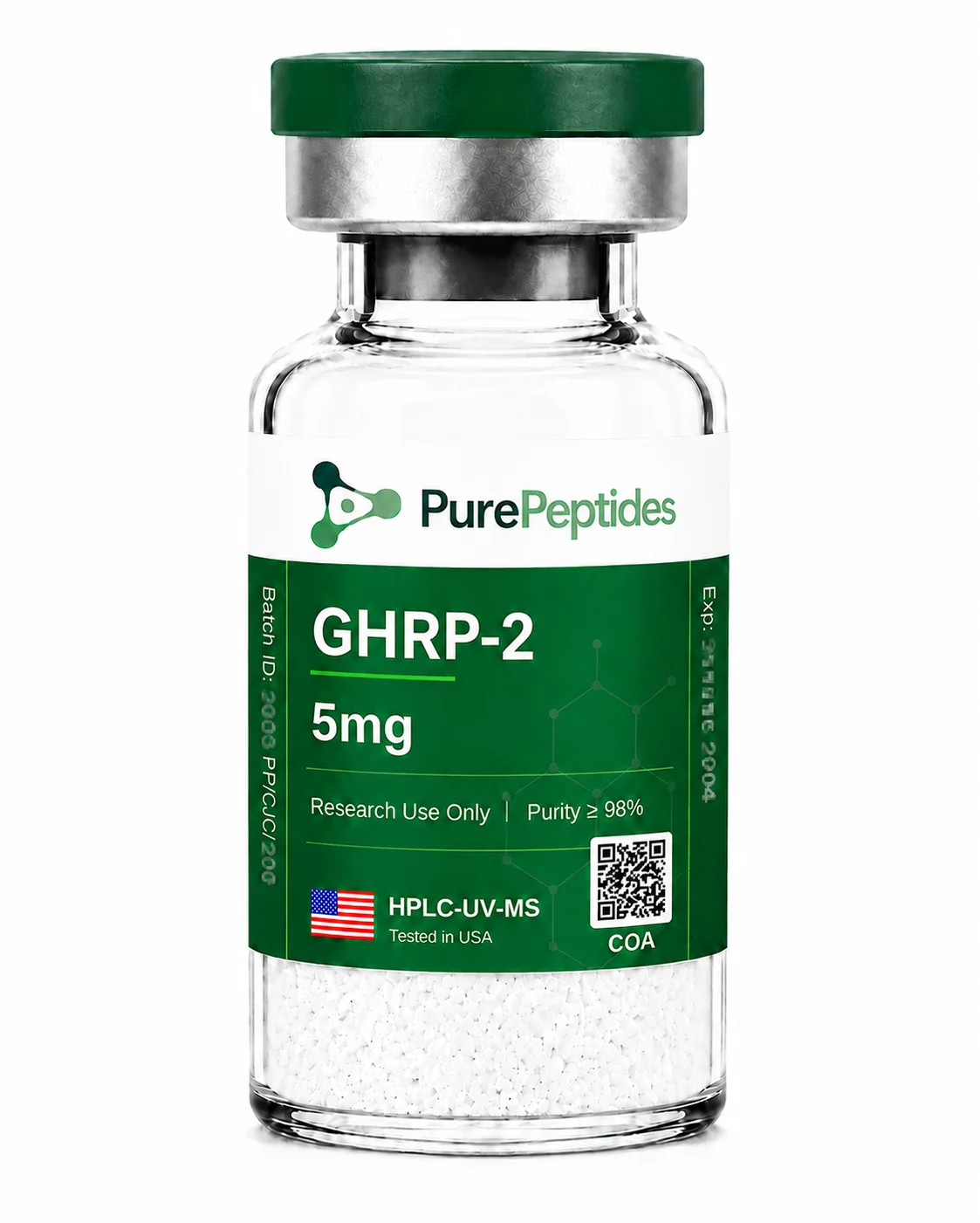
GHRP-2
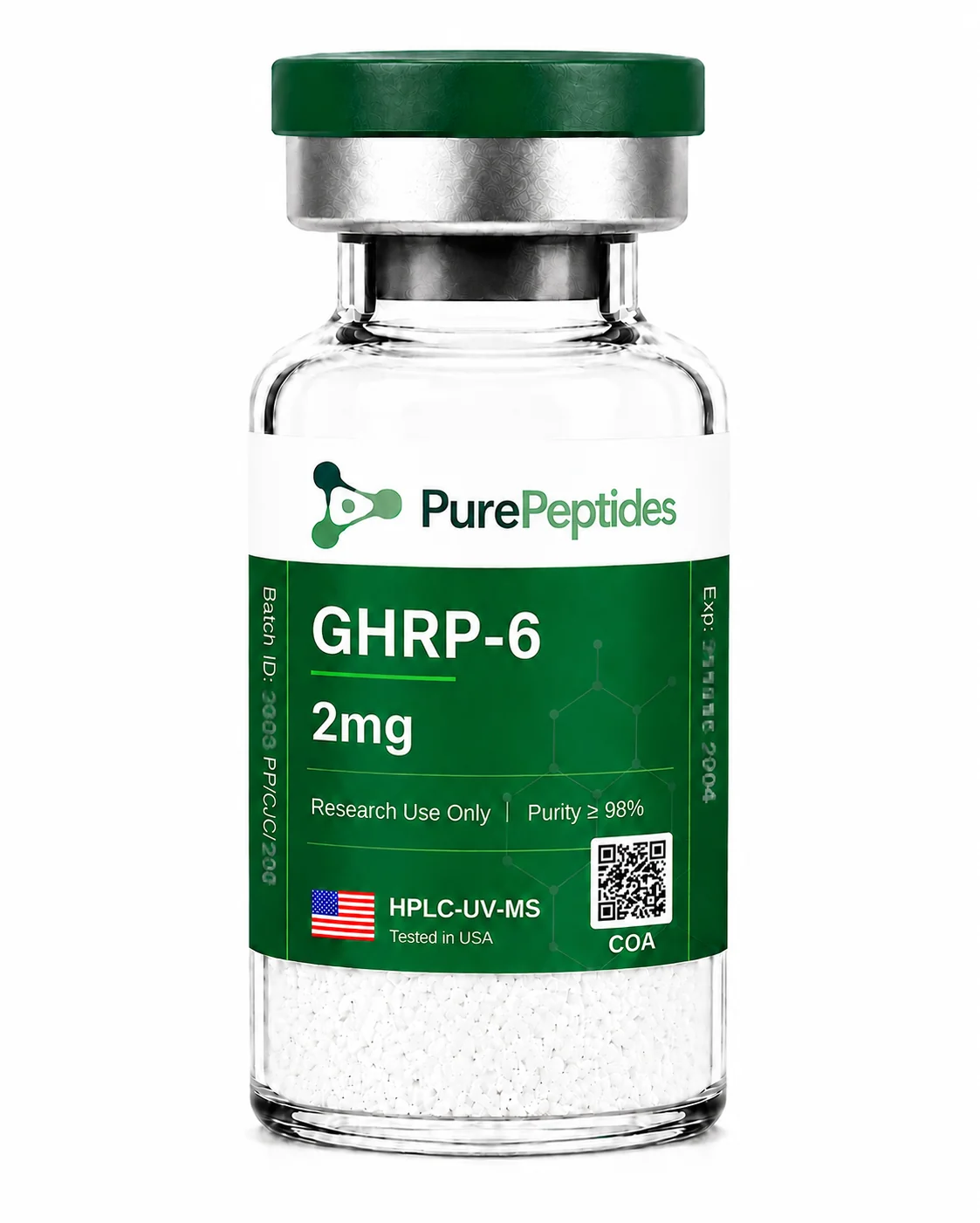
GHRP-6
NH2: C-terminal amide. A raised D marks a D-amino acid. 2Nal: 2-naphthylalanine. Codes are three-letter amino acid codes.
Drawn from the product database. Each measure's bars share one scale.
| Property | GHRP-2 | GHRP-6 |
|---|---|---|
| What it is | A synthetic six-residue peptide with a free N-terminal amine and a C-terminal amide. | A synthetic six-residue peptide with a free N-terminal amine and a C-terminal amide. |
| How they relate | Different molecules. GHRP-2 is a synthetic hexapeptide in which three of the six residues are D-configured. GHRP-6 is a synthetic hexapeptide in which two of the six residues are D-configured. | |
| CAS number | 158861-67-7 | 87616-84-0 |
| Molecular formula | C45H55N9O6 | C46H56N12O6 |
| Molecular weight | 817.99 g/mol | 873.01 g/mol |
| Sequence | D-Ala-D-2Nal-Ala-Trp-D-Phe-Lys-NH2 | His-D-Trp-Ala-Trp-D-Phe-Lys-NH2 |
| Evidence base | Human data on GHRP-2 are narrow. Registry searches return no registered interventional trials for it.[1] | In the literature reviewed for it, the human data come from acute studies. Registry searches return no registered interventional trials for it.[2] |
| Regulatory status | The FDA has not approved GHRP-2 for human use. | The FDA has not approved GHRP-6 for human use. |
| Compared head-to-head? | Yes: a 1998 study tested GHRP-2 and GHRP-6 in conscious swine.[3] Another 1998 study tested both in human pituitary and hypothalamic membranes.[4] Further comparisons found in PubMed (searched October 2026).[5] | |
| Handling difference | Neither contains cysteine or methionine. In each, tryptophan oxidation is the main stability concern: GHRP-2 carries one tryptophan and GHRP-6 two. | |
How GHRP-2 and GHRP-6 differ
GHRP-2 and GHRP-6 are different molecules. Both are synthetic six-residue peptides with a free N-terminal amine and a C-terminal amide. Their compositions differ. Three of GHRP-2's six residues are D-configured, it carries one tryptophan, and one of its residues, 2-naphthylalanine, does not occur in proteins. Two of GHRP-6's six residues are D-configured, and it carries two tryptophans.
A small human study often cited for GHRP-6 tested GHRP-2 and a third peptide.[6] GHRP-6 appears in it only in the introduction and was not tested.[6] No finding from that study was obtained with GHRP-6.
An author of the 1990 human study of GHRP-6 originated the GHRP series and held an inventor interest.[7]
Neither peptide contains cysteine, methionine, asparagine, glutamine or aspartate, so in each the routes that dominate most peptides' degradation are closed. What remains is oxidation of the tryptophan indole, driven by air, light and trace metals. In GHRP-6, the histidine coordinates transition metals, and trace metal contamination promotes tryptophan oxidation. Each is cationic and carries aromatic rings, so each can adsorb to surfaces both electrostatically and hydrophobically. In GHRP-2, those rings include the fused bicyclic naphthalene of its 2-naphthylalanine. In each, mass spectrometry cannot verify the configuration of the D-residues, since a D-residue and its L-form are identical in mass.
The FDA has not approved either GHRP-2 or GHRP-6 for human use.
Have GHRP-2 and GHRP-6 been compared directly?
A 1998 study tested GHRP-2 and GHRP-6 in conscious swine.[3] Results are reported for each compound in that model. Five studies in cells or tissue tested GHRP-2 and GHRP-6 in the same system. Two used human material: pituitary and hypothalamic membranes (1998)[4] and cell cultures from pituitary tumors (1996).[8] Three used animal pituitary cells: rat (1997),[9] sheep and rat (1996)[10] and sheep (1997).[11] Results are reported for each compound in each assay. A 2013 study tested both in mice.[12] Results are reported for each compound in that model.
Read more on each compound
GHRP-2
Frequently Asked Questions
Is GHRP-2 the same as GHRP-6?+−
GHRP-2 and GHRP-6 are different molecules, though each is a synthetic six-residue peptide. Three of GHRP-2's residues are D-configured, and one, 2-naphthylalanine, does not occur in proteins. Two of GHRP-6's residues are D-configured, and it carries two tryptophans.
Does research on GHRP-2 apply to GHRP-6?+−
A small human study often cited for GHRP-6 tested GHRP-2 and a third peptide, and GHRP-6 was not tested in it. No finding from that study was obtained with GHRP-6.
References
- 1ClinicalTrials.gov API v2 registry query for GHRP-2, retrieved 27 August 2026.
- 2ClinicalTrials.gov v2 API, per-compound queries by intervention and general term, 27 August 2026. GHRP-6 returns zero registered studies.
- 4Muccioli G, Ghè C, Ghigo MC, Papotti M, Arvat E, Boghen MF, Nilsson MH, Deghenghi R, Ong H, Ghigo E. J Endocrinol. 1998;157(1):99-106. PMID 9614363.
- 5PubMed search via NCBI E-utilities, run 3 October 2026; records entered to 2 October 2026. Query: ("GHRP-2"[tiab] OR "GHRP 2"[tiab] OR "GHRP2"[tiab] OR "pralmorelin"[tiab] OR "growth hormone-releasing peptide-2"[tiab] OR "growth hormone releasing peptide-2"[tiab] OR "growth hormone releasing peptide 2"[tiab]) AND ("GHRP-6"[tiab] OR "GHRP 6"[tiab] OR "GHRP6"[tiab] OR "growth hormone-releasing peptide-6"[tiab] OR "growth hormone releasing peptide-6"[tiab] OR "growth hormone releasing peptide 6"[tiab]) AND ("1800/01/01"[edat] : "2026/10/02"[edat]). 40 records, including the 7 direct comparisons described above.
- 6Arvat E, et al. Peptides 1997. PMID 9285939. DOI: 10.1016/s0196-9781(97)00016-8. GHRP-2 and hexarelin only; GHRP-6 was not administered.
- 8Adams EF, Lei T, Buchfelder M, Bowers CY, Fahlbusch R. Mol Endocrinol. 1996;10(4):432-438. PMID 8721987.
- 12Zeng P, Chen JX, Yang B, Zhi X, Guo FX, Sun ML, Wang JL, Wei J. Peptides. 2013;50:42-49. PMID 24113541.
Related comparisons
AOD-9604 vs HGH Fragment 176-191
AOD-9604 and HGH Fragment 176-191 are 16-residue peptides from the C-terminal end of human growth hormone that differ at one position.
Read ComparisonAOD-9604 vs Tesamorelin
AOD-9604 is a modified 16-residue peptide from the C-terminal end of human growth hormone; Tesamorelin is a 44-residue analog of human GHRH.
Read ComparisonCJC-1295 (No DAC) vs CJC-1295 with DAC
CJC-1295 with DAC is a chemically modified form of CJC-1295 (No DAC); the DAC-free peptide is essentially uncharacterized in humans.
Read Comparison