
Published · 6 references
Ipamorelin vs Sermorelin
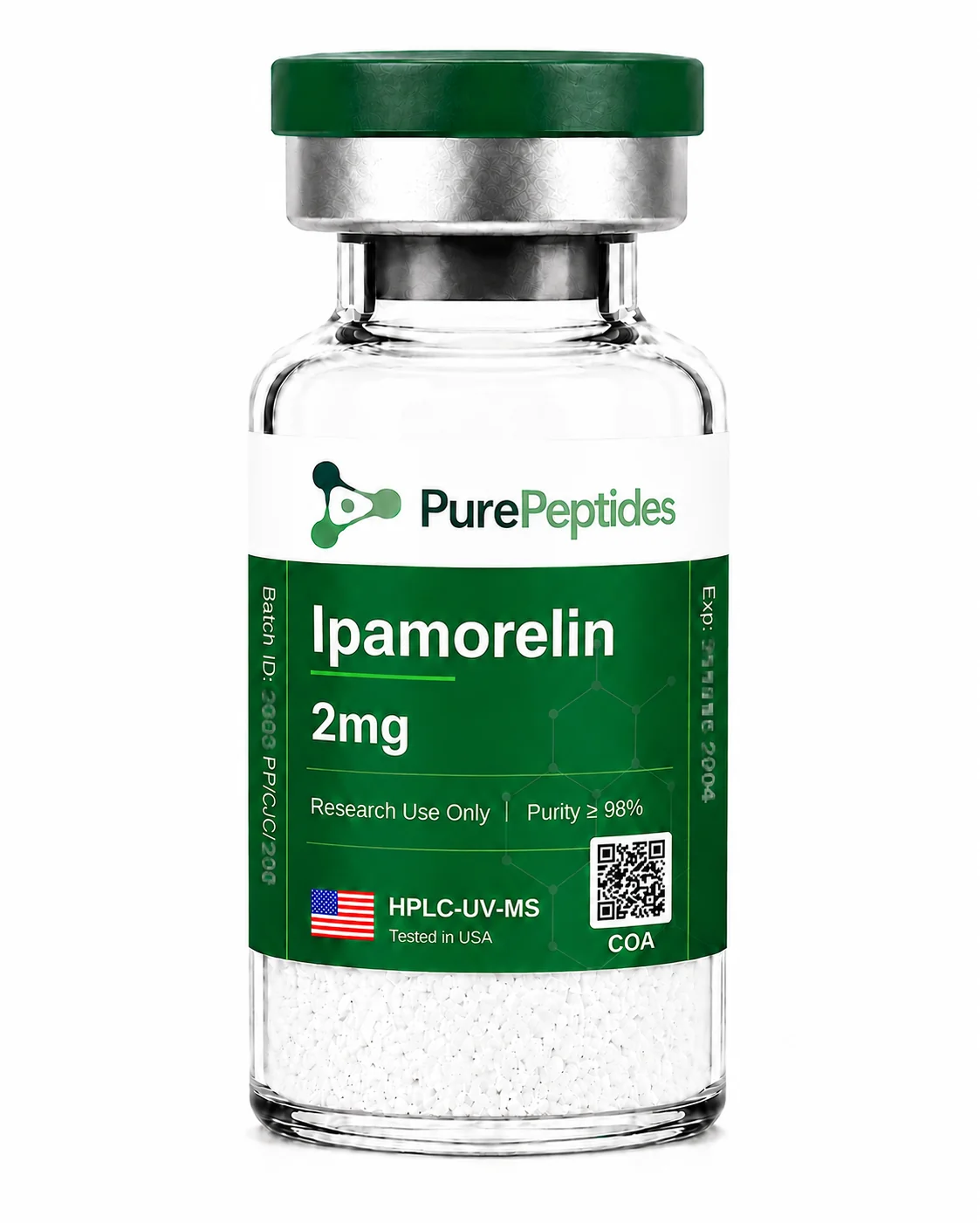
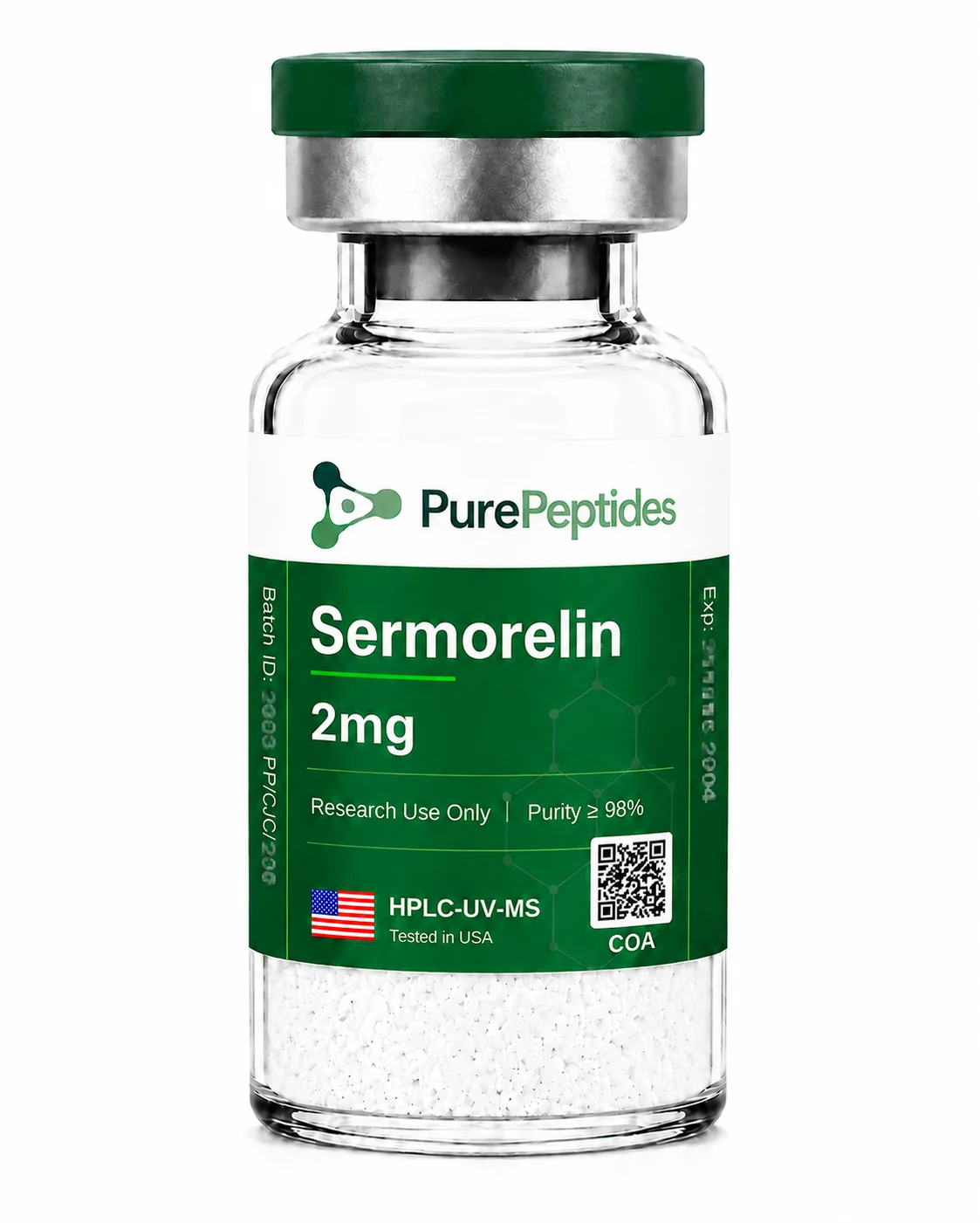
Ipamorelin and Sermorelin are different molecules: Ipamorelin is a five-residue peptide, and Sermorelin is the 29-residue N-terminal fragment of human growth hormone-releasing hormone.
Structure at a glance
Ipamorelin · 5 residues
Sermorelin · 29 residues
NH2: C-terminal amide. A raised D marks a D-amino acid. 2Nal: 2-naphthylalanine. Aib: alpha-aminoisobutyric acid. Codes are three-letter amino acid codes.
Drawn from the product database. Each measure's bars share one scale.
| Property | Ipamorelin | Sermorelin |
|---|---|---|
| What it is | A five-residue peptide that does not correspond to any natural peptide sequence. | A 29-residue peptide: the N-terminal fragment of the 44-residue human growth hormone-releasing hormone. |
| How they relate | Different molecules. Ipamorelin does not correspond to any natural peptide sequence. Sermorelin corresponds to the first 29 residues of the 44-residue human growth hormone-releasing hormone. | |
| CAS number | 170851-70-4 | 86168-78-7 |
| Molecular formula | C38H49N9O5 | C149H246N44O42S |
| Molecular weight | 711.85 g/mol | 3,357.93 g/mol |
| Sequence | Aib-His-D-2Nal-D-Phe-Lys-NH2 | Tyr-Ala-Asp-Ala-Ile-Phe-Thr-Asn-Ser-Tyr-Arg-Lys-Val-Leu-Gly-Gln-Leu-Ser-Ala-Arg-Lys-Leu-Leu-Gln-Asp-Ile-Met-Ser-Arg-NH2 |
| Evidence base | Two human studies in the literature reviewed for it. One was a pharmacokinetic-pharmacodynamic study in healthy male volunteers.[1] The other, a randomized phase 2 trial, missed its key endpoint and its secondary analyses.[2] | Human studies, which supported two US approvals, each for one indication: one diagnostic, one therapeutic.[3][4] In the literature reviewed for Sermorelin, the therapeutic evidence base is thin. |
| Regulatory status | The FDA has not approved Ipamorelin for human use. | Sermorelin acetate held two US approvals, each for one indication: a diagnostic one in 1990 and a therapeutic one in 1997.[3][4] Both were withdrawn at the sponsor's request, as of June 2009.[3][4] No FDA-approved product containing it has existed since.[3] |
| Compared head-to-head? | No direct comparison found in PubMed (searched October 2026).[5] | |
| Handling difference | Neither contains a cysteine. Ipamorelin contains no sulfur and so no methionine; Sermorelin contains one methionine, which oxidizes on air exposure. | |
How Ipamorelin and Sermorelin differ
Ipamorelin and Sermorelin are different molecules. Ipamorelin is a five-residue peptide that does not correspond to any natural peptide sequence. Sermorelin is the N-terminal 29-residue fragment of the 44-residue human growth hormone-releasing hormone (GHRH). The names GRF(1-29) and GHRH(1-29) both refer to Sermorelin.
The literature reviewed for Ipamorelin includes two published human studies. One was an early-phase pharmacokinetic-pharmacodynamic study in healthy male volunteers.[1] The other was a randomized phase 2 trial of 114 participants, and it missed its key endpoint and its secondary analyses.[2] Almost everything else known about Ipamorelin comes from preclinical pharmacology. The foundational pharmacology study, published by Raun and colleagues in 1998, used rat cells in vitro, anesthetized rats and conscious swine.[6] In the literature reviewed for Sermorelin, the therapeutic evidence base is thin.
The FDA has not approved Ipamorelin for human use. Sermorelin acetate held two US approvals, each for one indication: a diagnostic one in 1990 and a therapeutic one in 1997.[3][4] Both were withdrawn at the sponsor's request, as of June 2009.[3][4] No FDA-approved product containing it has existed since.[3] Saying sermorelin acetate is FDA approved is false, and saying it was never FDA approved is equally false. That regulatory record belongs to sermorelin acetate alone. Sermorelin acetate was the active ingredient of prescription medicines, since withdrawn. The material supplied here is a research-grade preparation and is not one of those medicines.
Ipamorelin contains no sulfur, so it has no cysteine and no methionine. Sermorelin's single sulfur belongs to a methionine, so it has no cysteine either. That methionine converts to a sulfoxide on exposure to air, peroxides or trace metals.
Have Ipamorelin and Sermorelin been compared directly?
No direct comparison of Ipamorelin with Sermorelin was found in a PubMed search run in October 2026.[5] That search covers PubMed only.
Read more on each compound
Ipamorelin
Frequently Asked Questions
Is Ipamorelin the same as Sermorelin?+−
Ipamorelin and Sermorelin are different molecules. Ipamorelin is a five-residue peptide that does not correspond to any natural peptide sequence. Sermorelin is the N-terminal 29-residue fragment of the 44-residue human growth hormone-releasing hormone.
Is Ipamorelin or Sermorelin approved?+−
The FDA has not approved Ipamorelin for human use; sermorelin acetate held two US approvals, both withdrawn at the sponsor's request as of June 2009. Sermorelin acetate was the active ingredient of prescription medicines, since withdrawn. The material supplied here is a research-grade preparation and is not one of those medicines.
References
- 1Gobburu JV, Agerso H, Jusko WJ, Ynddal L. Pharm Res. 1999;16(9):1412-6. doi:10.1023/a:1018955126402. PMID 10496658.
- 2Beck DE, Sweeney WB, McCarter MD. 2014;29(12):1527-1534. doi:10.1007/s00384-014-2030-8. PMID 25331030.
- 3US Food and Drug Administration, Drugs@FDA. Records for the two sermorelin acetate applications; retrieved via the openFDA drug/drugsfda endpoint, 28 August 2026. Two applications and three products, all marketing status Discontinued.
- 4US Food and Drug Administration. Federal Register notice on the withdrawn sermorelin acetate products. 78 FR 14095, 4 March 2013, document 2013-04827. Full text retrieved from govinfo.gov, 28 August 2026.
- 5PubMed search via NCBI E-utilities, run 3 October 2026; records entered to 2 October 2026. Query: ("ipamorelin"[tiab]) AND ("sermorelin"[tiab] OR "GRF(1-29)"[tiab] OR "GHRH(1-29)"[tiab] OR "GRF 1-29"[tiab] OR "GHRH 1-29"[tiab] OR "hGRF(1-29)"[tiab] OR "growth hormone releasing hormone 1-29"[tiab] OR "growth hormone releasing factor 1-29"[tiab]) AND ("1800/01/01"[edat] : "2026/10/02"[edat]). 6 records; none was a direct comparison of the two compounds.
- 6Raun K, Hansen BS, Johansen NL, Thogersen H, Madsen K, Ankersen M, et al. 1998 Nov;139(5):552-61. doi:10.1530/eje.0.1390552. PMID 9849822.
Related comparisons
CJC-1295 (No DAC) vs Ipamorelin
CJC-1295 (No DAC) is a synthetic peptide built on human GHRH's first 29 residues; Ipamorelin is a synthetic five-residue peptide.
Read ComparisonCJC-1295 (No DAC) vs Sermorelin
CJC-1295 (No DAC) is human GHRH's first 29 residues with four substitutions; Sermorelin is the unmodified fragment.
Read ComparisonIpamorelin vs Tesamorelin
Ipamorelin is a synthetic five-residue peptide; Tesamorelin is a synthetic 44-residue analog of human GHRH.
Read Comparison