
Published · 5 references
CJC-1295 (No DAC) vs Ipamorelin
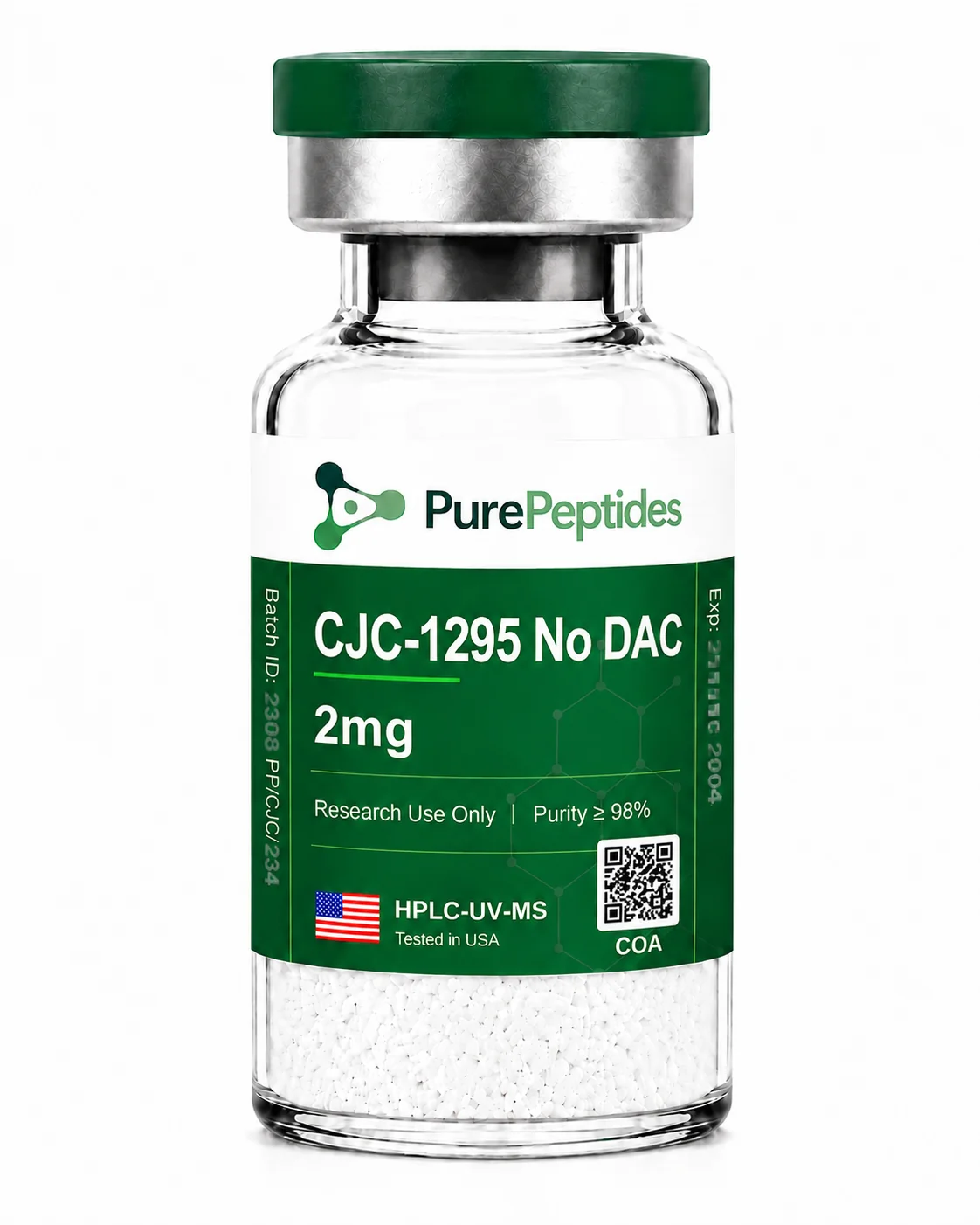
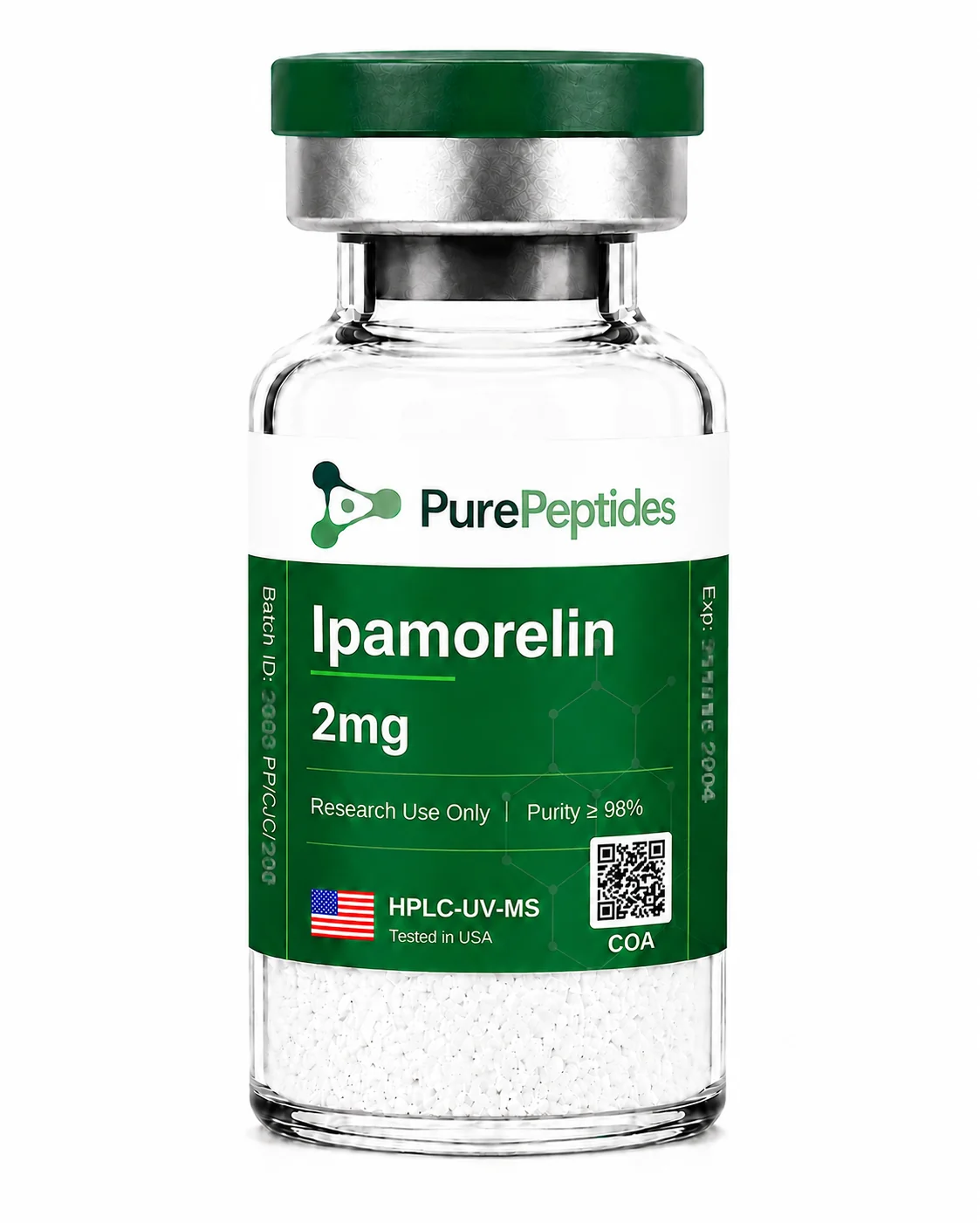
CJC-1295 (No DAC) and Ipamorelin are different molecules: CJC-1295 (No DAC) is a synthetic peptide built on human GHRH's first 29 residues, and Ipamorelin is a synthetic five-residue peptide.
Structure at a glance
CJC-1295 (No DAC) · 29 residues
Ipamorelin · 5 residues
NH2: C-terminal amide. A raised D marks a D-amino acid. 2Nal: 2-naphthylalanine. Aib: alpha-aminoisobutyric acid. Codes are three-letter amino acid codes.
Drawn from the product database. Each measure's bars share one scale.
| Property | CJC-1295 (No DAC) | Ipamorelin |
|---|---|---|
| What it is | A synthetic analog of growth hormone-releasing hormone. Built on the GRF(1-29) backbone, with four amino acid substitutions.[1] | A synthetic five-residue peptide that does not correspond to any natural peptide sequence. |
| How they relate | Different molecules. CJC-1295 (No DAC) is a synthetic peptide built on human GHRH's first 29 residues, with four substitutions. Ipamorelin is a synthetic construct that does not correspond to any natural peptide sequence. | |
| CAS number | 863288-34-0 | 170851-70-4 |
| Molecular formula | C152H252N44O42 | C38H49N9O5 |
| Molecular weight | 3,367.97 g/mol | 711.85 g/mol |
| Sequence | Tyr-D-Ala-Asp-Ala-Ile-Phe-Thr-Gln-Ser-Tyr-Arg-Lys-Val-Leu-Ala-Gln-Leu-Ser-Ala-Arg-Lys-Leu-Leu-Gln-Asp-Ile-Leu-Ser-Arg-NH2 | Aib-His-D-2Nal-D-Phe-Lys-NH2 |
| Evidence base | In the literature reviewed for CJC-1295 (No DAC), the pharmacokinetic findings were generated with the DAC form. Essentially uncharacterized in humans.[2] | Two human studies in the literature reviewed for it. One was a pharmacokinetic-pharmacodynamic study in healthy male volunteers.[3] The other, a randomized phase 2 trial, missed its key endpoint and its secondary analyses.[4] |
| Regulatory status | The FDA has not approved CJC-1295 (No DAC) for human use. | The FDA has not approved Ipamorelin for human use. |
| Compared head-to-head? | No direct comparison found in PubMed (searched October 2026).[5] | |
| Handling difference | Neither contains sulfur, so neither has a cysteine or a methionine. | |
How CJC-1295 (No DAC) and Ipamorelin differ
CJC-1295 (No DAC) and Ipamorelin are different molecules. CJC-1295 (No DAC) is a synthetic 29-residue peptide corresponding to the first 29 positions of human growth hormone-releasing hormone (GHRH), with four of those positions substituted. It is also sold as Modified GRF(1-29), a name that states that construction more plainly. Ipamorelin is a synthetic five-residue peptide that does not correspond to any natural peptide sequence.
In the literature reviewed for CJC-1295 (No DAC), the pharmacokinetic findings, in rats and healthy volunteers, came from CJC-1295 with DAC, whose albumin-binding linker CJC-1295 (No DAC) lacks. CJC-1295 (No DAC) itself is essentially uncharacterized in humans.[2] The literature reviewed for Ipamorelin includes two published human studies. One was an early-phase pharmacokinetic-pharmacodynamic study in healthy male volunteers.[3] The other was a randomized phase 2 trial of 114 participants, in one indication, and it missed its key endpoint and its secondary analyses.[4] Almost everything else known about Ipamorelin comes from preclinical pharmacology. Much of the defining preclinical work comes from the original developer, which raises the usual question of independent replication.
Neither compound holds an approval. CJC-1295 (No DAC) has no approval history of any kind. The FDA has not approved Ipamorelin for human use.
CJC-1295 (No DAC) contains no sulfur, so it carries neither cysteine nor methionine. With sulfur absent, its remaining chemical liabilities are hydrolytic: it contains aspartate, which can isomerize, and glutamine, which can deamidate. Ipamorelin also contains no sulfur. Its remaining liabilities are general: amide hydrolysis under strong acid or alkali, slow near neutral pH, and oxidation of aromatic side chains, far slower than for a tryptophan.
Have CJC-1295 (No DAC) and Ipamorelin been compared directly?
No direct comparison of CJC-1295 (No DAC) with Ipamorelin was found in a PubMed search run in October 2026.[5] That search covers PubMed only.
Read more on each compound
CJC-1295 (No DAC)
Frequently Asked Questions
Is CJC-1295 (No DAC) the same as Ipamorelin?+−
CJC-1295 (No DAC) and Ipamorelin are different molecules. CJC-1295 (No DAC) is a synthetic 29-residue peptide built on the first 29 positions of human growth hormone-releasing hormone, with four of them substituted. Ipamorelin is a synthetic five-residue peptide that does not correspond to any natural peptide sequence.
References
- 1Jetté L, Léger R, Thibaudeau K, Benquet C, Robitaille M, Pellerin I, et al. Endocrinology. 2005;146(7):3052-3058. doi:10.1210/en.2004-1286. PMID 15817669.
- 2Dominikowski A, et al. Front Endocrinol (Lausanne) 2026. PMID 42395176. DOI 10.3389/fendo.2026.1822475. Narrative review.
- 3Gobburu JV, Agerso H, Jusko WJ, Ynddal L. Pharm Res. 1999;16(9):1412-6. doi:10.1023/a:1018955126402. PMID 10496658.
- 4Beck DE, Sweeney WB, McCarter MD. 2014;29(12):1527-1534. doi:10.1007/s00384-014-2030-8. PMID 25331030.
- 5PubMed search via NCBI E-utilities, run 3 October 2026; records entered to 2 October 2026. Query: ("CJC-1295"[tiab] OR "CJC 1295"[tiab] OR "CJC1295"[tiab] OR "modified GRF"[tiab] OR "mod GRF"[tiab] OR "modGRF"[tiab] OR "tetrasubstituted"[tiab] OR "DAC-free"[tiab] OR "non-DAC"[tiab] OR "without DAC"[tiab] OR "no DAC"[tiab]) AND ("ipamorelin"[tiab]) AND ("1800/01/01"[edat] : "2026/10/02"[edat]). 11 records; none was a direct comparison of the two compounds.
Related comparisons
CJC-1295 (No DAC) vs CJC-1295 with DAC
CJC-1295 with DAC is a chemically modified form of CJC-1295 (No DAC); the DAC-free peptide is essentially uncharacterized in humans.
Read ComparisonCJC-1295 (No DAC) vs Sermorelin
CJC-1295 (No DAC) is human GHRH's first 29 residues with four substitutions; Sermorelin is the unmodified fragment.
Read ComparisonCJC-1295 (No DAC) vs Tesamorelin
CJC-1295 (No DAC) carries four substitutions in human GHRH's first 29 residues; Tesamorelin is an analog of the full 44-residue hormone.
Read Comparison