Published · 23 references
Thymosin Alpha-1 vs Thymosin Beta-4
Thymosin Alpha-1 and Thymosin Beta-4 are different molecules that share part of a name: a 28-residue peptide from a different precursor gene and a 43-residue peptide.
Structure at a glance
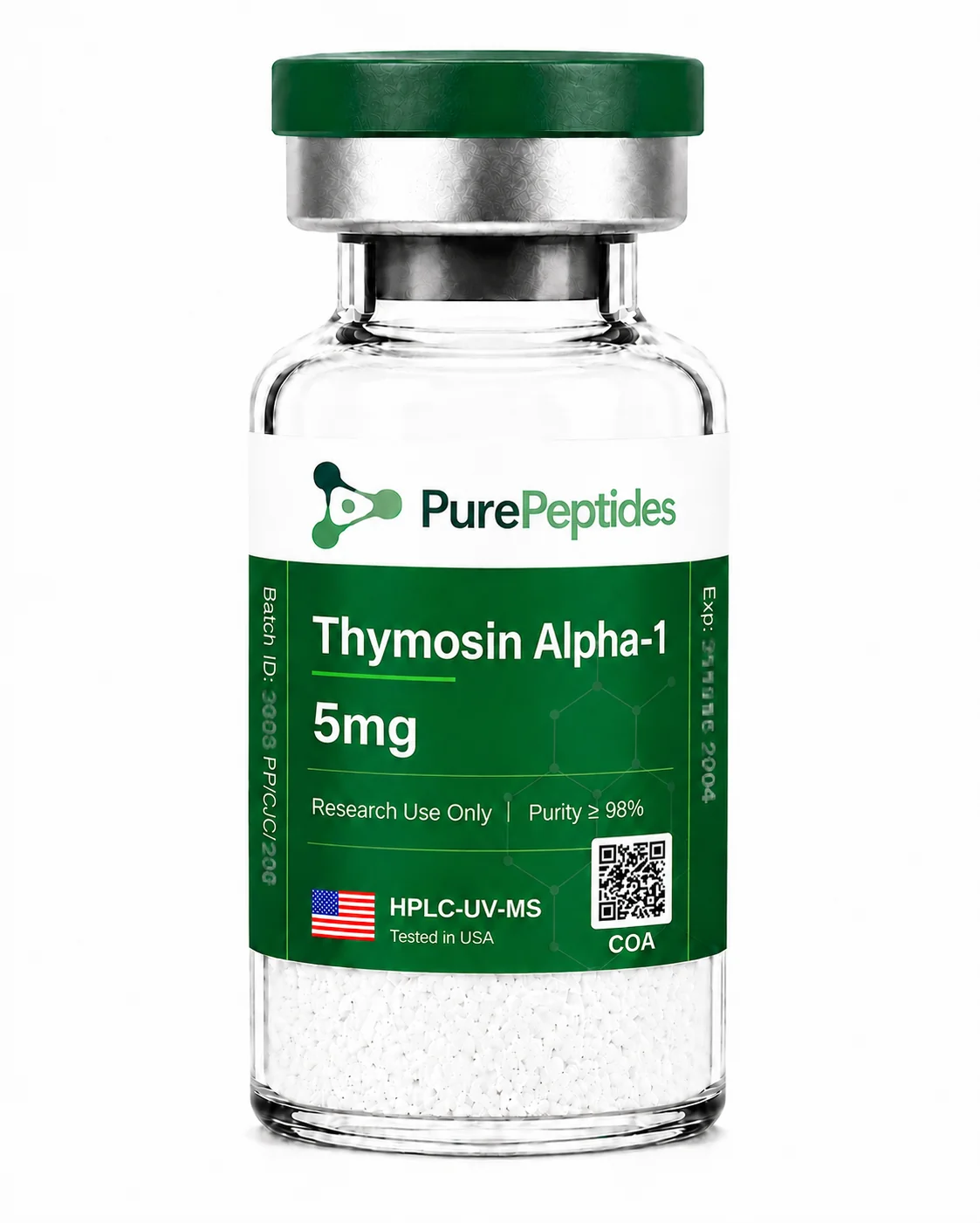
Thymosin Alpha-1 · 28 residues
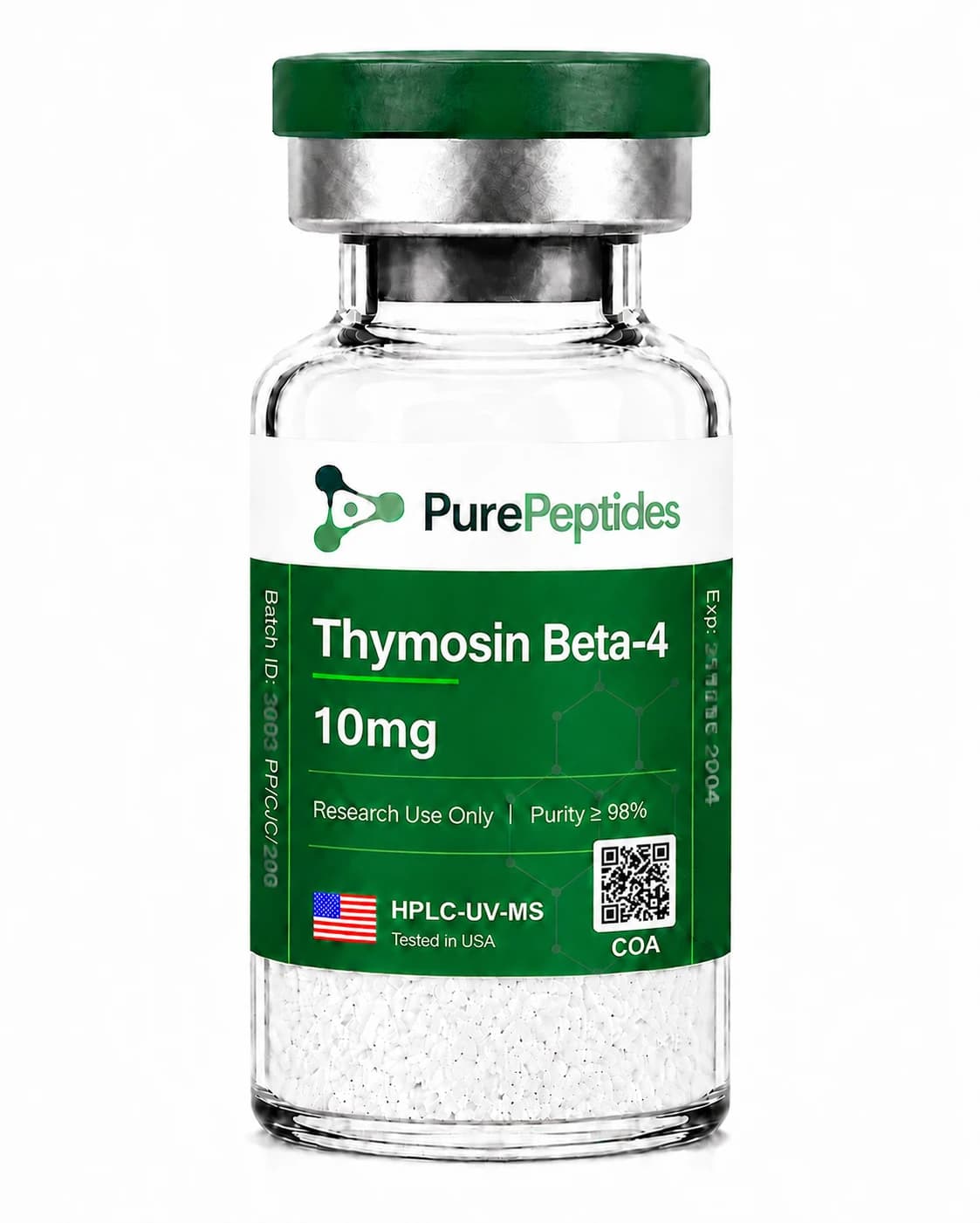
Thymosin Beta-4 · 43 residues
Ac: N-terminal acetyl group. Letters are one-letter amino acid codes.
Drawn from the product database. Each measure's bars share one scale.
| Property | Thymosin Alpha-1 | Thymosin Beta-4 |
|---|---|---|
| What it is | A synthetic 28-residue peptide whose sequence matches residues 2 to 29 of prothymosin alpha; its international nonproprietary name is thymalfasin. | A 43-residue peptide found across most human tissues; the material supplied is made in the laboratory. |
| How they relate | Different molecules. Thymosin Alpha-1 comes from a different precursor gene. Thymosin Beta-4 is a 43-residue peptide found across most human tissues. The two share part of a name and little else. | |
| CAS number | 62304-98-7 | 77591-33-4 |
| Molecular formula | C129H215N33O55 | C212H350N56O78S |
| Molecular weight | 3,108.31 g/mol | 4963.44 g/mol |
| Sequence | Ac-SDAAVDTSSEITTKDLKEKKEVVEEAEN | Ac-SDKPDMAEIEKFDKSKLKKTETQEKNPLPSKETIEQEKQAGES |
| Target | No target established for Thymosin Alpha-1. | Monomeric G-actin. Thymosin Beta-4 is the principal protein sequestering it inside cells, a role reviewed in 2005.[1] |
| Evidence base | Randomized human trials. The largest, of 1,106 participants, in one indication, found no significant difference overall on the measures reported for it.[2] Two registered trials are listed as completed but unpublished.[3] | Human trials over two decades of clinical development; most of what has read out has failed. Three later trials in one indication randomized 1,618 patients, and none has a peer-reviewed publication. |
| Regulatory status | A medicine containing thymalfasin holds a national marketing authorization in Italy, in one indication.[4] The FDA has approved no drug product containing it.[5] FDA granted four orphan designations, each in one indication; each record reads not approved for that indication.[6] | No marketing application has ever been submitted to the FDA, in any formulation. An orphan drug designation was granted in one indication, and a second is associated with another program; a designation is not a marketing authorization. |
| Compared head-to-head? | Yes: a study applied both peptides to rat hypothalamic tissue, superfused ex vivo.[7] Another exposed mouse macrophages to both in culture, then transferred cells from those cultures into mice.[8] Further comparisons found in PubMed (searched October 2026).[9] | |
| Handling difference | Thymosin Beta-4 contains a methionine, which oxidizes on air exposure; Thymosin Alpha-1 contains none. Neither contains a cysteine. | |
| Where they get confused | Thymosin Beta-4 is routinely confused with Thymosin Alpha-1, which shares part of its name. | |
How Thymosin Alpha-1 and Thymosin Beta-4 differ
Thymosin Alpha-1 and Thymosin Beta-4 are not the same molecule: they share part of a name and little else. Thymosin Alpha-1 is a synthetic 28-residue peptide whose sequence matches residues 2 to 29 of prothymosin alpha. Its international nonproprietary name is thymalfasin. Thymosin Beta-4 is a 43-residue peptide found across most human tissues. The material supplied is made in the laboratory. Thymosin Alpha-1 comes from a different precursor gene, yet Thymosin Beta-4 is routinely confused with it.
Evidence for Thymosin Beta-4 does not transfer to Thymosin Alpha-1. In the literature reviewed for Thymosin Alpha-1, the human record includes randomized trials. The largest, of 1,106 participants, in one indication, found no significant difference overall on the measures reported for it.[2] In that trial, no safety outcome differed from placebo overall, and one prespecified subgroup showed higher mortality on the drug than on placebo, a hypothesis-generating finding.[2] FDA's review also cites reports of fatal immune hemolytic anemia and engraftment failure in transplant recipients; such reports cannot show cause or frequency.[5] Two registered trials are listed as completed but unpublished.[3]
Thymosin Beta-4 has a two-decade record of human clinical development, and most of what has read out has failed. Three later trials in one indication randomized 1,618 patients between them, and none of the three has a peer-reviewed publication. The literature reviewed for Thymosin Beta-4 reports no serious safety finding from its published human studies.
A medicine containing thymalfasin holds a national marketing authorization in Italy, in one indication.[4] Thymalfasin is the active ingredient of a medicine authorized in Italy. The material supplied here is a research-grade preparation, is not that medicine, and holds no marketing authorization. The Italian authorization belongs to thymalfasin alone and is not an approval of Thymosin Beta-4. The FDA has approved no drug product containing thymalfasin.[5] No marketing application for Thymosin Beta-4 has ever been submitted to the FDA, in any formulation.
Have Thymosin Alpha-1 and Thymosin Beta-4 been compared directly?
Between 1981 and 2007, fourteen studies in the literature reviewed for Thymosin Beta-4 each applied both Thymosin Alpha-1 and Thymosin Beta-4 in the same experimental system. Seven used human cells in vitro, among them blood cells and sperm cells.[10][11][12][13][14][15][16] Four used rat cells in vitro, among them adrenal and spleen cells.[17][18][19][20] One used rat hypothalamic tissue, superfused outside the body.[7] Two more included work in vivo. One exposed mouse macrophages to both peptides in culture, then transferred cells from those cultures into mice.[8] The other applied both peptides to the chick chorioallantoic membrane.[21] One of the human-cell studies also tested both peptides in mice.[15] Results are reported for each compound in each paper. For two further papers, the abstracts do not establish that both peptides were applied.[22][23]
Read more on each compound
Thymosin Alpha-1
Frequently Asked Questions
Is Thymosin Alpha-1 the same as Thymosin Beta-4?+−
No. Thymosin Alpha-1 and Thymosin Beta-4 are different molecules that share part of a name and little else. Thymosin Alpha-1 is a 28-residue peptide from a different precursor gene, and Thymosin Beta-4 is a 43-residue peptide. Thymosin Beta-4 is routinely confused with Thymosin Alpha-1.
Does research on Thymosin Beta-4 apply to Thymosin Alpha-1?+−
Evidence for Thymosin Beta-4 does not transfer to Thymosin Alpha-1. The fourteen studies reviewed for Thymosin Beta-4 that applied both peptides report results for each.
Is Thymosin Alpha-1 or Thymosin Beta-4 approved?+−
No FDA-approved drug product contains Thymosin Alpha-1, and Thymosin Beta-4 has no FDA marketing application. A medicine containing thymalfasin, Thymosin Alpha-1's nonproprietary name, is authorized in Italy. The material supplied here is a research-grade preparation, is not that medicine, and holds no marketing authorization. The Italian authorization belongs to thymalfasin alone and is not an approval of Thymosin Beta-4.
References
- 3ClinicalTrials.gov registry records NCT00040027 and NCT00039962. Both completed, enrollment 500 each, hasResults false. Retrieved via API v2 on 28 August 2026, with a PubMed search for either identifier returning zero records.
- 4European Medicines Agency. Public register entry, orphan designation for thymalfasin, designated 30 July 2002. Retrieved 28 August 2026.
- 5US Food and Drug Administration, Center for Drug Evaluation and Research. Briefing presentation, 4 December 2024. fda.gov
- 6US Food and Drug Administration, Office of Orphan Products Development. Orphan drug designation database, four thymalfasin designations, 1991 to 2006. Each record's FDA Orphan Approval Status field reads "Not FDA Approved for Orphan Indication". Reported as previously recorded rather than read live, 28 August 2026.
- 9PubMed search via NCBI E-utilities, run 3 October 2026; records entered to 2 October 2026. Query: ("thymosin alpha-1"[tiab] OR "thymosin alpha 1"[tiab] OR "thymosin alpha1"[tiab] OR "thymosin α1"[tiab] OR "thymosin α-1"[tiab] OR "Tα1"[tiab] OR "Talpha1"[tiab] OR "thymalfasin"[tiab]) AND ("thymosin beta-4"[tiab] OR "thymosin beta 4"[tiab] OR "thymosin beta4"[tiab] OR "thymosin β4"[tiab] OR "Tβ4"[tiab] OR "Tbeta4"[tiab] OR "timbetasin"[tiab]) AND ("1800/01/01"[edat] : "2026/10/02"[edat]). 50 records, including 10 of the 14 comparisons described above; supplementary searches, for other name forms and across all fields, run the same day under the same date limit, found the other 4.
Related comparisons
BPC-157 vs Thymosin Beta-4
BPC-157 is a 15-residue peptide and Thymosin Beta-4 a 43-residue member of the beta-thymosin family: two different molecules.
Read ComparisonTB-500 vs Thymosin Alpha-1
TB-500 is a seven-residue fragment of Thymosin Beta-4 and Thymosin Alpha-1 a separate 28-residue peptide: two different molecules.
Read ComparisonTB-500 vs Thymosin Beta-4
TB-500 is a seven-residue fragment of Thymosin Beta-4; most published research associated with TB-500 used the full 43-residue peptide.
Read Comparison