
Published · 4 references
BPC-157 vs Thymosin Beta-4
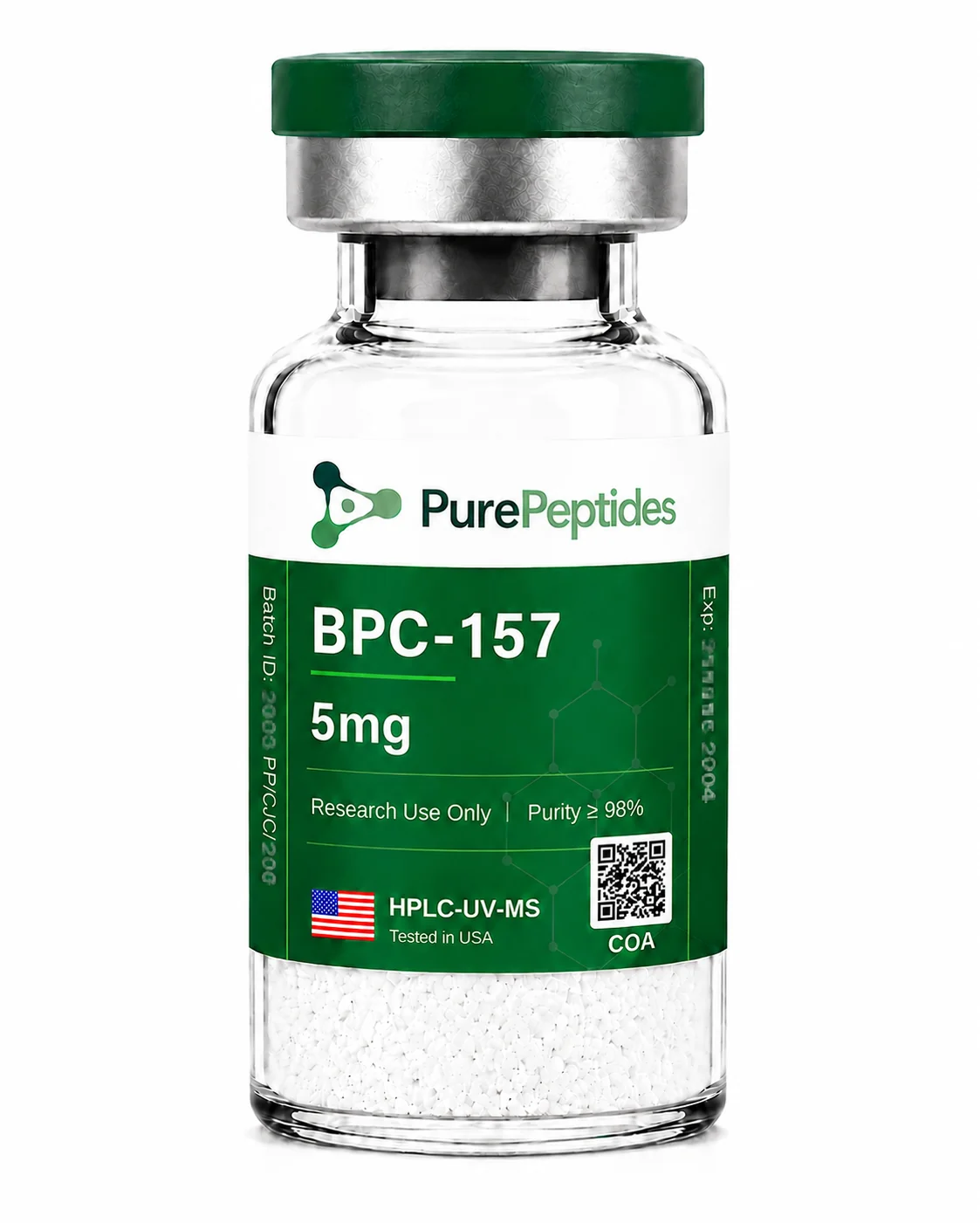
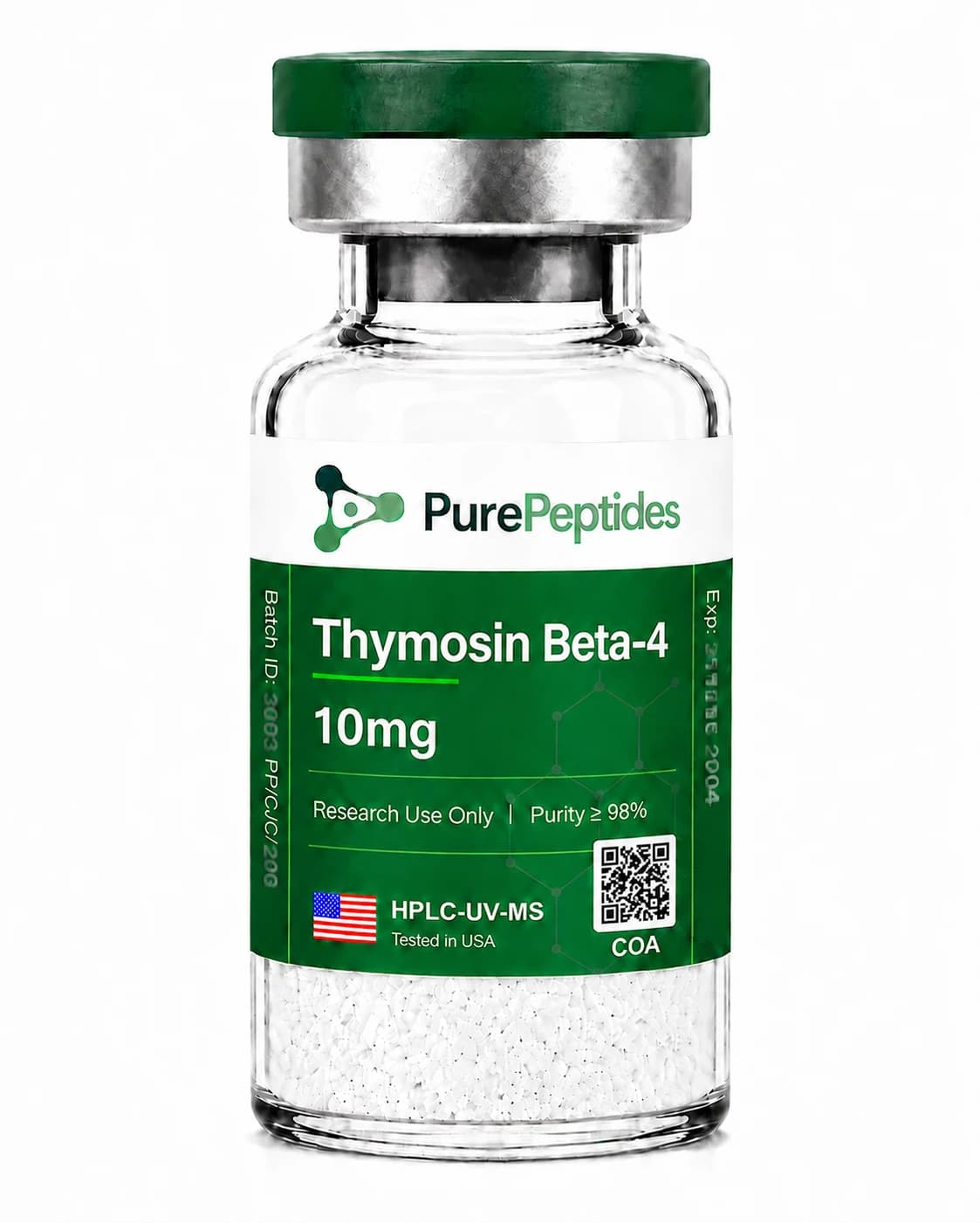
BPC-157 and Thymosin Beta-4 are different molecules: BPC-157 is a 15-residue peptide, and Thymosin Beta-4 is a 43-residue member of the beta-thymosin family.
Structure at a glance
BPC-157 · 15 residues
Thymosin Beta-4 · 43 residues
Ac: N-terminal acetyl group. Letters are one-letter amino acid codes.
Drawn from the product database. Each measure's bars share one scale.
| Property | BPC-157 | Thymosin Beta-4 |
|---|---|---|
| What it is | A synthetic 15-residue peptide. Described in the originating literature as a partial sequence of a protein reported in human gastric juice.[1] | A 43-residue peptide found across most human tissues; the material supplied is made in the laboratory. |
| How they relate | Different molecules. BPC-157 is described in the originating literature as a partial sequence of a protein reported in human gastric juice.[1] Thymosin Beta-4 is a highly conserved member of the beta-thymosin family. | |
| CAS number | 137525-51-0 | 77591-33-4 |
| Molecular formula | C62H98N16O22 | C212H350N56O78S |
| Molecular weight | 1,419.55 g/mol | 4963.44 g/mol |
| Sequence | GEPPPGKPADDAGLV | Ac-SDKPDMAEIEKFDKSKLKKTETQEKNPLPSKETIEQEKQAGES |
| Evidence base | Nearly all published research is preclinical. A 2025 systematic review counted 36 studies within its scope; the one clinical study was a retrospective case series of 12 patients. No randomized controlled trial has been published within that scope. | Human trials over two decades of clinical development; most of what has read out has failed. Three later trials in one indication randomized 1,618 patients, and none has a peer-reviewed publication. |
| Regulatory status | The FDA has not approved BPC-157 for human use. | No marketing application has ever been submitted to the FDA, in any formulation. An orphan drug designation was granted in one indication, and a second is associated with another program; a designation is not a marketing authorization. |
| Compared head-to-head? | Not with this form: a 2026 rat study tested BPC-157 and a product it calls TB-500 and describes as derived from Thymosin Beta-4, without giving a sequence.[2] No comparison of BPC-157 with a preparation identified as the 43-residue Thymosin Beta-4 found in PubMed (searched October 2026).[3] | |
| Handling difference | Thymosin Beta-4 contains a methionine, which oxidizes on air exposure; BPC-157 contains none. Neither contains a cysteine. | |
How BPC-157 and Thymosin Beta-4 differ
BPC-157 and Thymosin Beta-4 are different molecules. BPC-157 is a 15-residue peptide, described in the originating literature as a partial sequence of a protein reported in human gastric juice.[1] It does not occur in nature in that isolated form, and the material used in studies is produced synthetically. Thymosin Beta-4 is a 43-residue peptide found across most human tissues, and a highly conserved member of the beta-thymosin family. The material supplied is made in the laboratory.
At their N-terminal ends, BPC-157 has a free amine and Thymosin Beta-4 carries an acetyl group. Four of BPC-157's 15 residues are proline, three of them in a row, which makes it a conformationally constrained peptide rather than a flexible chain. In solution, BPC-157's fastest chemical route of degradation is rearrangement of its two adjacent aspartates. Thymosin Beta-4 is a chain long enough to fold, and its dominant stability risk is physical aggregation rather than chemical change.
A 2025 systematic review found that the BPC-157 evidence base within its scope remains overwhelmingly preclinical.[4] Within that review's scope, the one clinical study was a retrospective case series of 12 patients, and no randomized controlled trial has been published.
Thymosin Beta-4 has a two-decade record of human clinical development, and most of what has read out has failed. Three later trials in one indication randomized 1,618 patients between them, and none of the three has a peer-reviewed publication.
Have BPC-157 and Thymosin Beta-4 been compared directly?
A 2026 study tested BPC-157 and a product it calls TB-500, each in its own group, in a rat model.[2] The paper describes that product as a synthetic peptide derived from Thymosin Beta-4 but gives no sequence for it, so it does not establish which compound was tested.[2] Results are reported for each group in that model. No comparison of BPC-157 with a preparation identified as the 43-residue Thymosin Beta-4 was found in PubMed (searched October 2026).[3] That search covers PubMed only.
Read more on each compound
BPC-157
Frequently Asked Questions
Is BPC-157 the same as Thymosin Beta-4?+−
BPC-157 and Thymosin Beta-4 are different molecules: BPC-157 is a 15-residue peptide, and Thymosin Beta-4 is a 43-residue member of the beta-thymosin family. BPC-157 is described in the originating literature as a partial sequence of a protein reported in human gastric juice. Thymosin Beta-4 is found across most human tissues.
References
- 3PubMed search via NCBI E-utilities, run 3 October 2026; records entered to 2 October 2026. Query: ("BPC-157"[tiab] OR "BPC 157"[tiab] OR "BPC157"[tiab] OR "body protection compound"[tiab] OR "gastric pentadecapeptide"[tiab] OR "pentadecapeptide BPC"[tiab]) AND ("thymosin beta-4"[tiab] OR "thymosin beta 4"[tiab] OR "thymosin beta4"[tiab] OR "thymosin β4"[tiab] OR "Tβ4"[tiab] OR "Tbeta4"[tiab] OR "timbetasin"[tiab] OR "TB4"[tiab] OR "TB-4"[tiab]) AND ("1800/01/01"[edat] : "2026/10/02"[edat]). 8 records; none was a direct comparison of BPC-157 with a preparation identified as the 43-residue Thymosin Beta-4.
Related comparisons
BPC-157 vs KPV
BPC-157 is a 15-residue peptide and KPV a three-residue peptide corresponding to residues 11 to 13 of alpha-MSH: two different molecules.
Read ComparisonBPC-157 vs TB-500
BPC-157 is a 15-residue peptide and TB-500 a seven-residue fragment of Thymosin Beta-4: two different molecules.
Read ComparisonTB-500 vs Thymosin Beta-4
TB-500 is a seven-residue fragment of Thymosin Beta-4; most published research associated with TB-500 used the full 43-residue peptide.
Read Comparison