What Is a Peptide? Amino Acids, Peptides and Proteins Explained

Written by Dr. Sufia Ul Haque
Chemist and scientific writer · Published · 5 min read
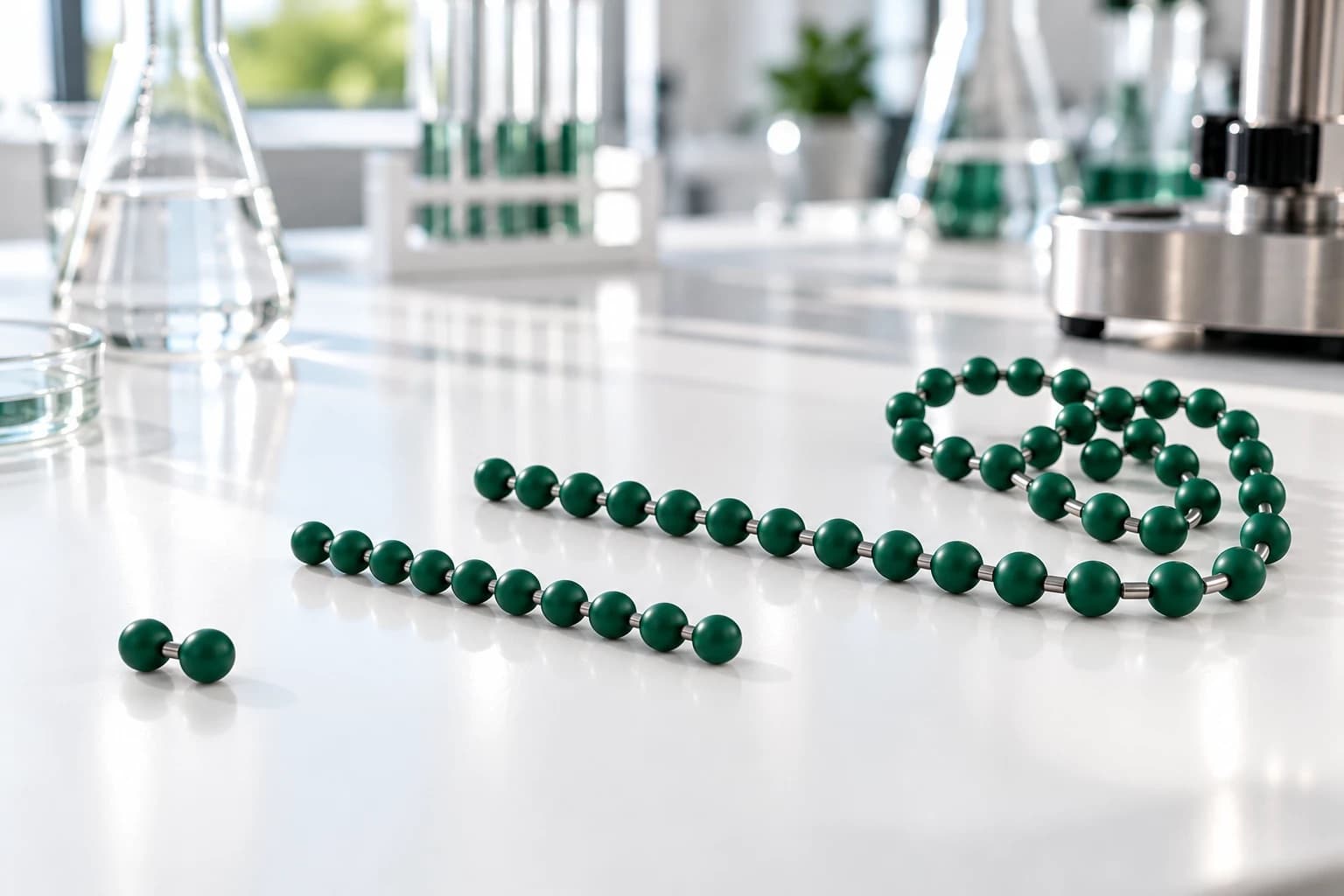
A peptide is a chain of at least two amino acids joined by peptide bonds. Add more amino acids and the chain gets longer, sometimes long enough to be called a protein. The surprising part is that there is no universally agreed number at which a peptide becomes a protein.
In this article+−
What is an amino acid?
An amino acid is one of the small molecules that make up peptides and proteins. Most amino acids found in proteins have a central carbon attached to an amino group (-NH2), a carboxyl group (-COOH), a hydrogen atom and a side chain. The side chain is the part that changes from one amino acid to another. Glycine, for example, has a hydrogen as its side chain, while other amino acids have larger groups that can affect how a chain behaves.
The International Union of Pure and Applied Chemistry (IUPAC) lists 20 amino acids commonly found in proteins in its 1983 recommendations. These are the familiar building blocks, though they are not the only amino acids that exist. Some organisms also use additional genetically encoded amino acids, and synthetic peptides may contain other types. Each common amino acid has a short code. Leucine, for instance, is Leu in three-letter notation and L in one-letter notation.
You can think of the amino acids as letters in an alphabet. Changing their order changes the sequence. Unlike letters on a page, however, amino-acid chains can bend and fold into three-dimensional shapes.
How do amino acids join into a peptide?
A peptide bond forms when the carboxyl group of one amino acid joins with the amino group of another. This is a type of amide bond with limited rotation due to partial double-bond character, and its formation formally involves removing the elements of one water molecule. However, this does not mean that free amino acids automatically join when mixed in water.
RelatedWhat is a peptide bond?
Once amino acids become part of a peptide chain, they are called residues. This term is important when counting peptide length. For example, a simple linear peptide containing 15 residues has 15 amino acid units connected by 14 peptide bonds. Its molecular formula differs from that of 15 separate free amino acids.
A linear peptide has two ends: the N-terminus (amino end) and the C-terminus (carboxyl end). Sequences are usually written from N to C. These ends can be chemically modified, while cyclic peptides may have no free ends.
Residue, dipeptide, oligopeptide, polypeptide: what do these words mean?
These terms describe chains of different lengths.
- Residue
- One amino acid that is part of a peptide chain.
- Dipeptide, tripeptide
- A peptide of two or three residues (tetrapeptide, pentapeptide and so on continue the count)
- Oligopeptide
- A short peptide: fewer than about 10 to 20 residues, by IUPAC's recommendations
- Polypeptide
- A longer chain of amino acid residues, generally beyond the oligopeptide range.
- Protein
- One or more polypeptide chains with a specific amino acid sequence, usually containing more than about 50 residues. Proteins often fold into three-dimensional shapes.
There is no strict peptide/protein boundary. IUPAC gives an approximate 10–20-residue upper range for oligopeptides. Broadly, peptides include proteins, although everyday usage reserves “peptide” for shorter chains.
Where does a peptide end and a protein begin?
There is no single boundary that everyone follows. IUPAC's 1983 recommendations say that chains with a defined sequence longer than about 50 residues are usually called proteins, but also acknowledge that authors differ greatly in where they begin using the term. Its 1995 glossary describes proteins using a molecular-weight guideline instead, above about 10,000. Neither is a universal rule.
The underlying chemistry does not suddenly change at residue 50. A chain with 49 residues and one with 51 still contain amino acids linked by peptide bonds. Longer chains may fold into organized shapes, but not every protein has one fixed three-dimensional structure. Some proteins, including prothymosin alpha, are described as intrinsically disordered, meaning they do not settle into one stable fold under typical conditions.
These are naming conventions, not separate kinds of molecules. The sequence and residue count are more informative than the label.
Where do real peptides fit on that scale?
Three peptides from the catalog show the spread:
15Residues
Sequence
Gly-Glu-Pro-Pro-Pro-Gly-Lys-Pro-Ala-Asp-Asp-Ala-Gly-Leu-Val
IUPAC classificationOligopeptide or polypeptide
28Residues
Sequence
Ac-SDAAVDTSSEITTKDLKEKKEVVEEAEN
IUPAC classificationPolypeptide, below 50 residues
The sequences use two different ways of writing amino acids. TB-500 and Thymosin Alpha-1 use one-letter codes, while BPC-157 uses three-letter codes. Both methods give the same information. The “Ac-” at the beginning of TB-500 and Thymosin Alpha-1 is a small chemical group attached to the peptide. It is not an amino acid, so it is not counted as a residue.
RelatedHow to read a peptide sequence
All three molecules contain fewer than 50 residues, so they are generally called peptides. BPC-157 has 15 residues, which falls within IUPAC’s approximate 10–20-residue boundary between oligopeptides and polypeptides. This means either term can be used. More details about BPC-157 are available on the BPC-157 reference page in the Learn library.
On this site
Why are so many peptides named after proteins?
Some peptides studied in laboratories are short fragments of larger proteins. Their names often come from these proteins, but this does not mean they have the same length or chemical structure.
For example, thymosin alpha-1 contains 28 amino acid residues and comes from one end of prothymosin alpha, a larger protein containing more than 100 residues. Despite their similar names, they are different molecules.
Another example is TB-500, a seven-residue peptide with the sequence LKKTETQ. This sequence is found within thymosin beta-4, a mature polypeptide containing 43 residues. In thymosin beta-4, LKKTETQ is connected to neighboring amino acids on both sides. However, TB-500 is a separate peptide with an acetyl group (Ac-) attached to its N-terminus. This chemical group is not an amino acid and is therefore not counted as a residue.
These examples show why peptide names alone can be misleading. Checking the amino acid sequence, residue count, and chemical modifications provides a clearer understanding of each molecule.
Frequently Asked Questions
Is a peptide the same as a protein?+−
They are built from the same kind of units: amino acids connected by peptide bonds. The main difference is how the terms are used for chains of different lengths. Proteins are generally longer, but there is no universally accepted cutoff. For a precise description, look at the sequence and residue count.
How many amino acids make a peptide?+−
At least two amino acids are needed. When two are joined by a peptide bond, the result is a dipeptide. Adding more residues produces longer chains. There is no single maximum length built into the broad chemical definition of peptide, although in everyday use the term usually refers to shorter chains.
What is the difference between a peptide and a polypeptide?+−
A polypeptide is a longer chain of amino-acid residues. IUPAC's 1983 guidance describes oligopeptides as having fewer than about 10 to 20 residues and polypeptides as longer chains. Because the boundary is approximate, the word polypeptide by itself does not tell you the exact number of residues.
Is an amino acid a peptide?+−
No. One amino acid is a building block, while a peptide contains at least two amino-acid residues joined by a peptide bond. When amino acids become part of a peptide, they are called residues because the overall bond-forming process corresponds to removing the elements of water from the separate starting molecules.
Sources
- IUPAC-IUB Joint Commission on Biochemical Nomenclature, Nomenclature and Symbolism for Amino Acids and Peptides (Recommendations 1983), sections 3AA-11 (Definition of Peptides) and 3AA-12 (Amino-Acid Residues) iupac.qmul.ac.uk/AminoAcid/A1113.html
- IUPAC-IUB Joint Commission on Biochemical Nomenclature, Nomenclature and Symbolism for Amino Acids and Peptides (Recommendations 1983), section 3AA-1 and Table 1 (Names of Common α-Amino Acids) iupac.qmul.ac.uk/AminoAcid/AA1n2.html
- IUPAC, Glossary of Class Names of Organic Compounds and Reactivity Intermediates Based on Structure (IUPAC Recommendations 1995), Pure and Applied Chemistry 67:1307, entries "peptides", "polypeptides" and "proteins" iupac.qmul.ac.uk/class/ONatP.html
- UniProt, entry P06454, Prothymosin alpha uniprot.org/uniprotkb/P06454/entry
- UniProt, entry P62328, Thymosin beta-4 uniprot.org/uniprotkb/P62328/entry
- Sarandeses CS, Covelo G, Díaz-Jullien C, Freire M. Prothymosin α is processed to thymosin α1 and thymosin α11 by a lysosomal asparaginyl endopeptidase. J Biol Chem 2003;278(15):13286-13293 doi.org/10.1074/jbc.M213005200
Worked example
The article borrows BPC-157, TB-500 and Thymosin Alpha-1 from the catalogue to show the idea on a real molecule.
Shop lot-tested BPC-157
View Product · BPC-157Shop lot-tested TB-500
View Product · TB-500Shop lot-tested Thymosin Alpha-1
View Product · Thymosin Alpha-1
About the author
Dr. Sufia Ul Haque
Chemist and scientific writer · PhD in chemistry, Aligarh Muslim University
Dr. Sufia Ul Haque is a chemist and scientific writer. She holds a PhD in chemistry from Aligarh Muslim University and carried out postdoctoral research in organic and natural-product synthesis in the United States, where her work included multistep synthesis, purification and chromatography. She has published in journals including Biosensors and Bioelectronics, the Journal of Power Sources and Scientific Reports, and reviews for several international journals. She writes about chemistry for readers without a scientific background.
Disclosure: No conflicts of interest declared.
The author checked the claims in this article against its sources and approved the text as published on .