
Published · 6 references
BPC-157 vs TB-500
BPC-157 and TB-500 are different molecules: BPC-157 is a 15-residue peptide, and TB-500 is a seven-residue fragment of Thymosin Beta-4.
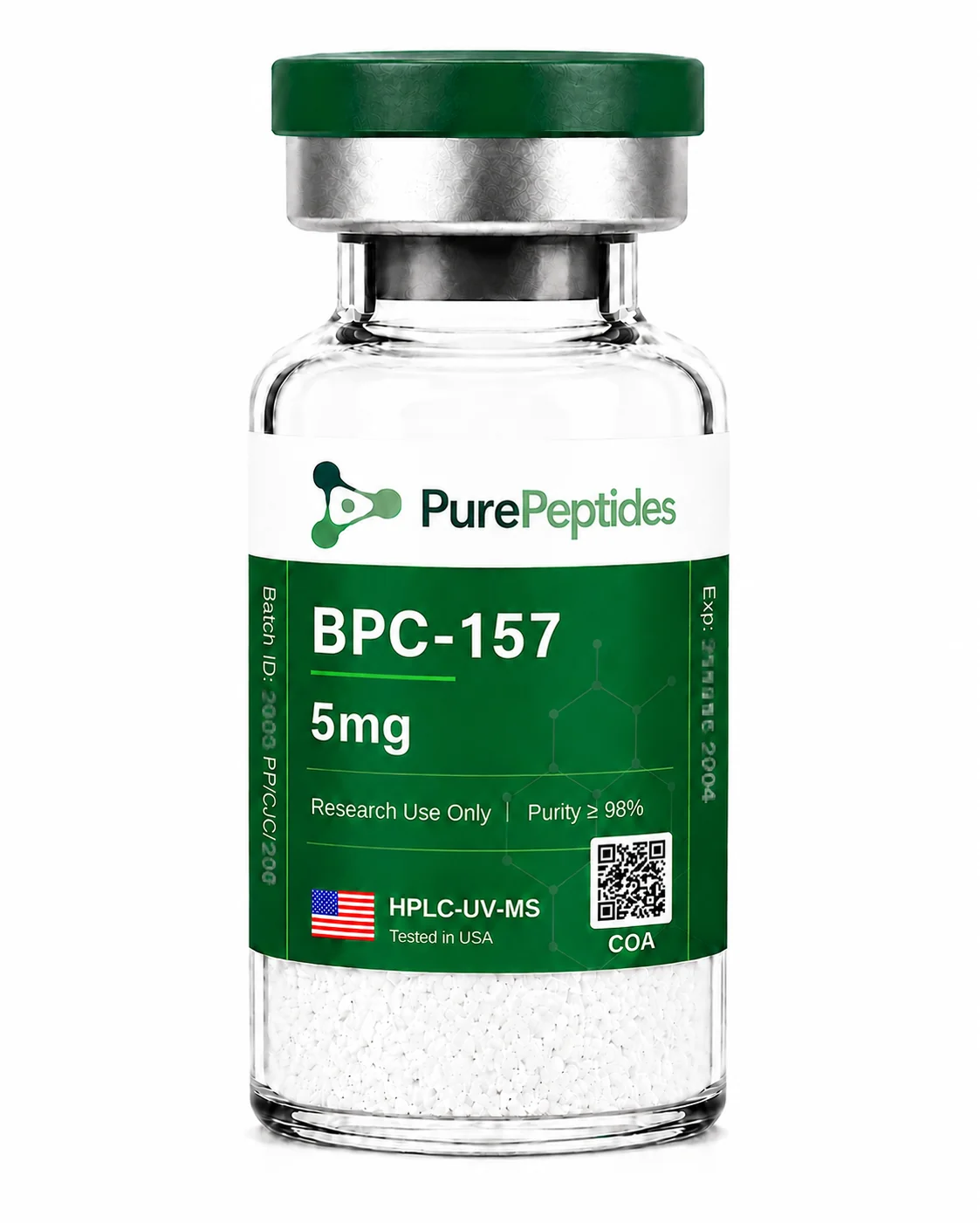
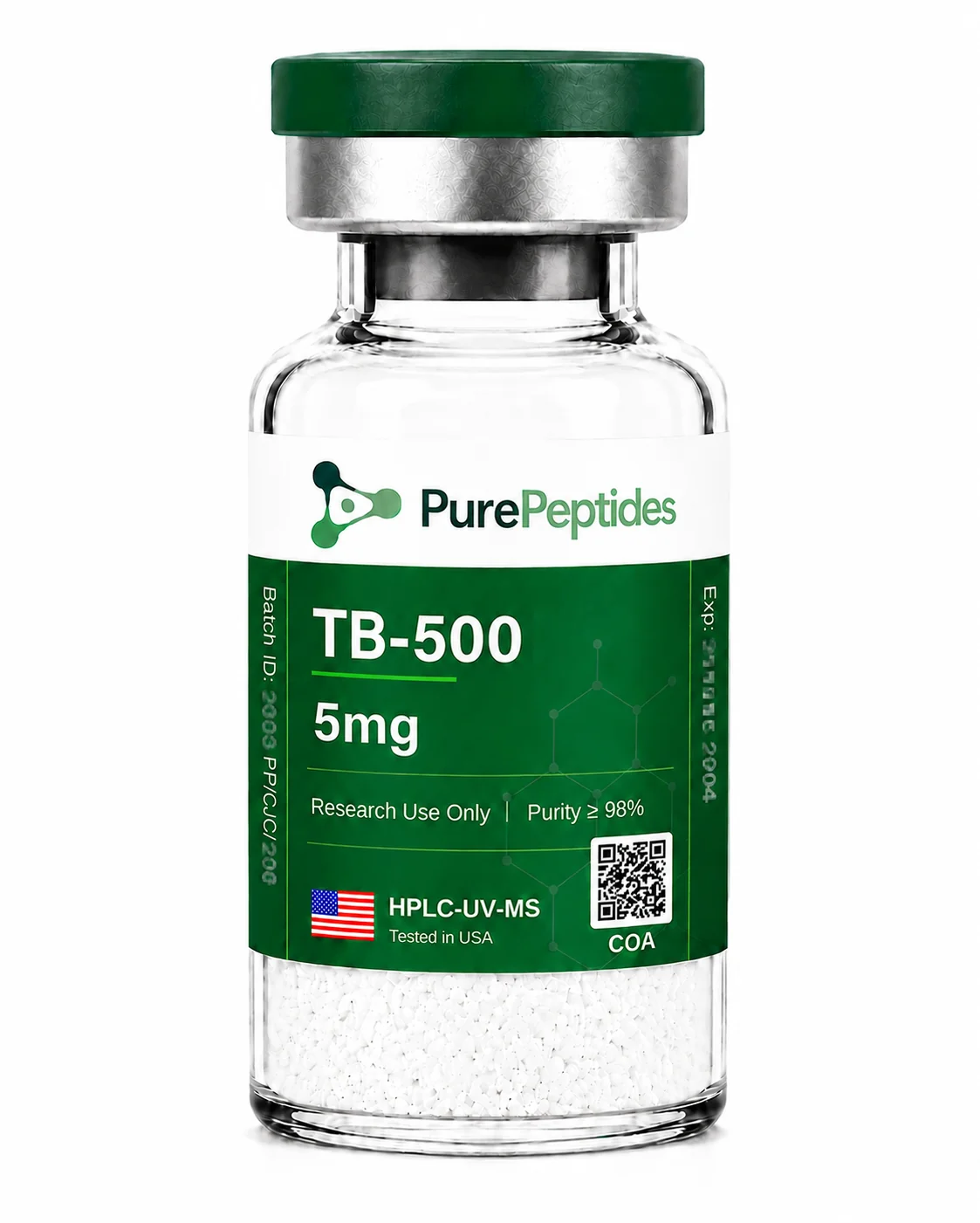
Structure at a glance
BPC-157 · 15 residues
TB-500 · 7 residues
Ac: N-terminal acetyl group. Letters are one-letter amino acid codes.
Drawn from the product database. Each measure's bars share one scale.
| Property | BPC-157 | TB-500 |
|---|---|---|
| What it is | A synthetic 15-residue peptide. Described in the originating literature as a partial sequence of a protein reported in human gastric juice.[1] | A synthetic seven-residue peptide corresponding to residues 17 to 23 of Thymosin Beta-4. |
| How they relate | Different molecules from different parents. BPC-157 is described in the originating literature as a partial sequence of a protein reported in human gastric juice.[1] TB-500 corresponds to residues 17 to 23 of Thymosin Beta-4. | |
| CAS number | 137525-51-0 | 885340-08-9 |
| Molecular formula | C62H98N16O22 | C38H68N10O14 |
| Molecular weight | 1,419.55 g/mol | 889.02 g/mol |
| Sequence | GEPPPGKPADDAGLV | Ac-LKKTETQ |
| Evidence base | Nearly all published research is preclinical. A 2025 systematic review counted 36 studies within its scope; the one clinical study was a retrospective case series of 12 patients. No randomized controlled trial has been published within that scope. | Cell-culture and explant assays tested a peptide with its seven-residue sequence.[2] An aged-mouse study tested a synthetic peptide with that sequence.[3] Attributed activity not directly determined with TB-500 itself in animal or human studies, in the literature reviewed for it. |
| Regulatory status | The FDA has not approved BPC-157 for human use. | The FDA has not approved TB-500 for human use. |
| Compared head-to-head? | Not with this form: a 2026 rat study tested BPC-157 and a product it calls TB-500, without giving that product's sequence.[4] No comparison of BPC-157 with a preparation identified as TB-500's seven-residue fragment found in PubMed (searched October 2026).[5] | |
| Handling difference | Neither contains a cysteine, a methionine or an aromatic residue. In solution, BPC-157 degrades fastest by rearrangement of its adjacent aspartates, and TB-500 by deamidation of its C-terminal glutamine. | |
How BPC-157 and TB-500 differ
BPC-157 and TB-500 are different molecules with different parents. BPC-157 is a 15-residue peptide, described in the originating literature as a partial sequence of a protein reported in human gastric juice.[1] It does not occur in nature in that isolated form, and the material used in studies is produced synthetically. TB-500 is a synthetic seven-residue peptide. At their N-terminal ends, BPC-157 has a free amine and TB-500 carries an acetyl group.
TB-500 corresponds to residues 17 to 23 of Thymosin Beta-4, and in the literature reviewed for TB-500, most studies used the full-length parent rather than a peptide with TB-500's sequence. Much of that foundational work comes from a relatively small number of groups. A small number of affiliated laboratories produced much of the foundational animal work on BPC-157.
A 2025 systematic review found that the BPC-157 evidence base within its scope remains overwhelmingly preclinical.[6] Within that review's scope, the one clinical study was a retrospective case series of 12 patients, and no randomized controlled trial has been published. In the literature reviewed for TB-500, the activity attributed to it has not been directly determined with TB-500 itself in animal or human studies.
Have BPC-157 and TB-500 been compared directly?
A 2026 study tested BPC-157 and a product it calls TB-500, each in its own group, in a rat model.[4] The paper describes that product as a synthetic peptide derived from Thymosin Beta-4 but gives no sequence for it, so it does not establish which compound was tested.[4] Results are reported for each compound in that model. No comparison of BPC-157 with a preparation identified as TB-500's seven-residue fragment found in PubMed (searched October 2026).[5] That search covers PubMed only.
Read more on each compound
BPC-157
Frequently Asked Questions
Is BPC-157 the same as TB-500?+−
BPC-157 and TB-500 are different molecules: BPC-157 is a 15-residue peptide, and TB-500 is a seven-residue fragment of Thymosin Beta-4. BPC-157 is described in the originating literature as a partial sequence of a protein reported in human gastric juice.
References
- 1Sikiric P, Seiwerth S, Grabarevic Z, Petek M, Rucman R, Turkovic B, et al. The beneficial effect of BPC 157, a 15 amino acid peptide BPC fragment, on gastric and duodenal lesions induced by restraint stress, cysteamine and 96% ethanol in rats. Life Sci. 1994;54(5):PL63-68. PMID 7904712
- 2Philp D, Huff T, Gho YS, Hannappel E, Kleinman HK. The actin binding site on thymosin beta4 promotes angiogenesis. FASEB J. 2003;17(14):2103-2105. PMID 14500546
- 3Philp D, Badamchian M, Scheremeta B, Nguyen M, Goldstein AL, Kleinman HK. Thymosin beta 4 and a synthetic peptide containing its actin-binding domain promote dermal wound repair in db/db diabetic mice and in aged mice. Wound Repair Regen. 2003;11(1):19-24. PMID 12581423.
- 4Biçer O, Adanir O, Güleryüz Y, Balci EC, Dinçel YM, Yenigün MY, Aydin C, Bayrak BY. Effects of BPC-157 and TB-500 on Achilles tendon healing in rats: a histopathological and biomechanical study. Jt Dis Relat Surg. 2026;37(3):822-837. doi:10.52312/jdrs.2026.2951. PMID 42542926.
- 5PubMed search via NCBI E-utilities, run 3 October 2026; records entered to 2 October 2026. Query: ("BPC-157"[tiab] OR "BPC 157"[tiab] OR "BPC157"[tiab] OR "body protection compound"[tiab] OR "gastric pentadecapeptide"[tiab] OR "pentadecapeptide BPC"[tiab]) AND ("TB-500"[tiab] OR "TB500"[tiab] OR "TB 500"[tiab] OR "LKKTETQ"[tiab] OR "Ac-LKKTETQ"[tiab]) AND ("1800/01/01"[edat] : "2026/10/02"[edat]). 10 records; none was a direct comparison of BPC-157 with a preparation identified as TB-500's seven-residue fragment.
- 6Vasireddi N, Hahamyan H, Salata MJ, Karns M, Calcei JG, Voos JE, et al. Emerging use of BPC-157 in orthopaedic sports medicine: a systematic review. HSS J. 2025 Jul 31;21(4):485-95. doi:10.1177/15563316251355551. PMID 40756949.
Related comparisons
TB-500 vs Thymosin Beta-4
TB-500 is a seven-residue fragment of Thymosin Beta-4; most published research associated with TB-500 used the full 43-residue peptide.
Read Comparison