
Published · 9 references
IGF-1 LR3 vs Tesamorelin
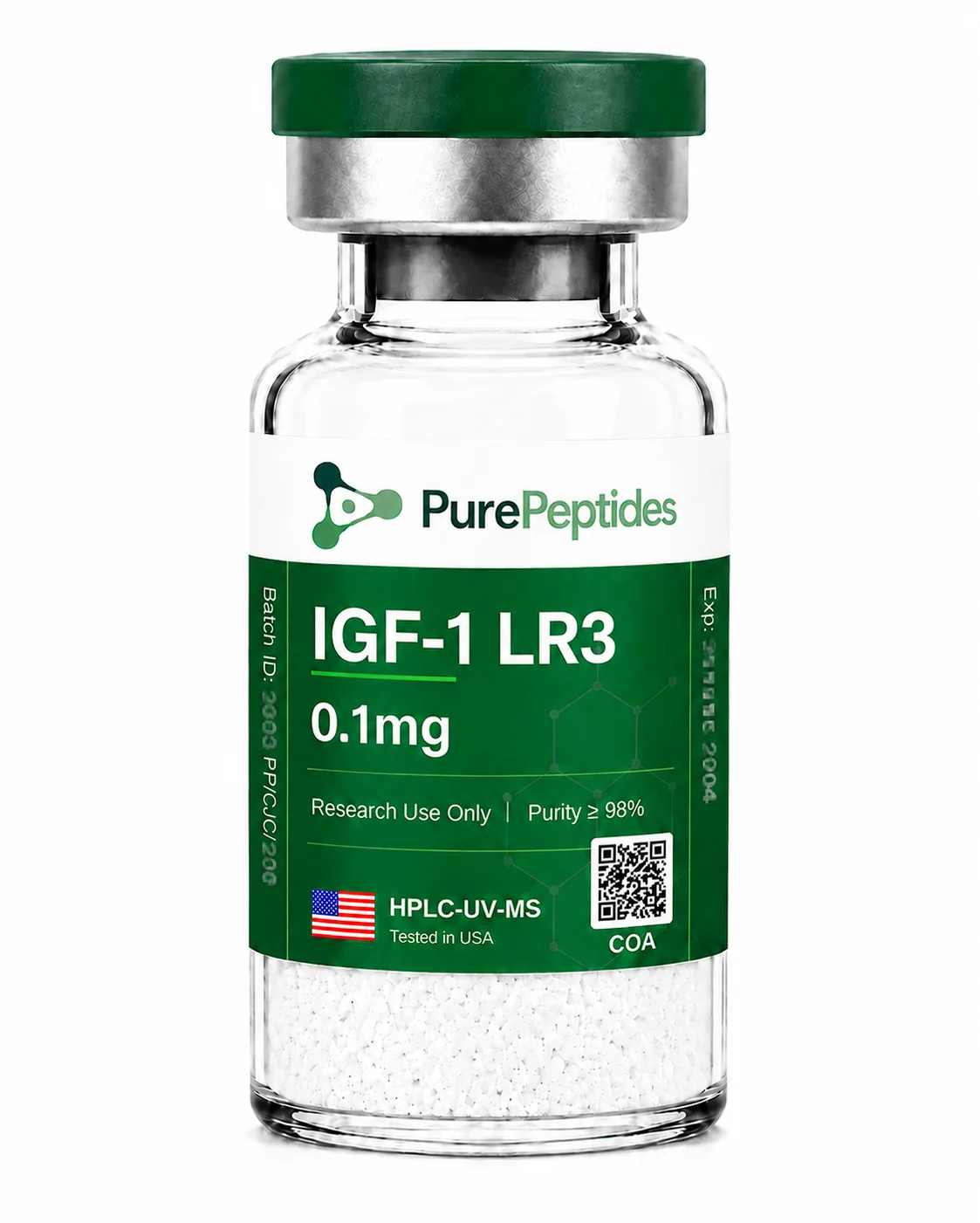
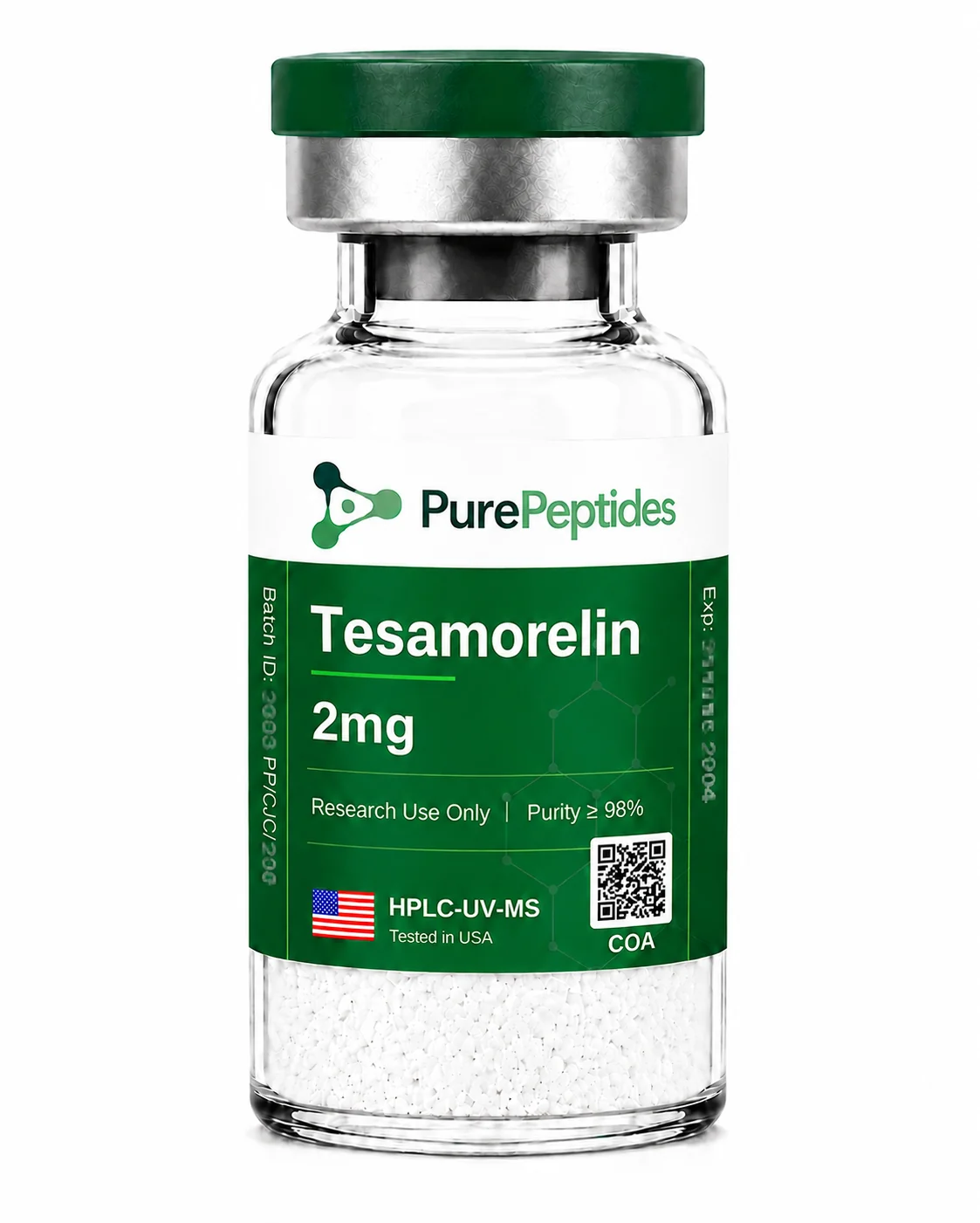
IGF-1 LR3 and Tesamorelin are different molecules: IGF-1 LR3 is an 83-residue protein with two changes to human IGF-1, and Tesamorelin is a 44-residue analog of human growth hormone-releasing hormone.
Structure at a glance
IGF-1 LR3 · 83 residues
Tesamorelin · 44 residues
Hex: N-terminal trans-3-hexenoyl group. NH2: C-terminal amide. Letters are one-letter amino acid codes.
Drawn from the product database. Each measure's bars share one scale.
| Property | IGF-1 LR3 | Tesamorelin |
|---|---|---|
| What it is | An 83-residue protein carrying two changes to native human IGF-1: arginine in place of glutamate at position 3, and a 13-residue N-terminal extension.[1] | A 44-residue peptide: an analog of human growth hormone-releasing hormone with an N-terminal trans-3-hexenoyl group. |
| How they relate | Different molecules from different parents. IGF-1 LR3 carries two changes to native human insulin-like growth factor 1 (IGF-1).[1] Tesamorelin is an analog of the full 44-residue human growth hormone-releasing hormone. | |
| CAS number | 143045-27-6 | 218949-48-5 |
| Molecular formula | C400H619N111O115S9 | C221H366N72O67S |
| Molecular weight | 9,111.45 g/mol | 5,135.86 g/mol |
| Sequence | MFPAMPLSSLFVNGPRTLCGAELVDALQFVCGDRGFYFNKPTGYGSSSRRAPQTGIVDECCFRSCDLRRLEMYCAPLKPAKSA | trans-3-hexenoyl-YADAIFTNSYRKVLGQLSARKLLQDIMSRQQGESNQERGARARL-NH2 |
| Evidence base | Measured findings in the literature reviewed for it: in vitro or animal work, none in people. No registered interventional trials in humans.[2] Almost every cited in vivo result comes from one consortium of its developers; independent replication is essentially absent.[3] | Human studies, which supported an approval for one indication. A pooled analysis of two phase 3 trials covered 806 randomized participants.[4] Their primary endpoints were imaging surrogates. The trial papers were manufacturer-sponsored. |
| Regulatory status | IGF-1 LR3 holds no marketing authorization anywhere. | The FDA approved tesamorelin acetate in 2010 for one therapeutic indication.[5][6] That approval is current, and it does not extend to IGF-1 LR3. |
| Compared head-to-head? | No direct comparison found in PubMed (searched October 2026).[7] | |
| Handling difference | IGF-1 LR3 holds three disulfide bonds and three methionines; each methionine is an oxidation site. Tesamorelin contains no cysteine and one methionine, which oxidizes on air exposure. | |
How IGF-1 LR3 and Tesamorelin differ
IGF-1 LR3 and Tesamorelin are different molecules from different parents. IGF-1 LR3 is an 83-residue protein carrying two changes to native human insulin-like growth factor 1 (IGF-1).[1] Arginine replaces glutamate at position 3 of the native sequence, and a 13-residue N-terminal extension is added.[1] Its name encodes both changes: "Long" for the extension and "R3" for the arginine at native position 3. Tesamorelin is an analog of the full 44-residue human growth hormone-releasing hormone, with a trans-3-hexenoyl group on its N-terminus.
In the literature reviewed for IGF-1 LR3, the measured findings are in vitro or animal work, none of it in people. No study testing IGF-1 LR3 in a person is retrievable. There are no registered interventional trials of it in humans.[2] That registry finding is not the same claim as never studied. Almost every in vivo result in that literature comes from one consortium of the compound's developers, and independent replication is essentially absent.[3] The literature reviewed for IGF-1 LR3 reports no human safety data.
A pooled analysis of Tesamorelin's two phase 3 trials covered 806 randomized participants.[4] In the literature reviewed for Tesamorelin, those two trials used imaging surrogates as primary endpoints, not clinical outcomes. The two trial papers and the pooled analysis were manufacturer-sponsored, with sponsor-affiliated co-authors. In the first of the two randomized placebo-controlled phase 3 trials, withdrawal because of an adverse event was higher on Tesamorelin than on placebo.[8]
IGF-1 LR3 holds no marketing authorization anywhere. The FDA approved tesamorelin acetate in 2010 for one therapeutic indication.[5][6] That approval is current, and it belongs to tesamorelin acetate and to that one indication. It does not extend to IGF-1 LR3. Tesamorelin acetate is the active ingredient of a prescription medicine sold under another name. The material supplied here is a research-grade preparation, is not that medicine, and holds no marketing authorization. That medicine's label lists glucose intolerance or new diabetes among its warnings; HbA1c reached 6.5% or above in 5% of participants on the drug against 1% on placebo.[9]
IGF-1 LR3 holds six cysteines joined in three disulfide bonds, and it carries three methionines. Each methionine is an independent oxidation site. Under alkaline conditions, its three disulfide bonds can also scramble, which leaves the formula and mass unchanged. Tesamorelin contains no cysteine, so no disulfide is possible. Its single methionine oxidizes to a sulfoxide on air exposure.
Have IGF-1 LR3 and Tesamorelin been compared directly?
No direct comparison of IGF-1 LR3 with Tesamorelin was found in a PubMed search run in October 2026.[7] That search covers PubMed only.
Read more on each compound
IGF-1 LR3
Frequently Asked Questions
Is IGF-1 LR3 the same as Tesamorelin?+−
IGF-1 LR3 and Tesamorelin are different molecules from different parents. IGF-1 LR3 is an 83-residue protein carrying two changes to native human IGF-1. Tesamorelin is an analog of the full 44-residue human growth hormone-releasing hormone, with a trans-3-hexenoyl group on its N-terminus.
Is IGF-1 LR3 or Tesamorelin approved?+−
IGF-1 LR3 holds no marketing authorization anywhere; the FDA approved tesamorelin acetate in 2010 for one therapeutic indication, and that approval does not extend to IGF-1 LR3. Tesamorelin acetate is the active ingredient of a prescription medicine sold under another name. The material supplied here is a research-grade preparation, is not that medicine, and holds no marketing authorization.
References
- 2Per-compound registry searches for IGF-1 LR3. ClinicalTrials.gov API v2, query.intr and query.term for "IGF-1 LR3" and "LR3-IGF-1", both returning zero studies. Run 27 August 2026.
- 3Affiliation audit of the in vivo IGF-1 analogue papers cited in the IGF-1 LR3 research article. PubMed E-utilities efetch across the cited PMIDs. Run 27 August 2026.
- 5US Food and Drug Administration, Center for Drug Evaluation and Research. Approval letter for tesamorelin, 10 November 2010 (Reference ID 2863003).
- 6US Food and Drug Administration, Drugs@FDA. Approval record whose active ingredient is tesamorelin acetate; marketing status Prescription. Retrieved via api.fda.gov/drug/drugsfda.json on products.active_ingredients.name "TESAMORELIN ACETATE", 3 October 2026.
- 7PubMed search via NCBI E-utilities, run 3 October 2026; records entered to 2 October 2026. Query: ("IGF-1 LR3"[tiab] OR "IGF-I LR3"[tiab] OR "LR3-IGF-1"[tiab] OR "LR3-IGF-I"[tiab] OR "LR3 IGF-1"[tiab] OR "LR3 IGF-I"[tiab] OR "Long R3 IGF-1"[tiab] OR "Long R3 IGF-I"[tiab] OR "Long-R3-IGF-1"[tiab] OR "Long-R3-IGF-I"[tiab] OR "Long R3"[tiab] OR "long-R3"[tiab] OR "LR3"[tiab] OR "LR(3)"[tiab] OR "long R(3)"[tiab] OR "long-R(3)"[tiab] OR "R(3)-IGF-1"[tiab] OR "R(3)-IGF-I"[tiab] OR "R3-IGF-1"[tiab] OR "R3-IGF-I"[tiab]) AND ("tesamorelin"[tiab] OR "trans-3-hexenoyl"[tiab] OR "hexenoyl"[tiab]) AND ("1800/01/01"[edat] : "2026/10/02"[edat]). 3 records; none was a direct comparison of the two compounds.
- 9US Food and Drug Administration. Approved prescribing information for tesamorelin acetate; label version 29 July 2026. Retrieved via openFDA drug/label.
Related comparisons
AOD-9604 vs Tesamorelin
AOD-9604 is a modified 16-residue peptide from the C-terminal end of human growth hormone; Tesamorelin is a 44-residue analog of human GHRH.
Read ComparisonCJC-1295 (No DAC) vs IGF-1 LR3
CJC-1295 (No DAC), a 29-residue peptide, and IGF-1 LR3, an 83-residue protein, are different molecules from different parents.
Read ComparisonCJC-1295 (No DAC) vs Tesamorelin
CJC-1295 (No DAC) carries four substitutions in human GHRH's first 29 residues; Tesamorelin is an analog of the full 44-residue hormone.
Read Comparison