
Published · 9 references
MOTS-c vs SS-31
MOTS-c and SS-31 are different molecules: MOTS-c is a 16-residue peptide encoded within a ribosomal RNA gene, and SS-31 is a four-residue peptide containing a D-arginine.
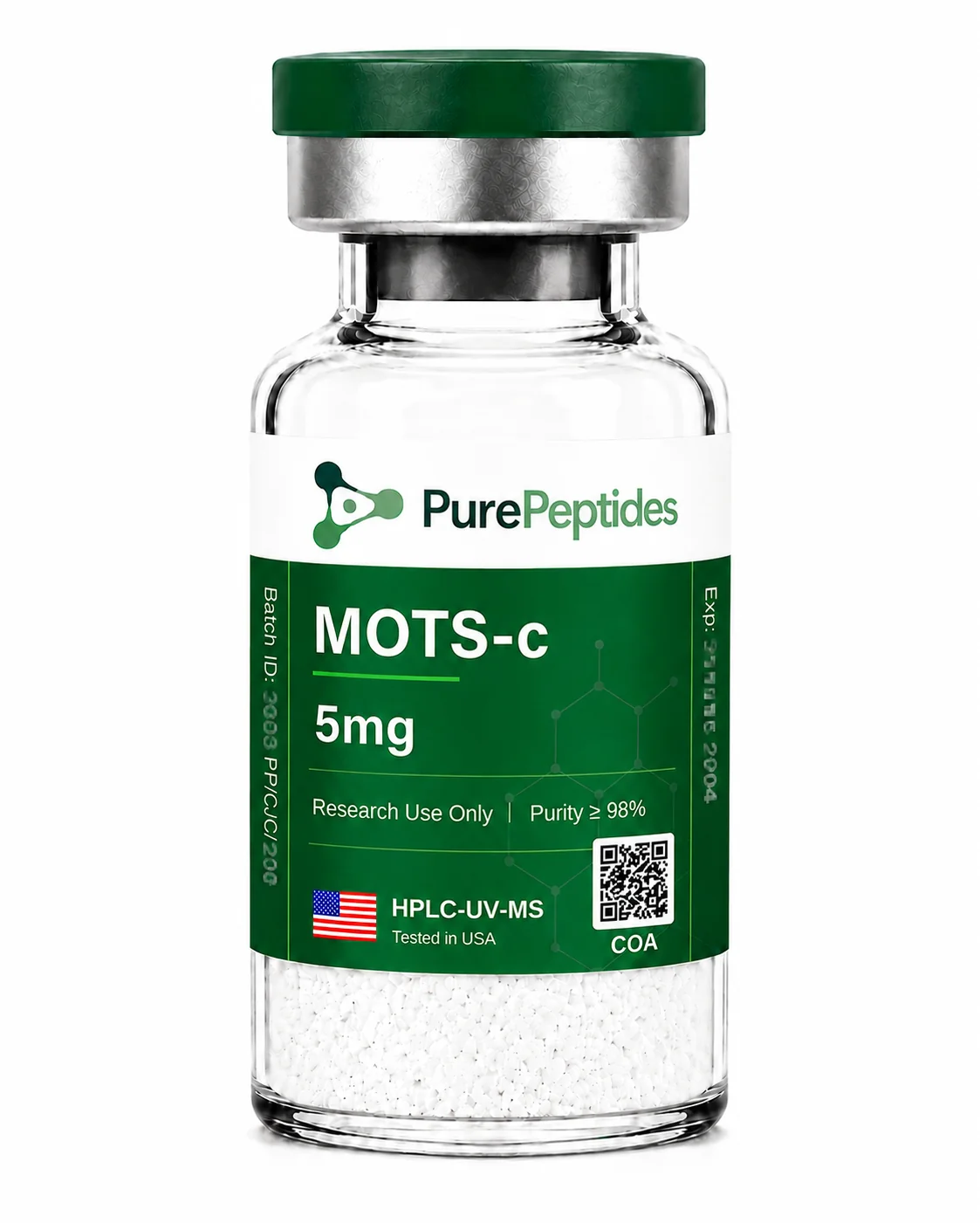
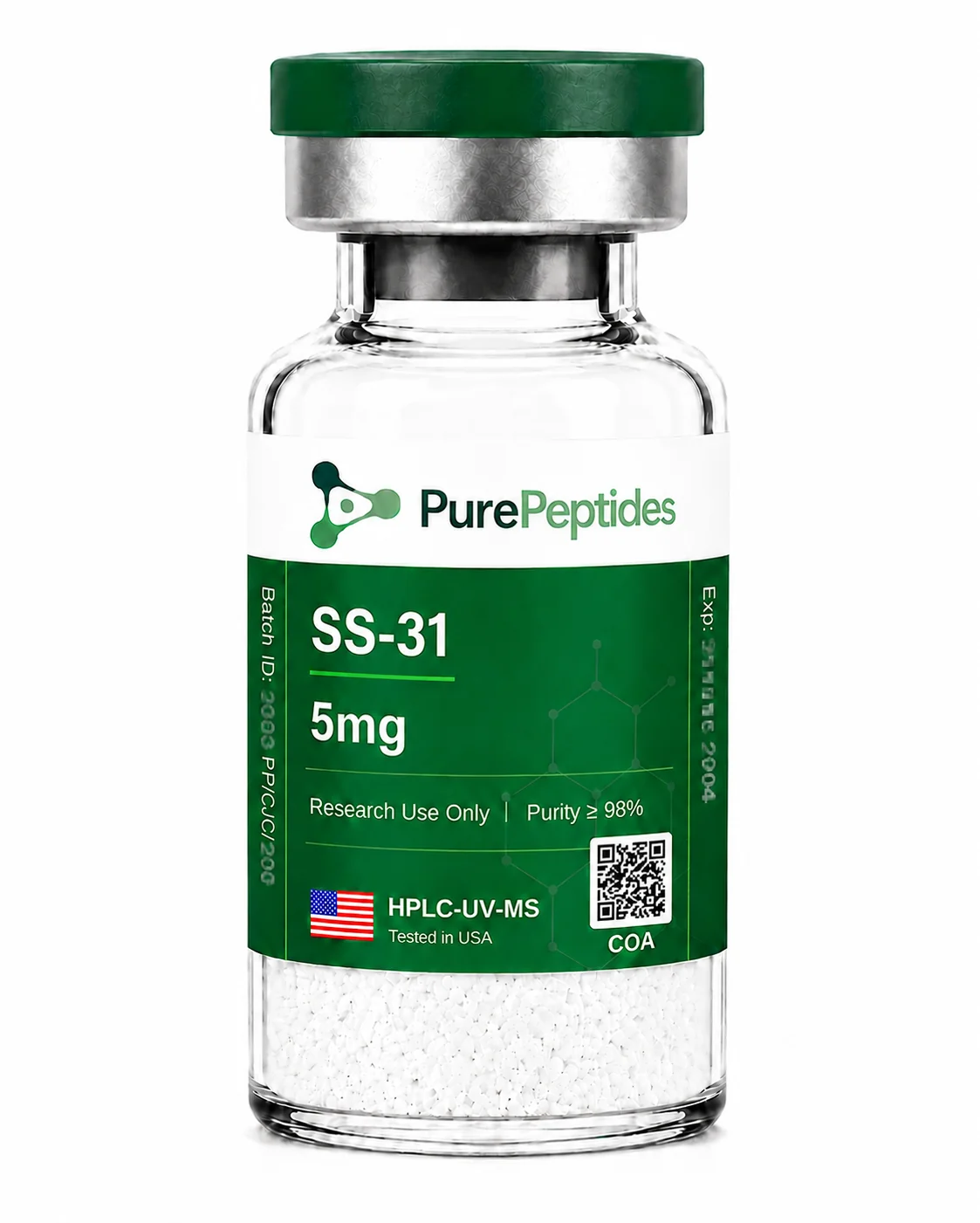
Structure at a glance
MOTS-c · 16 residues
SS-31 · 4 residues
NH2: C-terminal amide. A raised D marks a D-amino acid. Dmt: dimethyltyrosine. Codes are three-letter amino acid codes.
Drawn from the product database. Each measure's bars share one scale.
| Property | MOTS-c | SS-31 |
|---|---|---|
| What it is | A 16-residue peptide encoded by a short open reading frame within the mitochondrial 12S rRNA gene.[1] Ends in a free C-terminal acid. | A tetrapeptide, also named elamipretide.[2][3] Four residues, with a D-arginine and a C-terminal amide. |
| How they relate | Different molecules. MOTS-c is encoded by a short open reading frame within the mitochondrial 12S rRNA gene.[1] SS-31 is a synthetic tetrapeptide.[2][3] | |
| CAS number | 1627580-64-6 | 736992-21-5 |
| Molecular formula | C101H152N28O22S2 | C32H49N9O5 |
| Molecular weight | 2,174.62 g/mol | 639.80 g/mol |
| Sequence | Met-Arg-Trp-Gln-Glu-Met-Gly-Tyr-Ile-Phe-Tyr-Pro-Arg-Lys-Leu-Arg | D-Arg-dimethylTyr-Lys-Phe-NH2 |
| Evidence base | Animal and cell studies. No completed controlled study testing MOTS-c in people has published results. Human studies in the literature reviewed for it measured the body's own MOTS-c. | Randomized human trials. One, in an indication other than the approved one, was negative on its primary endpoint and every prespecified secondary.[4] The developer sponsored essentially the entire clinical program.[5] |
| Regulatory status | MOTS-c is not approved for human therapeutic use, and Drugs@FDA holds no approved application for it.[6] | Elamipretide hydrochloride holds an accelerated US approval, granted in September 2025, for one therapeutic indication.[7][8] |
| Compared head-to-head? | No direct comparison found in PubMed (searched October 2026).[9] | |
| Handling difference | MOTS-c has three oxidation-prone residues: two methionines and a tryptophan. SS-31 contains no sulfur; its specific liability is epimerization of its D-arginine, which leaves formula and mass unchanged. | |
How MOTS-c and SS-31 differ
MOTS-c and SS-31 are different molecules. MOTS-c is a 16-residue peptide encoded by a short open reading frame within the mitochondrial 12S rRNA (ribosomal RNA) gene.[1] Its chain ends in a free C-terminal acid. SS-31 is a synthetic tetrapeptide, and elamipretide is another name for the same molecule.[2][3] Its four residues include a D-arginine, and its chain ends in a C-terminal amide.
No completed controlled study testing MOTS-c in people has published results. In the literature reviewed for MOTS-c, the human studies measured the body's own MOTS-c. The findings of the 2015 paper that first described MOTS-c are animal and cell findings, and none of them has been shown in humans.[1] SS-31 has been tested in randomized human trials. One, in an indication other than the approved one, was negative on its primary endpoint and on every prespecified secondary.[4] The compound's developer sponsored essentially the entire clinical program in the literature reviewed for SS-31.[5]
Elamipretide hydrochloride holds an accelerated US approval, granted in September 2025, for one therapeutic indication.[7][8] That approval does not extend to research-grade material, to any other indication, or to any other compound. Elamipretide hydrochloride is the active ingredient of a prescription medicine sold under another name. The material supplied here is a research-grade preparation, is not that medicine, and holds no marketing authorization. MOTS-c is not approved for human therapeutic use, and Drugs@FDA holds no approved application for it.[6]
MOTS-c carries two methionines and a tryptophan, three residues that can each take up oxygen when exposed to air, light or trace metals. A glutamine gives it a second, slower route, deamidation in solution. SS-31 contains no sulfur, so it has no methionine to oxidize, and it has no residue open to deamidation. The stability concern specific to SS-31 is its D-arginine: a peptide that epimerizes at that residue keeps an identical formula and mass, so mass spectrometry cannot detect the change. Neither can form a disulfide, and both carry a substantial net positive charge. Solid-phase synthesis delivers each as a salt, and in both the counter-ion makes up a large share of the material.
Have MOTS-c and SS-31 been compared directly?
No direct comparison of MOTS-c with SS-31 was found in a PubMed search run in October 2026.[9] That search covers PubMed only.
Read more on each compound
MOTS-c
Frequently Asked Questions
Is MOTS-c the same as SS-31?+−
MOTS-c and SS-31 are different molecules: MOTS-c is a 16-residue peptide encoded within a ribosomal RNA gene, and SS-31 is a four-residue peptide containing a D-arginine. Elamipretide is another name for SS-31.
Is MOTS-c or SS-31 approved?+−
MOTS-c is not approved for human therapeutic use; elamipretide hydrochloride, a salt of the SS-31 molecule, is the active ingredient of a prescription medicine sold under another name. The material supplied here is a research-grade preparation, is not that medicine, and holds no marketing authorization.
References
- 2NCBI PubChem. Compound records for the free base and the trihydrochloride. Retrieved 28 August 2026.
- 3Tung C. International Journal of Molecular Sciences, 2025. PMID 39940712. DOI: 10.3390/ijms26030944.
- 5US Food and Drug Administration. Approved prescribing information for elamipretide; approval date 20250919, label version 20251210. Retrieved via field-qualified openFDA queries.
- 6US Food and Drug Administration. openFDA drug/label and drug/drugsfda endpoints, snapshot last updated 2026-08-26. Field-qualified substance-name query returned no record for MOTS-c.
- 8US Food and Drug Administration, Drugs@FDA. Approval record whose active ingredient is elamipretide hydrochloride. Retrieved via api.fda.gov/drug/drugsfda.json on products.active_ingredients.name "ELAMIPRETIDE HYDROCHLORIDE", 3 October 2026.
- 9PubMed search via NCBI E-utilities, run 3 October 2026; records entered to 2 October 2026. Query: ("MOTS-c"[tiab] OR "MOTSc"[tiab] OR "MOTS c"[tiab]) AND ("SS-31"[tiab] OR "SS31"[tiab] OR "SS 31"[tiab] OR "elamipretide"[tiab]) AND ("1800/01/01"[edat] : "2026/10/02"[edat]). 1 record; none was a direct comparison of the two compounds.
Related comparisons
AOD-9604 vs HGH Fragment 176-191
AOD-9604 and HGH Fragment 176-191 are 16-residue peptides from the C-terminal end of human growth hormone that differ at one position.
Read Comparison