
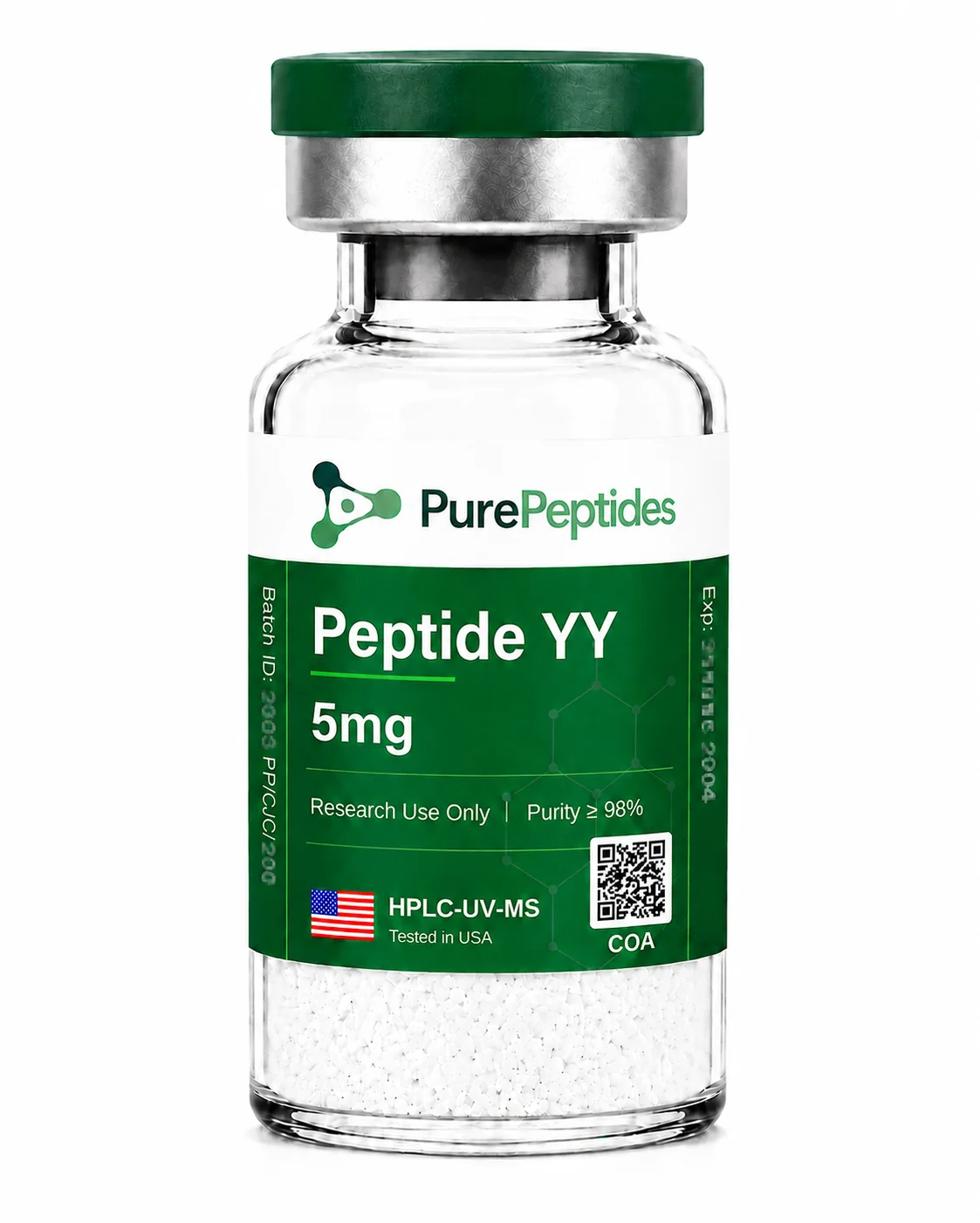
Peptide YY (PYY 3-36) Research Peptide
PYY 3-36 is a 34-amino-acid fragment of a gut hormone called peptide YY.
Multi-vial Discount Available
Select Size
Research Use Only · Not for human or veterinary consumption.
People also purchased
5mg · $43.00
5mg · $29.00
10mg · $43.00
Safety Data Sheet
In the 16-section GHS format covering identification, hazards, handling, storage and disposal.
- Ships Next Day
- Quality Guaranteed
- Cold-Chain Shipping
- Free US Shipping Over $150
What is Peptide YY (PYY 3-36)?
PYY 3-36 is a 34-amino-acid fragment of a gut hormone called peptide YY. The gut releases the full-length hormone after a meal. An enzyme then trims two residues off one end to make this shorter form. Trimming changes which receptors it prefers. The fragment acts at the Y2 receptor. The full-length hormone it comes from is a different molecule and is not sold here. Almost everything published about the fragment concerns food intake, and that literature holds a well-documented argument.

Product information reviewed by Dr. Martina Rossi, PhD
Scientific Contributor and Reviewer · Reviewed
Peptide YY (PYY 3-36) Research & Reference
What Peptide YY (PYY 3-36) does in published studies, and how to work with it in the laboratory, are covered in full on two dedicated pages rather than summarised here, so neither the evidence nor the handling detail is cut short.
Technical Specs
Labeled quantity is net peptide content, not gross salt weight.
Frequently Asked Questions
Is Peptide YY (PYY 3-36) third-party tested for purity?+−
Yes. Every batch of Peptide YY (PYY 3-36) is tested by an independent third-party laboratory using HPLC and MS-UPLC, confirming purity and mass identity before the batch is released. Pure Peptides does not test its own material.
What does "Research Use Only" mean?+−
It means Peptide YY (PYY 3-36) is supplied for in-vitro laboratory research and for no other purpose, and must not be administered to humans or animals. PYY 3-36 is legal to purchase in the United States for in vitro and non-clinical laboratory research. It has no FDA approval and no approved human use. No approved product containing this peptide was found in the sources retrieved for this page; the most advanced program located is a long-acting analogue, a different molecule, which reached phase 2. PYY 3-36 is not a scheduled substance under the Controlled Substances Act. Sold strictly for qualified research use, not human or veterinary administration.
How is Peptide YY (PYY 3-36) shipped and stored?+−
Peptide YY (PYY 3-36) ships from US stock with cold-chain packaging and full tracking; orders placed before noon EST on business days are typically dispatched the same business day. On arrival, store the lyophilized powder at -20°C or below, dry and protected from light.
What is the difference between PYY 3-36 and PYY 1-36?+−
PYY 1-36 is the full-length gut hormone. PYY 3-36 is what remains after the first two residues are cleaved off, and that shorter form acts at the Y2 receptor. They are different molecules with different receptor behavior, and a result for one is not a result for the other. Papers are not always explicit about which they used, so it is worth checking before comparing findings.
Is the appetite finding settled?+−
No, and the disagreement is on the public record. A 2002 Nature paper reported that the peptide reduces food intake in rodents and in people. In 2004 the same journal published a Comment from 42 authors stating they could not replicate the rodent result and that this called the approach into question. In 2005 a separate group reproduced a reduction in human calorie intake but found it significant only at concentrations higher than the body produces on its own, and reported nausea and fullness at the top dose. The PYY 3-36 research article sets out all three positions without picking a winner.
Metabolic & Cellular Research
Related Compounds

Reviewed for scientific accuracy
Dr. Martina Rossi, PhD
PhD, Université Grenoble Alpes · Scientific Contributor and Reviewer
Dr. Rossi's doctoral research at Université Grenoble Alpes examined the vascular functions of bone morphogenetic proteins. Her peer-reviewed work spans cell and molecular biology, vascular biology, and gene therapy, in journals including Cardiovascular Research, Scientific Reports, and Brain Sciences. She reviews Pure Peptides' product, reference, and research pages for scientific accuracy against the sources they cite.