
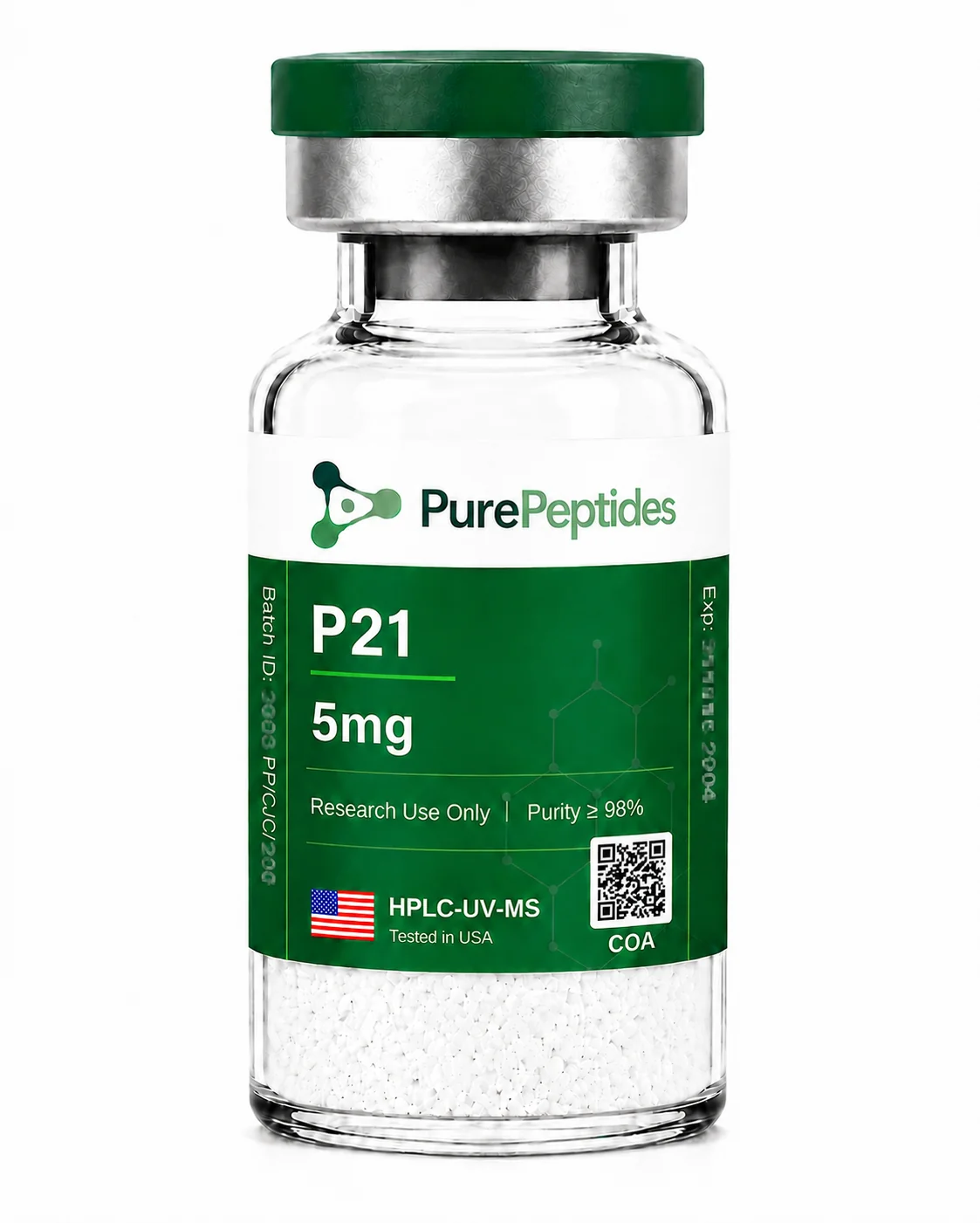
P21 (P021) Research Peptide
P21, also written P021, is a small synthetic molecule.
- Purity
- >99%
- Dispatch
- Dispatched next business day with cold-chain delivery
- Cold chain
- Temperature-controlled packaging from lab to door
- Certificate
- Batch-specific Certificate of Analysis available on this page
Multi-vial Discount Available
Select Size
Ships Next Day
Orders confirmed before 12pm EST ship the same business day; orders after 12pm EST ship the next business day. Monday to Friday.
Quality Guaranteed
Every batch is HPLC-tested to >99% purity. Certificate of Analysis available on this page; MSDS available on request.
Verify Batch
Lot-level COA, Batch DF/P21/062026. Check the batch number printed on your vial against the certificate below, which reports the tests run on it.
What is P21 (P021)?
P21, also written P021, is a small synthetic molecule. Four of its parts are amino acids, copied from a short stretch of a natural human protein called CNTF, and the other two are chemical groups attached at each end: a small cap at one end and a rigid cage-shaped carbon group at the other. Those two additions make up a large share of the molecule, so calling it a peptide only tells part of the story. The published evidence is split: results in cells and in one strain of mice are positive, and an unconnected group testing it in a different strain found much less.
Technical Specs
Labeled quantity is net peptide content, not gross salt weight.
P21 (P021) Research & Reference
What P21 (P021) does in published studies, and how to work with it in the laboratory, are covered in full on two dedicated pages rather than summarised here, so neither the evidence nor the handling detail is cut short.
Certificates of Analysis
Every batch is tested by an independent laboratory before release. The certificate covering this batch of P21 (P021), and its safety data sheet, are below as PDFs, so the figures on this page can be checked against the source.
Frequently Asked Questions
Is P21 (P021) independently tested for purity?+−
Yes. Every batch of P21 (P021) is tested by an independent third-party laboratory using HPLC and MS-UPLC, confirming purity and mass identity before the batch is released. Pure Peptides does not test its own material.
Can I see the Certificate of Analysis before buying?+−
Yes. The Certificate of Analysis for the batch currently in stock can be viewed and downloaded directly on this page, before you place an order. Each certificate states the batch number, the measured purity, and the date of analysis, and can be verified independently with the issuing laboratory using the report number it carries.
What does "Research Use Only" mean?+−
It means P21 (P021) is supplied for in-vitro laboratory research and for no other purpose, and must not be administered to humans or animals. P21 is legal to purchase in the United States for in vitro and non-clinical laboratory research. It has no FDA approval and no approved human use. P21 is not a scheduled substance under the Controlled Substances Act. Sold strictly for qualified research use, not human or veterinary administration.
How is P21 (P021) shipped and stored?+−
P21 (P021) ships from US stock with cold-chain packaging and full tracking; orders placed before noon EST on business days are typically dispatched the same business day. On arrival, store the lyophilized powder at -20°C or below, dry and protected from light.
Does P21 work by increasing BDNF?+−
That is the mechanism proposed by the laboratory that developed it, stated in its own paper as "probably via" increased BDNF expression lowering GSK3-beta activity. An independent group testing the compound in 2024 found that chronic treatment in mice failed to increase BDNF levels at all, though it corrected the same GSK3-beta pathway in the corresponding human cell model. The Published Research tab reports both and does not choose between them.
How much of P21 is actually peptide?+−
Four of its components are amino acids: aspartate, glycine, glycine and leucine. The rest is an acetyl group at one end and an adamantyl group at the other, and at a molecular weight of 578.67 those two account for a substantial share of the molecule. Note also that the literature designation Ac-DGGLAG-NH2 does not mean the sequence ends in alanine and glycine: the "AG" denotes the adamantylated glycine cap.
Related Compounds
 >99%
>99% >99%
>99% >99%
>99% >99%
>99% >99%
>99% >99%
>99% >99%
>99% >99%
>99%