
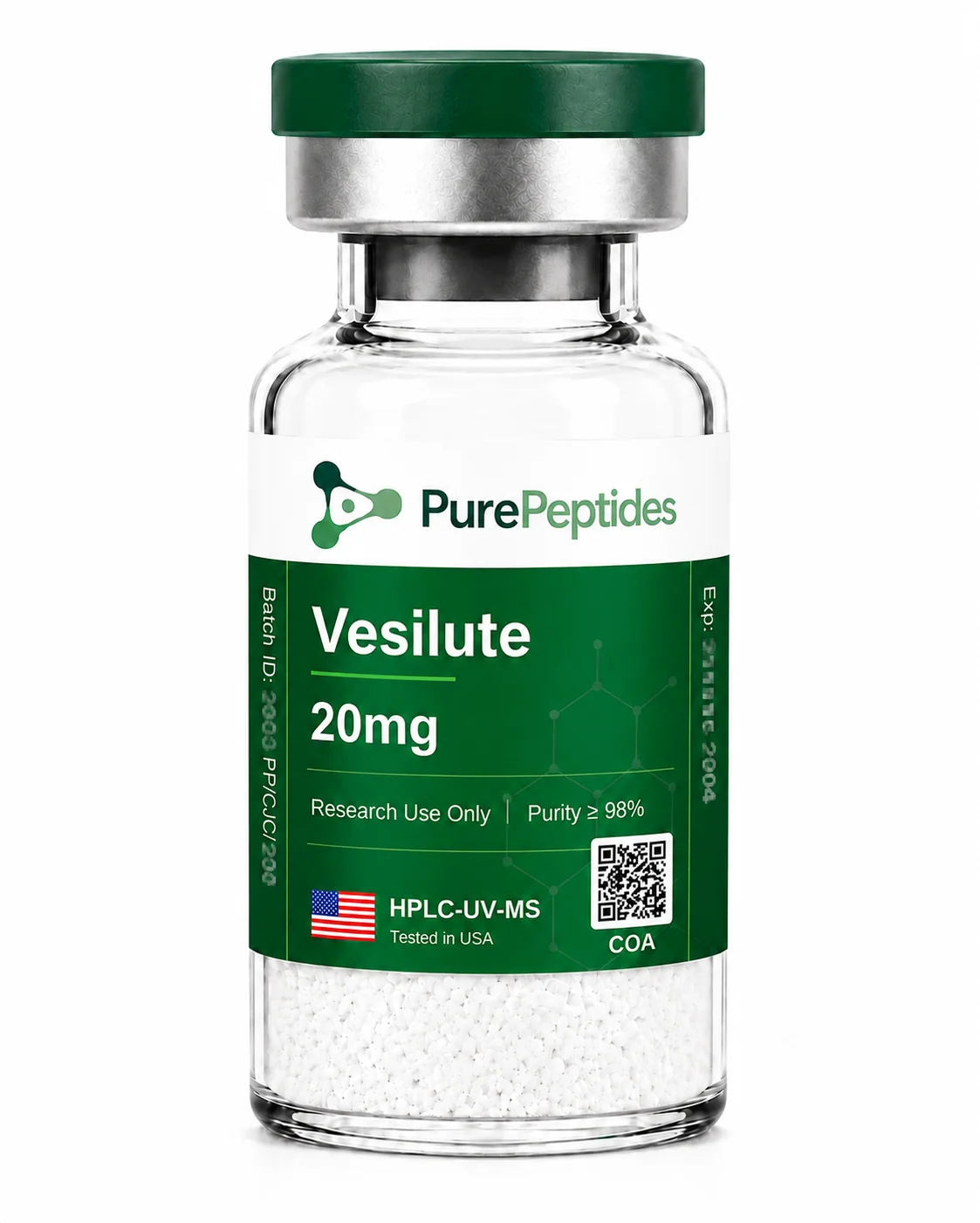
Vesilute Research Peptide
Vesilute is a laboratory-made peptide of just two amino acids: glutamic acid joined to aspartic acid.
Multi-vial Discount Available
Get notified when this batch is released
Enter your email and we'll let you know as soon as this product is available again.
Research Use Only · Not for human or veterinary consumption.
People also purchased
5mg · $43.00
5mg · $29.00
10mg · $43.00
Safety Data Sheet
In the 16-section GHS format covering identification, hazards, handling, storage and disposal.
- Next batch coming soon
- Quality Guaranteed
- Cold-Chain Shipping
- Free US Shipping Over $150
What is Vesilute?
Vesilute is a laboratory-made peptide of just two amino acids: glutamic acid joined to aspartic acid. Both of those amino acids carry a negative charge at ordinary pH, so the molecule is small and acidic. One peer-reviewed study has tested it in living animals: a 1999 study in mice found it no different from its two constituent amino acids on immune, phagocytosis and antitoxic measures. The points below describe chemistry that has been measured, either on this exact pairing or on very short peptides as a group.

Product information reviewed by Dr. Martina Rossi, PhD
Scientific Contributor and Reviewer · Reviewed
Vesilute Research & Reference
What Vesilute does in published studies, and how to work with it in the laboratory, are covered in full on two dedicated pages rather than summarised here, so neither the evidence nor the handling detail is cut short.
Technical Specs
Labeled quantity is net peptide content, not gross salt weight.
Frequently Asked Questions
Is Vesilute third-party tested for purity?+−
Yes. Every batch of Vesilute is tested by an independent third-party laboratory using HPLC and MS-UPLC, confirming purity and mass identity before the batch is released. Pure Peptides does not test its own material.
What does "Research Use Only" mean?+−
It means Vesilute is supplied for in-vitro laboratory research and for no other purpose, and must not be administered to humans or animals. Vesilute is legal to purchase in the United States for in vitro and non-clinical laboratory research. It has no FDA approval and no approved human use. Vesilute is not a scheduled substance under the Controlled Substances Act. Sold strictly for qualified research use, not human or veterinary administration.
How is Vesilute shipped and stored?+−
Vesilute ships from US stock with cold-chain packaging and full tracking; orders placed before noon EST on business days are typically dispatched the same business day. On arrival, store the lyophilized powder at -20°C or below, dry and protected from light.
What research has been published on Vesilute?+−
Very little. The Vesilute research article lists the searches run on its name and what each returned. A 1999 study tested this dipeptide, Glu-Asp, in mice and in vitro alongside four other dipeptides, and found no difference from its constituent amino acids on immune, phagocytosis or antitoxic measures. A 2015 study found it was one of five soybean peptides that reduced the calcium response to salicin in cells carrying a human bitter taste receptor. One physical chemistry paper has measured calcium binding to this dipeptide, and the result was unremarkable. Other peptides in the same series have their own literature. The trade name appears in two indexed papers from that program: a 2016 docking study that lists it with no activity label, and a 2022 review that gives it a computed docking score and a bladder label that cites no source. The bladder attribution itself goes back at least to the program's own patent filing, which has not been peer reviewed.
Peptide Bioregulators
Related Compounds

Reviewed for scientific accuracy
Dr. Martina Rossi, PhD
PhD, Université Grenoble Alpes · Scientific Contributor and Reviewer
Dr. Rossi's doctoral research at Université Grenoble Alpes examined the vascular functions of bone morphogenetic proteins. Her peer-reviewed work spans cell and molecular biology, vascular biology, and gene therapy, in journals including Cardiovascular Research, Scientific Reports, and Brain Sciences. She reviews Pure Peptides' product, reference, and research pages for scientific accuracy against the sources they cite.