
- Purity
- >99%
- Verified
- Independent HPLC purity verification on every batch
- Cold chain
- Temperature-controlled packaging from lab to door
- Certificate
- Certificate of Analysis available on request for this batch
Multi-vial Discount Available
Get notified when this batch is released
Enter your email and we'll let you know as soon as this product is available again.
Next batch coming soon
This compound is temporarily out of stock. Check back soon or contact us for a restock estimate.
Quality Guaranteed
Every batch is HPLC-tested to >99% purity. Certificate of Analysis available on request; MSDS available on request.
Certificate of Analysis Available on Request
Request this batch's certificate using your order number.
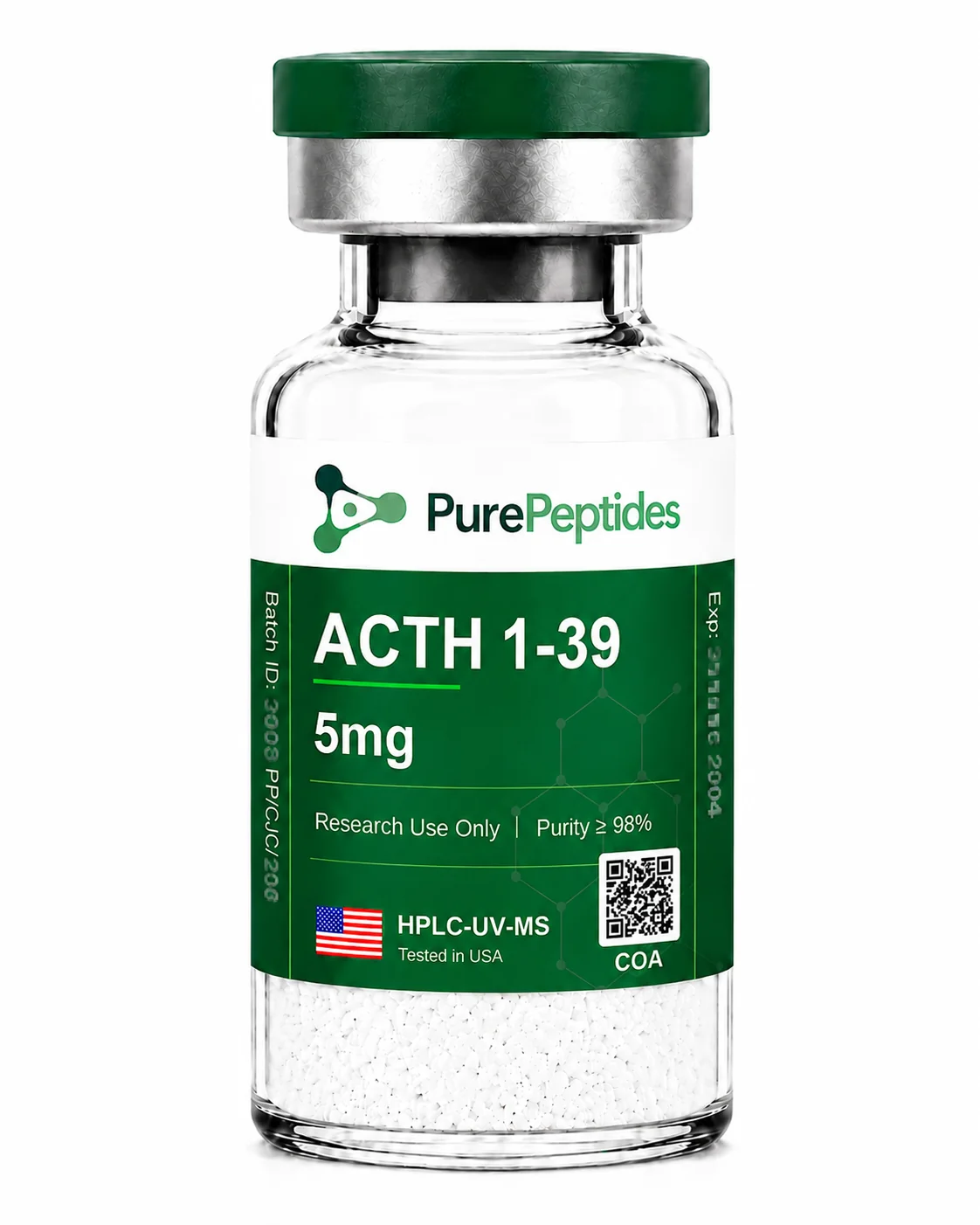
What is ACTH 1-39?
ACTH 1-39 is a peptide of 39 residues. It is the full-length form of the hormone usually called corticotropin. It binds one receptor, MC2R, and that receptor is odd among its family. It is the only one of the five melanocortin receptors that cannot reach the cell surface by itself. It needs a second protein, MRAP, to get there and to work. Semax, listed separately here, copies a short fragment of this sequence and is a different molecule.
Technical Specs
Labeled quantity is net peptide content, not gross salt weight.
ACTH 1-39 Research & Reference
What ACTH 1-39 does in published studies, and how to work with it in the laboratory, are covered in full on two dedicated pages rather than summarised here, so neither the evidence nor the handling detail is cut short.
Safety Data Sheet
The safety data sheet for ACTH 1-39 is below as a PDF, in the 16-section GHS format covering identification, hazards, handling, storage and disposal.
Frequently Asked Questions
Is ACTH 1-39 independently tested for purity?+−
Yes. Every batch of ACTH 1-39 is tested by an independent third-party laboratory using HPLC and MS-UPLC, confirming purity and mass identity before the batch is released. Pure Peptides does not test its own material.
What does "Research Use Only" mean?+−
It means ACTH 1-39 is supplied for in-vitro laboratory research and for no other purpose, and must not be administered to humans or animals. ACTH 1-39 is legal to purchase in the United States for in vitro and non-clinical laboratory research. Corticotropin is the active ingredient of a prescription medicine sold under another name, prepared from an animal-derived source rather than by peptide synthesis. The material supplied here is a research-grade synthetic preparation, is not that medicine, and holds no marketing authorisation. ACTH 1-39 is not a scheduled substance under the Controlled Substances Act. Sold strictly for qualified research use, not human or veterinary administration.
How is ACTH 1-39 shipped and stored?+−
ACTH 1-39 ships from US stock with cold-chain packaging and full tracking; orders placed before noon EST on business days are typically dispatched the same business day. On arrival, store the lyophilized powder at -20°C or below, dry and protected from light.
Why does MC2R need an accessory protein?+−
MC2R is the only one of the five melanocortin receptors that cannot reach the cell surface on its own. A protein called MRAP is required for it to traffic there and to signal. MRAP was identified in 2005 through genetic mapping of a form of inherited unresponsiveness to ACTH in which the receptor gene itself is intact. A 2009 study showed that MRAP and its homologue MRAP2 work in two directions at once: enabling MC2R while reducing how strongly the other four melanocortin receptors respond to a melanocortin agonist.
Does ACTH 1-39 bind the other melanocortin receptors?+−
The published binding work points the other way. In mouse adrenocortical cells expressing MC2R, radiolabelled ACTH 1-39 bound at a dissociation constant of about 130 picomolar, and four other melanocortin peptides tested against it could not compete for that binding at all. The authors describe it as the first clear demonstration that the ACTH receptor binds ACTH and not the other melanocortins. That selectivity is what separates this peptide from the other melanocortin compounds listed on this site.
Related Compounds
 >99%
>99% >99%
>99% >99%
>99% >99%
>99% >99%
>99% >99%
>99% >99%
>99% >99%
>99%