
PNC-27 Research Peptide
PNC-27 is a single peptide of 32 residues, built from two joined parts.
Multi-vial Discount Available
Select Size
Research Use Only · Not for human or veterinary consumption.
People also purchased
10mg · $39.00
10mg · $42.00
8mg · $47.00
Certificates of Analysis
Every batch is tested by an independent laboratory before release.
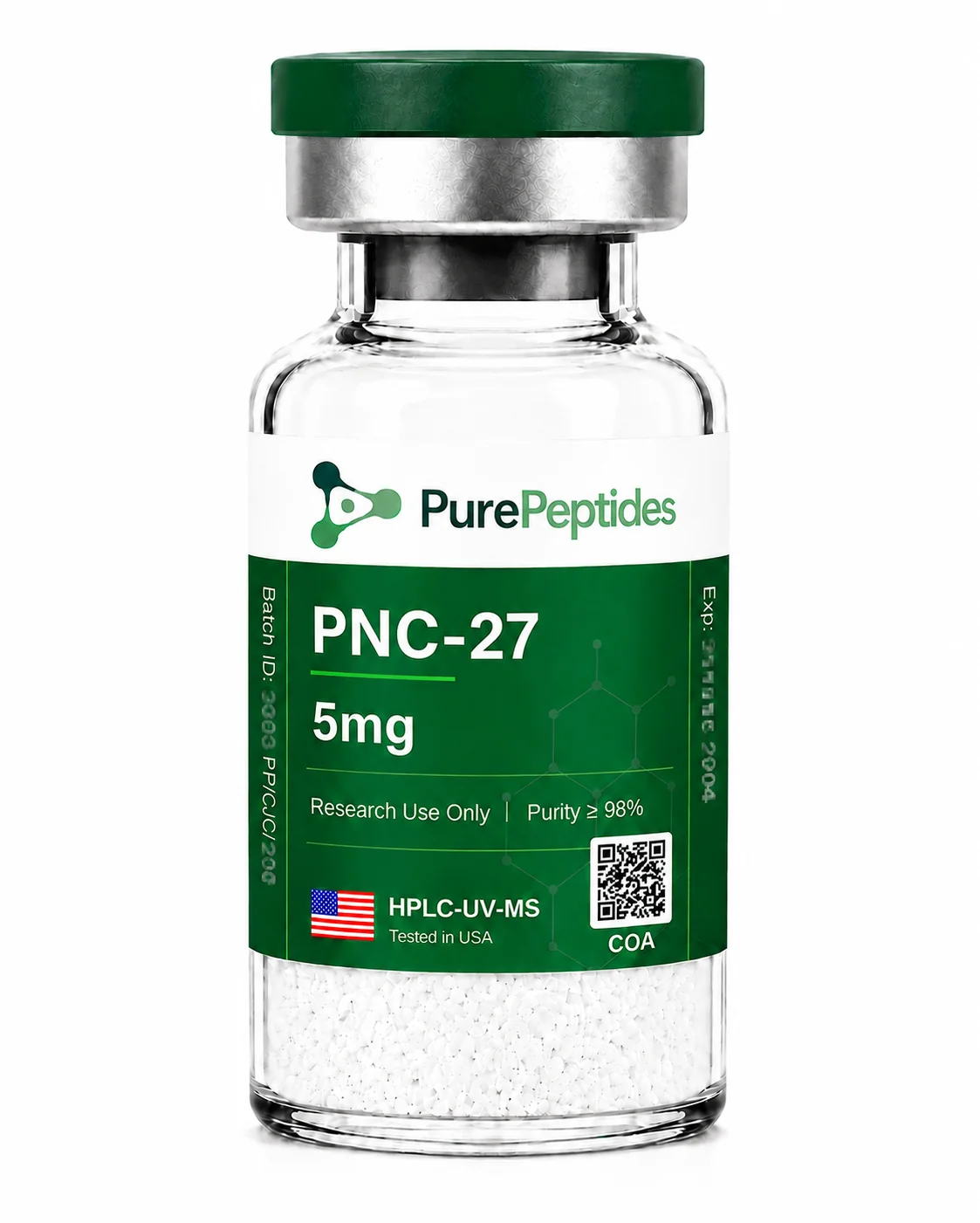
Verify Batch. Lot-level COA, Batch DF/PNC/062026. Check the batch number printed on your vial against the certificate below, which reports the tests run on it.
- Ships Next Day
- Quality Guaranteed
- Cold-Chain Shipping
- Free US Shipping Over $150
What is PNC-27?
PNC-27 is a single peptide of 32 residues, built from two joined parts. One part copies a short stretch of the human p53 protein, residues 12 to 26. That is the region p53 uses to bind a protein called HDM-2. The other part is penetratin, a sequence borrowed from a fruit fly, which helps peptides cross cell membranes. The design aim is selectivity: to act on cells that display HDM-2 on their surface and leave those that do not.

Product information reviewed by Dr. Martina Rossi, PhD
Scientific Contributor and Reviewer · Reviewed
PNC-27 Research & Reference
What PNC-27 does in published studies, and how to work with it in the laboratory, are covered in full on two dedicated pages rather than summarised here, so neither the evidence nor the handling detail is cut short.
Technical Specs
Labeled quantity is net peptide content, not gross salt weight.
PNC-27 Batch Results
Batch DF/PNC/062026
- Laboratory
- Kovera Labs
- Certified
- August 13, 2026
- Sample
- 5 mg vial
- Report
- KVR-2026-02AB06
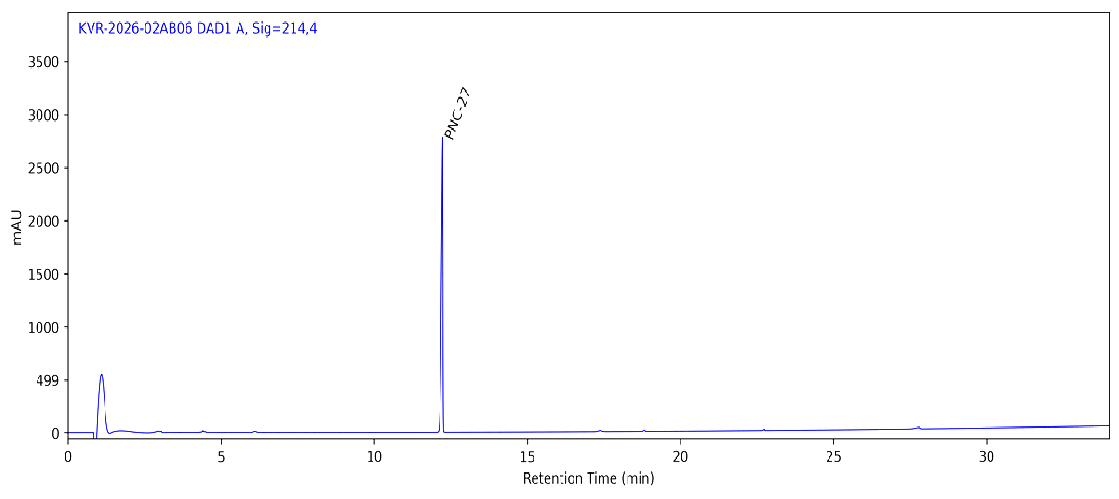
An independent laboratory, Kovera Labs, tested a sample from this batch. These are the results on its certificate.
Purity
Pass99.342%
RP-HPLC, C18 column, 214 nm
Identity
PassConfirmed
LC-MS
Purity is an HPLC figure: the main peak’s share of everything the detector recorded at one wavelength. It’s not a weight. What a purity figure counts →
Check it with the lab. Kovera Labs’ verification page looks a certificate up by its report number. Product, batch, date and results should match this page.
Chromatogram
RP-HPLC · C18 · DAD 214 nm
Frequently Asked Questions
Is PNC-27 third-party tested for purity?+−
Yes. Every batch of PNC-27 is tested by an independent third-party laboratory using HPLC and MS-UPLC, confirming purity and mass identity before the batch is released. Pure Peptides does not test its own material.
Can I see the Certificate of Analysis before buying?+−
Yes. The Certificate of Analysis for the batch currently in stock can be viewed and downloaded directly on this page, before you place an order. Each certificate states the batch number, the measured purity, and the date of analysis, and can be verified independently with the issuing laboratory using the report number it carries.
What does "Research Use Only" mean?+−
It means PNC-27 is supplied for in-vitro laboratory research and for no other purpose, and must not be administered to humans or animals.
How is PNC-27 shipped and stored?+−
PNC-27 ships from US stock with cold-chain packaging and full tracking; orders placed before noon EST on business days are typically dispatched the same business day. On arrival, store the lyophilized powder at -20°C or below, dry and protected from light.
How large is the published literature on PNC-27?+−
Small. A PubMed search for the compound returns 25 records, and most come from one research program. Several independent groups have also published, including a 2020 leukemia study and a 2010 study whose cell experiments dispute how selective the peptide is. Work in mice comes from the originating program, from that leukemia study, and from one independent group that tested the peptide attached to a drug-carrying liposome. The PNC-27 research article names who wrote what, because on a literature this size that matters as much as the results.
What is PNC-28, and is its research the same thing?+−
No. PNC-28 is a related construct from the same program that carries a shorter piece of p53, residues 17 to 26 instead of 12 to 26. It is a different molecule. It is worth knowing about because the study of it concluded that the penetratin half, not the p53 half, is what changes how the cells die. That is the origin group's own finding.
Metabolic & Cellular Research
Related Compounds

Reviewed for scientific accuracy
Dr. Martina Rossi, PhD
PhD, Université Grenoble Alpes · Scientific Contributor and Reviewer
Dr. Rossi's doctoral research at Université Grenoble Alpes examined the vascular functions of bone morphogenetic proteins. Her peer-reviewed work spans cell and molecular biology, vascular biology, and gene therapy, in journals including Cardiovascular Research, Scientific Reports, and Brain Sciences. She reviews Pure Peptides' product, reference, and research pages for scientific accuracy against the sources they cite.